



Glass looks like it is solid but telling a materials engineer that glass is a solid is like telling an aerospace engineer Bernoulli is why planes fly (or Newton, for that matter - whichever you say, they will argue the opposite).

Glass flows - but slowly. The question is does it ever really stop flowing? Researchers at the University of Bristol and Kyoto University used computer simulation and information theory to try and settle this long-standing bar bet in the physics community.

First, the premise: We know glass flows at high heat because we have all seen glass blowers shape swans and such. Once the glass has cooled down to room temperature though, it has become solid and we can pour wine in it or make window panes out of it.

By Anton Wallner, Australian National University

Our understanding of heavy element production in supernovae, exploding stars way beyond our solar system, may need to change following some discoveries we have made looking not to the skies, but deep under our oceans.

Supernova explosions are one of the most violent events in our galaxy and are thought to produce elements essential for life such as iron and iodine but also some of the heaviest elements existing in nature.

When a star goes supernova and explodes, these heavy elements are thrown out into space as dust and debris.

If you are in the United States and travel to Mexico, you are cautioned not to drink the water, just like if you travel to Taiwan or China you are cautioned not to eat chicken bought from a street vendor; people are immune to some nasty stuff you probably are not.

Getting diarrhea in Mexico is called Montezuma's revenge - it means the natives are still getting back at the Spanish 500 years later and the rest of the world is thrown in for good measure. But it doesn't just end there. Taking antibiotics for diarrhea may put travelers visiting developing parts of the world at higher risk for contracting superbugs and spreading drug-resistant bacteria to their home countries.

Researchers at the RIKEN-Max Planck Joint Research Center in Japan have demonstrated that hallmark symptoms of Alzheimer's disease can be reduced when sugars are prevented from binding to one of the key enzymes implicated in the disease. The new findings, reported in EMBO Molecular Medicine, show that abnormal attachment of a particular sugar to the enzyme BACE1 is a critical factor leading to the formation of Aβ plaques in the brain, and that plaques were reduced and cognitive performance improved when this action was prevented in mice through loss of the enzyme GnT-III. In doing so, this work has revealed a novel mechanism for Alzheimer's disease development, potentially opening the way to a new approach for treatment.

In the majority of cases, the onset of cancer is characterized by a minor change in a person's genetic material. A cell's DNA mutates in a particular area to the extent that the cell no longer divides in a controlled manner, but begins to grow uncontrollably. In many cases, this type of genetic mutation involves chemical changes to individual building blocks of DNA.

One in five cases of Lassa fever - a disease that kills around 5,000 people a year in West Africa - could be due to human-to-human transmission, with a large proportion of these cases caused by 'super-spreaders', according to a new paper.

Between 2006 and 2012 in the U.S., there was a decline in rates of episiotomy, a surgical procedure for widening the outlet of the birth canal to make it easier for the mother to give birth, according to a study in the January 13 issue of JAMA.

Episiotomy is a common obstetric procedure, estimated to be performed in 25 percent of vaginal deliveries in the United States in 2004. Restrictive use of episiotomy has been recommended given the risks of the procedure and unclear benefits of routine use. Decreasing use of the procedure was documented in the 1990s; however, whether rates have continued to decrease after evidencebased recommendations has not been known, according to background information in the article.

Scientists have gained new insight into fragile X syndrome, the most common cause of inherited intellectual disability, by studying the case of a person without the disorder, but with two of its classic symptoms.

Fragile X syndrome results from an inherited genetic error in a gene called FMR1. The error prevents the manufacture of a protein called FMRP. Loss of FMRP is known to affect how cells in the brain receive signals, dialing up the amount of information allowed in. The gene is on the X chromosome, so the syndrome affects males more often and more severely than females, who may be able to compensate for the genetic error if their second copy of FMR1 is normal.

Every summer, there are reports linking a bacterium called Vibrio vulnificus to people getting sick or dying. The bacteria are found in warm saltwater and problems occur after eating raw tainted shellfish or when an open wound comes in contact with seawater.

People with a weakened immune system, chronic liver disease or iron overload disease are most at risk for severe illness. Vibrio vulnificus infections in high-risk individuals are fatal 50 percent of the time.

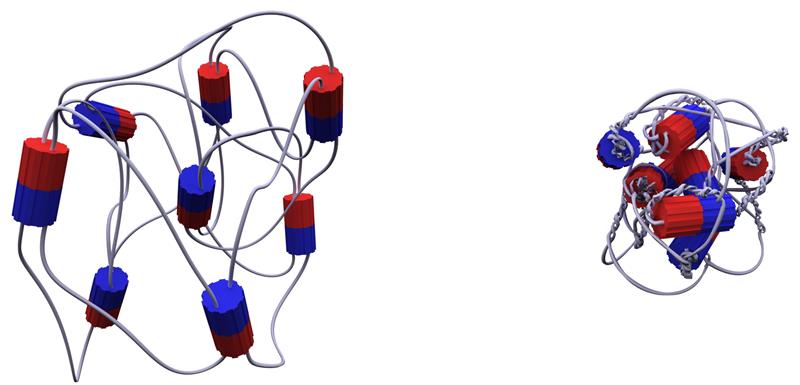
Living systems have the ability to produce collective molecular motions that have an effect at the macroscale, such as a muscle that contracts via the concerted action of protein motors. In order to reproduce this phenomenon, a team at CNRS's Institut Charles Sadron led by Nicolas Giuseppone, professor at the Université de Strasbourg, has made a polymer gel that is able to contract through the action of artificial molecular motors. When activated by light, these nanoscale motors twist the polymer chains in the gel, which as a result contracts by several centimeters.

Another advantage is that the new material is able to store the light energy absorbed.

