







You might never know that you're hard of thinking. Robin Zebrowski/Flickr, CC BY-NC

By Stephan Lewandowsky, University of Bristol and Richard Pancost, University of Bristol

It is an unfortunate paradox: if you’re bad at something, you probably also lack the skills to assess your own performance. And if you don’t know much about a topic, you’re unlikely to be aware of the scope of your own ignorance.


Nationals MP George Christensen told Parliament that the hot temperatures of 1896 have been "wiped from the official record". It's a bit more complicated than that. AAP Image/Lukas Coch

By Neville Nicholls, Monash University

Breathing secondhand marijuana smoke could damage your heart and blood vessels as much as secondhand cigarette smoke, according to preliminary research presented at the American Heart Association's Scientific Sessions 2014.


Pfizer's evergreening tactics have made it the target of protests. Michael Fleshman/Flickr, CC BY-SA

By Hazel Moir, Australian National University and Deborah Gleeson, La Trobe University

Efforts by pharmaceutical companies to extend their patents cost taxpayers millions of dollars each year. In some cases they also mean people are subjected to unnecessary clinical trials.

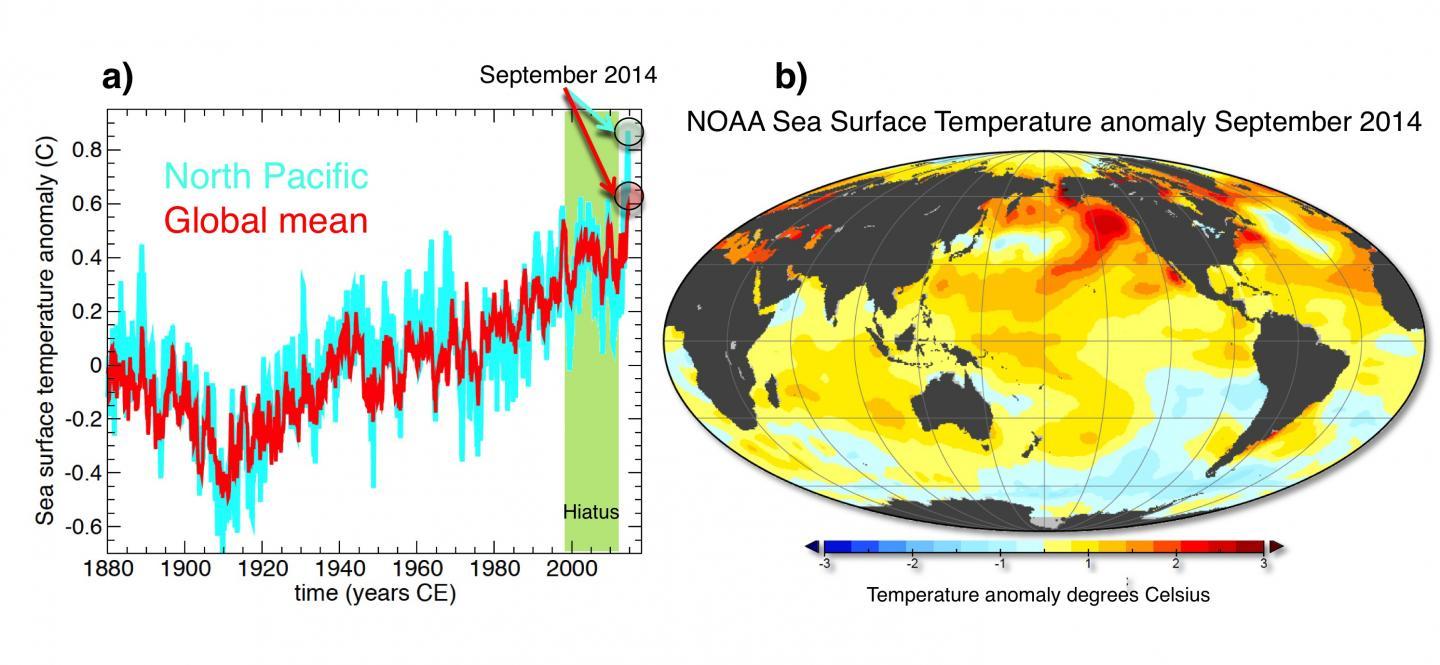
From 2000-2013 the global ocean surface temperature did not rise in spite of increasing greenhouse gas concentrations. This Global Warming Hiatus generated a lot of public and scientific interest and no small amount of skepticism about the accuracy of the numerical models created by climate scientists. But data is another matter entirely and as of April 2014 ocean warming has picked up speed again, according to a new analysis of ocean temperature datasets.  

When two
giant LIGO detectors
are switched on in the US next year, they will help scientists pick up the faint ripples of black hole collisions millions of years ago, known as gravitational waves. 

Black holes cannot be seen, but scientists hope the revamped detectors, which act like giant microphones, will find remnants of black hole collisions - and theoretical physicists hope experimentalists will give validation for their numerical model.

I am quite happy to report today that the CMS experiment at the CERN Large Hadron Collider has just published a new search which fills a gap in studies of extended Higgs boson sectors. It is a search for the decay of the A boson into Zh pairs, where the Z in turn decays to an electron-positron or a muon-antimuon pair, and the h is assumed to be the 125 GeV Higgs and is sought for in its decay to b-quark pairs. 

If you are short of time, this is the bottomline: no A boson is found in Run 1 CMS data, and limits are set in the parameter space of the relevant theories. But if you have a bit more time to spend here, let's start with the beginning - What's the A boson, you might wonder for a start. 
While the use of IC50’s is a huge problem in the biological sciences, Academia, Industry and Regulatory bodies have good reason to avoid the established field of enzyme kinetics. As I said in the last post, the problem with IC50 values is that they strip away or obscure finer details of molecular interactions producing an artificial wall on the amount of information we can obtain from biological systems.  However, the perception is that modern enzyme kinetic drug studies do not provide a significant improvement in our understanding relative to the increase in resources that are required to do the studies.

Home dialysis therapies may help prolong the lives of patients with kidney failure compared with hemodialysis treatments administered in medical centers, according to an upcoming study at ASN Kidney Week 2014 at the Pennsylvania Convention Center in Philadelphia, PA.

Home dialysis therapies are more convenient and less expensive than in-center treatment, but it's unclear whether all home therapies - which include peritoneal dialysis and home hemodialysis - can prolong patients' survival. Researchers led by Austin Stack, MD, MBBCh, FASN (Graduate Entry Medical School, University of Limerick, in Ireland) analyzed national data to compare dialysis survival among 585,911 patients who started dialysis in the United States between 2005 and 2010. 

Air pollution may play a role in the development of kidney disease, according to a study upcoming at ASN Kidney Week 2014 November 11-16 at the Pennsylvania Convention Center in Philadelphia, Pennsylvania.

There are wide variances in the prevalence of chronic kidney disease (CKD) across the United States, only part of which is explained by differences in individuals' risk factors. To see if air quality may also play a role, Jennifer Bragg-Gresham, PhD (University of Michigan) and her colleagues looked at 2010 Medicare information on 1.1 million persons as well as air-quality data for all US counties provide by the Environmental Protection Agency.

