States that have hunting industries have the best of both possible worlds; instead of having state union workers expensively managing wildlife, they get the public to do it - and pay for the privilege. That money is then used to pay for state biologists and conservation programs.

A forest in South Carolina, a supercomputer in Ohio and some glow-in-the-dark yarn have helped a team of field ecologists conclude that woodland corridors connecting patches of endangered plants not only increase dispersal of seeds from one patch to another, but also create wind conditions that can spread the seeds for much longer distances.

The idea for the study emerged from modern animal conservation practices, where landscape connectivity – the degree to which landscapes facilitate movement – is being used to counteract the impacts of habitat loss and fragmentation on animal movement.

DALLAS, March 19, 2014 — When cancer spreads from one part of the body to another, it becomes even more deadly. It moves with stealth and can go undetected for months or years. But a new technology that uses "nano-flares" has the potential to catch these lurking, mobilized tumor cells early on. Today, scientists presented the latest advances in nano-flare technology as it applies to the detection of metastatic breast cancer cells.

The report was one of more than 10,000 at the 247th National Meeting & Exposition of the American Chemical Society (ACS). The meeting is taking place here through Thursday.

In a study published today (19/3/2014) in the scientific journal Neuron, neuroscientists at the Champalimaud Foundation, in collaboration with neuroscientists from Harvard University, describe the first activity maps at the resolution of single cells and throughout the entire brain of behaving zebrafish.

Researchers from the Santa Fe Institute and the Smithsonian Institution have pieced together a highly detailed picture of feeding relationships among 700 mammal, bird, reptile, fish, insect, and plant species from a 48 million year old lake and forest ecosystem.

Their analysis of fossilized remains from the Messel deposit near Frankfurt, Germany, provides the most compelling evidence to date that ancient food webs were organized much like modern food webs. Their paper describing the research appears online and open access this week in Proceedings of the Royal Society B: Biological Sciences.

Hungry dogs would be expected to choose alternatives leading to more food rather than less food. But just as with humans and monkeys, they sometimes show a "less is more" effect. Thus conclude Kristina Pattison and Thomas Zentall of the University of Kentucky in the US, who tested the principle by feeding baby carrots and string cheese to ten dogs of various breeds. The findings are published in Springer's journal Animal Cognition.

The research was conducted on dogs that would willingly eat cheese and baby carrots when offered, but showed a preference for the cheese. However, when given a choice between one slice of cheese, or the cheese together with a piece of carrot, nine of the ten dogs chose the cheese alone. That is, they chose less food over more food.

New research led by the University of Exeter suggests that rising global temperatures will increase the quantity of the key greenhouse gas methane emitted from freshwater ecosystems to the Earth's atmosphere – which could in turn lead to further warming.

The collaborative study, led by Dr Gabriel Yvon-Durocher from the University of Exeter, collated data from hundreds of laboratory experiments and field surveys to demonstrate that the speed at which methane fluxes increase with temperature was the same whether single species populations of methanogens, microbial communities or whole ecosystems were analyzed.

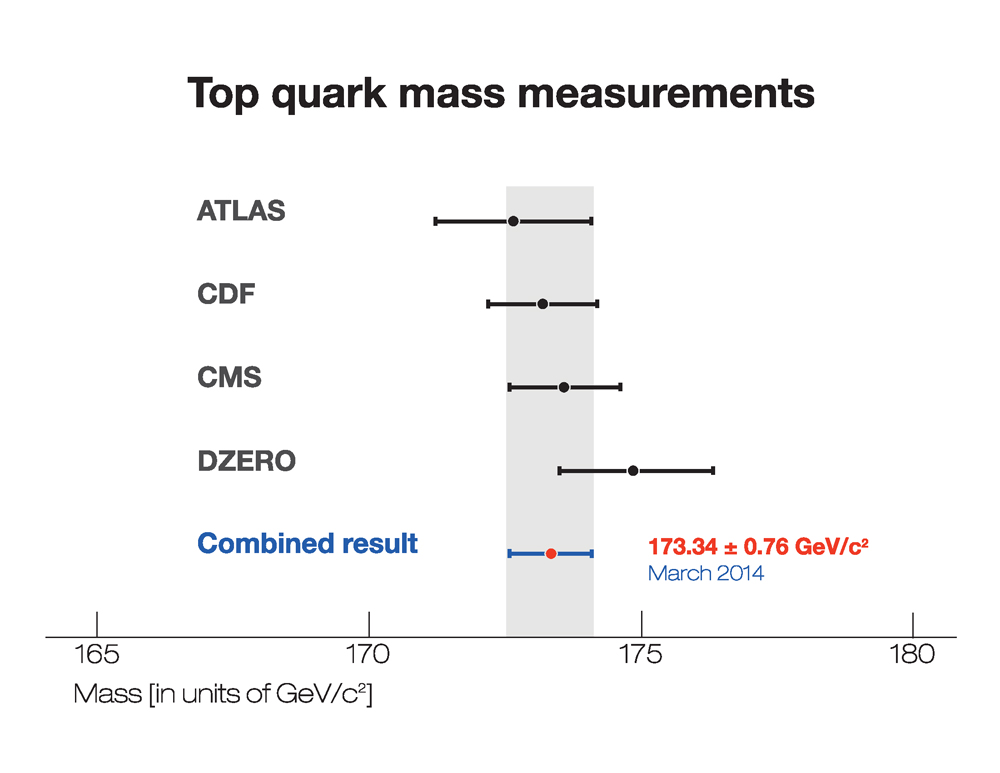
The world's leading particle collider experiments, Fermilab's Tevatron and CERN's Large Hadron Collider (LHC), have joined forces. Scientists from the four experiments involved — ATLAS, CDF, CMS and DZero — announced their joint findings on the mass of the top quark today at the Rencontres de Moriond international physics conference in Italy. 

They pooled their data analysis power to arrive at a new world's best value for the mass of the top quark of 173.34 plus/minus 0.76 GeV/c2.

Building a strong connection to a social group helps clinically depressed patients recover and helps prevent relapse, according to a new study.

For the paper, Canadian Institute for Advanced Research (CIFAR) Senior Fellow Alexander Haslam, lead author Tegan Cruwys and their colleagues at the University of Queensland conducted two studies of patients diagnosed with depression or anxiety. The patients either joined a community group with activities such as sewing, yoga, sports and art, or partook in group therapy at a psychiatric hospital.

The genome of the loblolly pine is truly massive, aound seven times bigger than the human genome, making it the largest genome sequenced to date and the most complete conifer genome sequence ever published.

The achievement, described in GENETICS and Genome Biology, marks the first big test of a new analysis method that can speed up genome assembly by compressing the raw sequence data 100-fold.

Loblolly pine is the most commercially important tree species in the United States and the source of most American paper products. The tree is also being developed as a feedstock for biofuel. The genome sequence will help scientists breed improved varieties and understand the evolution and diversity of plants.

