
CAMBRIDGE, Mass-- Flexible, layered materials textured with nanoscale wrinkles could provide a new way of controlling the wavelengths and distribution of waves, whether of sound or light. The new method, developed by researchers at MIT, could eventually find applications from nondestructive testing of materials to sound suppression, and could also provide new insights into soft biological systems and possibly lead to new diagnostic tools.

The findings are described in a paper published this week in the journal Physical Review Letters, written by MIT postdoc Stephan Rudykh and Mary Boyce, a former professor of mechanical engineering at MIT who is now dean of the Fu Foundation School of Engineering and Applied Science at Columbia University.

AMHERST, Mass. – Introducing a new approach that combines evolutionary and engineering analyses to identify the targets of natural selection, researchers report in the current issue of Evolution that the new tool opens a way of discovering evidence for selection for biomechanical function in very diverse organisms and of reconstructing skull shapes in long-extinct ancestral species.

Evolutionary biologist Elizabeth Dumont and mechanical engineer Ian Grosse at the University of Massachusetts Amherst, with evolutionary biologist Liliana Dávalos of Stony Brook University and support from the National Science Foundation, studied the evolutionary histories of the adaptive radiation of New World leaf-nosed bats based on their dietary niches.

ESO's Very Large Telescope has been used to create the first ever map of the weather on the surface of the nearest brown dwarf to Earth. An international team has made a chart of the dark and light features on WISE J104915.57-531906.1B, which is informally known as Luhman 16B and is one of two recently discovered brown dwarfs forming a pair only six light-years from the Sun. The new results are being published in the 30 January 2014 issue of the journal Nature.

On January 29 at 1430 UTC/9:30 a.m. EST, the Joint Typhoon Warning Center dropped System 91S from formation alert status, but the low pressure area still has a medium chance for development in the next 24 hours. System 91S was located near 18.2 south and 39.1 east, about 585 nautical miles northeast of Maputo, Mozambique. An image from India's Oceansat satellite indicated 20 to 25 knot (37.0 to 46.3 kph/23.0 to 28.7 mph winds over the eastern semi-circle of the storm. Meanwhile the NOAA-19 polar orbiting satellite data showed weak, shallow convective banding of thunderstorms wrapping into the low-level center on January 29.

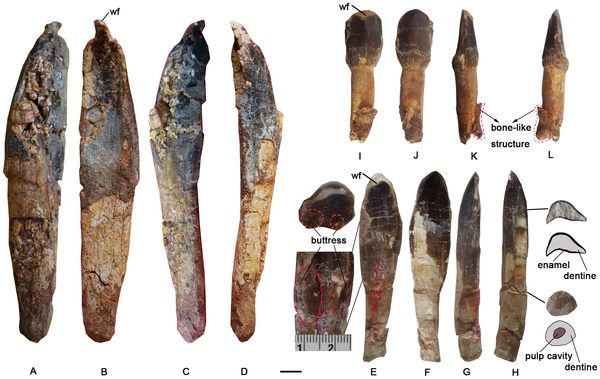
A team has characterized a new dinosaur based on fossil remains found in northwestern China. The species, a plant-eating sauropod named Yongjinglong datangi, roamed during the Early Cretaceous period, more than 100 million years ago. This sauropod belonged to a group known as Titanosauria, members of which were among the largest living creatures to ever walk the earth.

At roughly 50-60 feet long, the Yongjinglong individual discovered was a medium-sized Titanosaur. Anatomical evidence, however, points to it being a juvenile; adults may have been larger.

We know now that asteroids are relics that can tell us what the planets in our solar system may have been like before they formed cores and mantles and crusts. But that wasn't always the case. Until the past few decades asteroids were viewed in a more static way. Those that formed near the sun remained near the sun, those that formed farther out stayed on the outskirts.

Then it was discovered that some asteroids have compositions that don't match their locations in space. Those that looked like they formed in warmer environments were found further out in the solar system, and vice versa. Anomalous "rogue" asteroids.

By analyzing whole-genome sequencing data from 665 people from Europe and East Asia  as part of the 1,000 Genomes Project, researchers have determined that more than 20 percent of the Neanderthal genome survives in the DNA of this contemporary group. 

That means a substantial fraction of the Neanderthal genome persists in modern human populations. Neanderthals became extinct about 30,000 years ago but their time on earth and their geographic range overlapped with us. 

I was able to find the EYESPY Spydercam at Goodwill. Several hacks for it came to mind, but the simplest is attaching it to a remote control vehicle. I have an old Lego remote control car that’s been gathering dust so I decided to use it for this article. You can, however, attach it to any remote controlled vehicle you may have. I've attached it to the Popular Mechanics RC Tank--hint: use a rubber band to fasten the Spydercam to the battery block. You might not be able to find the RC Tank any more except on eBay. I've also attached it to the Snap Circuits Rover.

Yield is economically important in field corn production, and there is no question that has been a success, but sweet corn has an additional metric for being considered a win. It's reported that  crop yield responses due to sweet corn research are actually helpful to the industry, but are they?

Writing
in Field Crops Research, Marty Williams, a USDA-ARS ecologist and University of Illinois crop sciences researcher, analyzes results after collecting and studying sweet corn data representing 31 hybrids across 22 locations in Illinois over an 8-year period. The result: A disconnect in what researchers are measuring in the field and what processors and seed companies need to know in order to make improved production decisions.

Voice voting is still used at some civic, local and county meetings. In more of a traditional sense, it's also still employed in Congress and some state meetings.

But new paper finds that a single loud voice can skew the result if that's not accounted for - the louder the voice, the cloudier the choice, according to a paper in the Journal of the Acoustical Society of America.

In voice voting, if you have never witnessed it, a presiding officer states a question, and the group that replies either yea or nay. The loudest is declared the winner, because volume is usually representative of numbers.

