



Moore's Law, originating in 1965 [1], is an observation of transistor density on a single CPU core increasing exponentially with time. Futurists such as Ray Kurzweil [2] extend this to the claim that CPU-core computation rate (operations per second) will also increase exponentially with time, allowing for a technological explosion of super-intelligent machines in soon-to-come decades.

Anorexia nervosa is a multifactorial neuropsychiatric condition that affects as many as one percent of women in the Western world, and has an estimated mortality as high as 10 percent, making it perhaps the deadliest of mental illnesses. Anorexics severely restrict eating and become emaciated, yet consider themselves overweight. Individuals with anorexia tend to be perfectionistic, anxious or depressed, and obsessive.

A team of researchers have published new data that could prove vital for advances in care for women who suffer from recurrent miscarriage.

The recurrent loss of pregnancy through miscarriage causes significant distress to couples, often exacerbated by there being so few treatments available to clinicians.

The search for an effective treatment has been the cause of significant controversy in the field of medical research, centering on the role of natural killer cells (or NK cells) and the ability of steroids to prevent miscarriage.

Scientists have been uncertain about how these NK cells could contribute to a miscarriage and this has raised doubt over their importance in causing pregnancy loss.

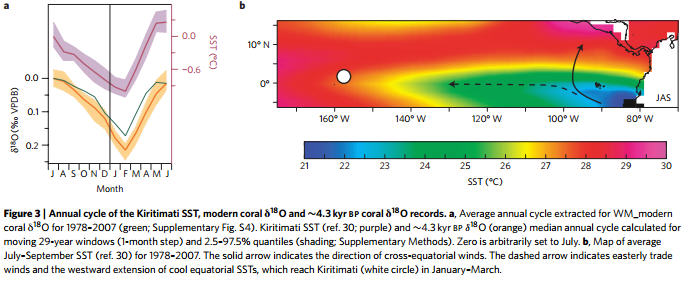
20 years ago, El Niño had an uncorrected impact on the data that went into global warming models, causing puzzling results. Now, those results have been corrected and instead of El Niño impacting global warming, global warming could be impacting El Niño.

Using coral samples from Kiribati, researchers have outlined how El Niño Southern Oscillation (ENSO) cycle has changed over the past 4,300 years - altering the cycles of El Niño and La Niña events that bring extreme drought and flooding to Australia and many other Pacific-rim countries. The new paper suggests that external changes have an impact on the strength and timing of El Niño events.

Astronomers has begun to map the location of the most massive and mysterious objects in our galaxy – the Southern Milky Way and its giant gas clouds, where new stars are born.

Nootkatone, the substance behind the citrus flavor and aroma of grapefruit that is already used in beverages and prestige perfumes, may be heading for a new use in battling mosquitoes, ticks and other pests thanks to a less expensive way of making large amounts of the once rare and pricey ingredient.

Nootkatone previously had to be harvested from tons of grapefruit and is an excellent example of the potential for developing new pesticides based on natural sources. Nootkatone is a component of the oil in grapefruit, and has been on the U.S. Food and Drug Administration's list of substances generally recognized as safe for use in food.

Very good news for the Quantum Randi Challenge, the most engaging bit of science outreach that already helped tripping up a notorious crackpot, and which now starts to gain momentum toward its main aim, which is helping a wide audience to understand the essence of quantum mechanics while being immunized against quantum–mysticism, which is sadly promoted by established scientists as badly as by snake-oil sellers.

Finding the collaboration by educators and artists that the Quantum Randi Challenge needs is now easier, as most of the didactic core has passed the scientific community’s peer review system, and not just with one paper, but two!

Last week I met Marek Karliner at the ICNFP 2013 conference in Crete, where we both enjoyed a nice friendly atmosphere, great food, and a wonderful peaceful location. Professor Marek Karliner is the chair of the Institute of Theoretical Physics of Tel Aviv in Israel. Since he agrees that outreach in physics is an important service that researchers should provide to the community, I was able to convince him to write for this blog the short article which you find below, on the interesting topic of baryons containing two heavy quarks - TD.

The human brain is adept at linking seemingly random details into a cohesive memory that can trigger myriad associations — some good and some not so good.

For recovering addicts or individuals with post-traumatic stress disorder (PTSD), unwanted memories can make recovery difficult. For example, former meth addicts report intense drug cravings triggered by associations with cigarettes, money, even gum, which makes them more likely to stumble during recovery.

Scientists have been able to erase drug-associated memories in mice and rats without affecting other more benign memories. Their discovery points to a clear and workable method to disrupt unwanted memories while leaving the rest intact.

Changing the Structure of Memory

Attila E. Pavlath, Ph.D., who turned fresh-cut apple slices into a popular convenience food, outlined advances in keeping other foods fresh, flavorful and safe for longer periods of time through the use of invisible, colorless, odorless, tasteless coatings.

