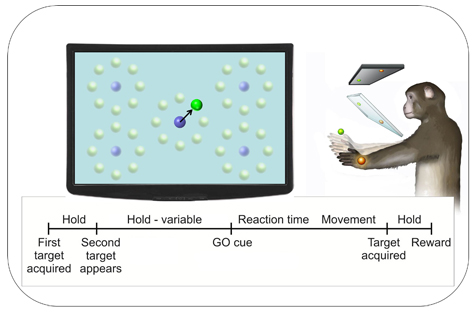
Brain activity is a complex cipher but researchers were recently able to 'decode' monkey thoughts and determine how the little primates were planning to approach the same task - before they moved a muscle.
Watching large groups of neurons doesn't reveal much but a group of scientists recently took it to another level; they demonstrated that multiple parameters can be embedded in the firing rate of a single neuron and that certain types of parameters are encoded only if they are needed to solve the task at hand. Interesting enough, but they also discovered that the population vectors could reveal different planning strategies.
They could, in effect, read the monkeys' minds.
The following text has been offered as a followup of the Higgs observation by the LHC experiments, which finds a signal at a mass compatible with the pre-discovery predictions made some time ago by Vladimir Khachatryan - ones which I published in this blog. - T.D.
Considerations following the Higgs boson discovery - Ashay Dharwadker
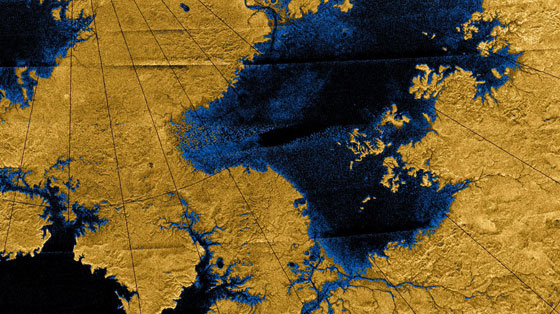
Compared to most moons in our solar system, Titan is relatively smooth. It has few craters but Titan is around four billion years old, about the same age as the rest of the solar system - so it isn't an age issue. Yet if you went by the number of craters, its surface looks much younger, between 100 million and one billion years old.
In 2004, radar images from the Cassini-Huygens spacecraft penetrated the atmosphere of Titan and revealed an icy terrain carved out over millions of years by rivers of liquid methane, similar to how rivers of water have etched into Earth's rocky continents but that opened up the mystery about its geologic past.
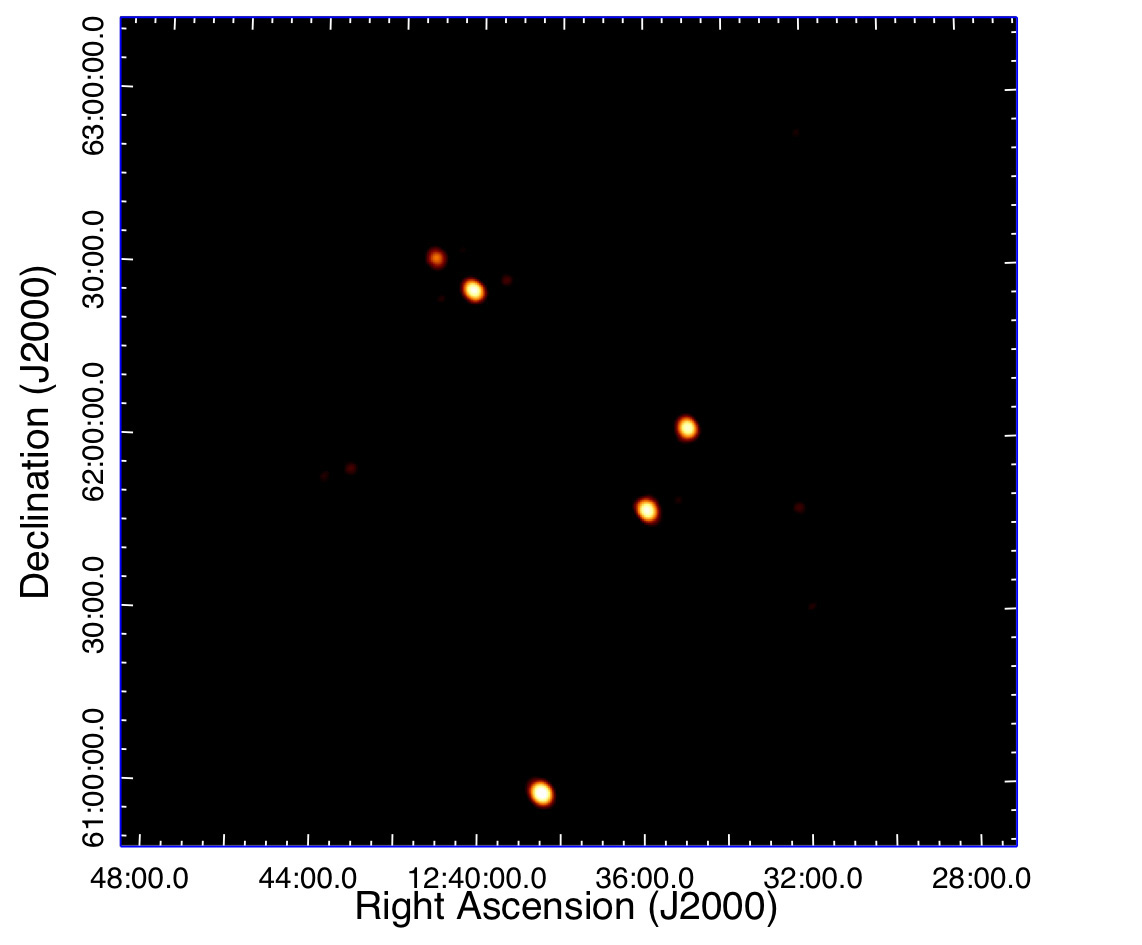
The Very Large Array (VLA) radio astronomy observatory, named for American physicist Karl Guthe Jansky, who discovered radio waves emanating from the Milky Way in 1931, is the largest and most capable radio telescope in the world
We just had Snowmageddon and then heat a heat wave in parts of the US. Local, short-term weather events are suddenly proof of long-term climate change once again, according to journalists and biased bloggers who claim to care about science.
"Generation X", as marketing people call the generation after the Baby Boomers, aren't buying it, despite the fact that awareness campaigns about global warming have gone on for most of their lives.
California had the highest number of cases of whooping cough (pertussis) in 60 years, despite the fact that it has a readily available vaccine. A new study in The Journal of Pediatrics describes that 2010 whooping cough epidemic and details strategies to decrease the incidence of this infection.
Some science education would be a good place to start. California has a strong anti-vaccine mentality, especially in coastal regions, and results showed much higher incidents of Whooping Cough in those areas, despite those being high income, well-educated communities.
Global emissions of carbon dioxide (CO2), considered the main cause of global warming, increased by 3% last year, reaching an all-time high of 34 billion tons in 2011.
We
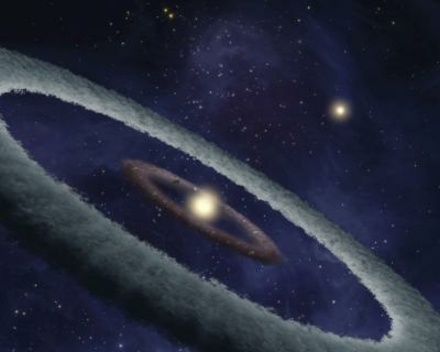
live in times of extraordinary discovery. Exoplanets appear to be quite common
in our galaxy. NASA’s Kepler Telescope has identified over 2,000 planetary
candidates orbiting other stars. And yet the universe appears to be silent – at
least when it comes to any detectable signs of alien civilizations, either at
present in our galaxy or their remnants from the last couple of billion
years.
Redheads are dangerous to human men but in wild boars, red hair means a danger to themselves.
New research has found that boars with more reddish hair tend to have higher levels of oxidative stress; damage that occurs as toxins from cell respiration build up. The researchers suggest it is because the process of producing reddish pigment eats up a valuable antioxidant that would otherwise be fighting the free radicals that lead to oxidative stress.
Southern dumpling squid are tuckered out by sex. So say Australian researchers Franklin et al. in the journal
Biology Letters. Sure, it's salacious science, but so what?
 Dumpling squid: they are frisky. Photo by Mark Norman, published in Biology Letters.