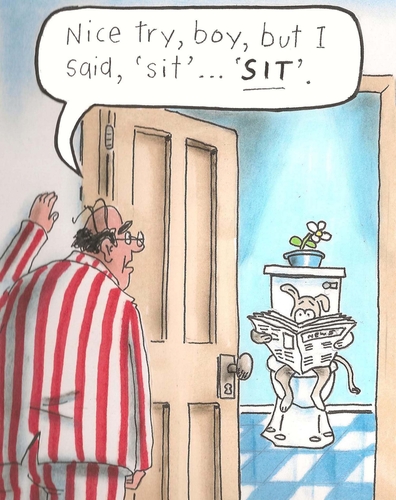
LONDON, March 22, 2012 - Two new surveys conducted among 2,500 adults and 400 teachers show what is really on the minds of those concerned about education; the need to teach about pets in schools.
89% of adults, 78% of primary teachers and 70% of secondary teachers believed it is important to teach responsibility using pets and most adults thought it was more important to teach younger children how to care for pets than it was to teach them about sex education or money management. Isn't that going to cause a fight with the 'teach kids to have sex at younger ages' lobby, though? It's Big Pet versus Big Condom for the mindshare of 8-year-olds.
“In this paper, we consider musical cell-phone ringtones as virtual, communicative and cultural performances.”
- say the authors of a paper entitled
‘The Musical Madeleine: Communication, Performance, and Identity in Musical Ringtones’ - which is published in the journal
Popular Music and Society, Volume 33, Issue 1 February 2010.
Most of the time, we do not think of plants as having the ability to plan, move, and attack. Certain behaviors of plants have been known for many years, such as the ability to turn to face sunlight, to open and close leaves each day and night, and to catch insects. It is only recently that the behavior of plants has moved into the center of biological research, with some striking findings that raise further questions about what plants know and what they are able to do. We are beginning to see complex communication between plants, and elaborate defenses against invaders.
Climate change is a polarizing science policy debate the likes of which humankind has never witnessed before. Even President Obama's science advisor John Holdren never dreamed up this kind of doomsday scenario when he was writing books with the king of doomsday predictions, Paul Ehrlich. Women in the workforce, CFCs, acid rain, islands of garbage - nothing from past cultural debates compares to the scariness of rolling drought and melting glaciers. What to do? On one side we have people who insist a world where elites have energy and others do not must be implemented right now.

The notion of gun-propelled launch goes back to Jules Verne. Such Mass Drivers have been envisioned in numerous Sci Fi tales, including "Earthlight", by Arthur C. Clarke, Robert A. Heinlein's "The Moon is a Harsh Mistress" and "Heart of the Comet" by Benford&Brin. We've also seen them portrayed in Buck Rogers, Babylon 5 and Halo.
I just saw the most annoying video about an interesting physics question. Apart from the over the top stereotypical German (supposed to be funny or is he for real?) and arrogant “look how clever we physicists are” attitude, the most annoying is that the really interesting stuff about the question isn’t even mentioned. Arrrggg - how can one be so ignorant?
Supersonic passenger jets are so 1970s. The Concorde has been gone for almost 10 years and most people don't miss it. But its fundamental concept - people want to get places faster - has not gone away.
Now an MIT researcher says he has come up with a concept that may solve many of the problems that grounded the Concorde, like expensive tickets, high fuel costs, limited seating and noise disruption from the jet’s sonic boom. Qiqi Wang, an assistant professor of aeronautics and astronautics, says the solution, in principle, is simple, going back to the earliest days of flight: Instead of flying with one wing to a side, why not two?
A new imaging system uses walls, doors or floors as 'mirrors' to gather information about scenes that it can't see, even though those objects are not reflective.
Yes, it could ultimately lead to imaging systems that allow emergency responders to evaluate dangerous environments or vehicle navigation systems that can negotiate blind turns, among other applications, but spying on people sounds like more fun.
Time is relative, of course, but we still hate to be late for appointments. So there has always been research on making our keeping of time a little more accurate.
A new clock tied to the orbiting of a neutron around an atomic nucleus could have such unprecedented accuracy that it neither gains nor loses 1/20th of a second in 14 billion years - basically, you wouldn't have needed to reset your watch yet even if you had been around at the beginning of the Universe.
Whenever I try to explain something about particle physics to a layman, I run into the problem of mass/energy units. A Giga-electronVolt is not something you may expect people to be familiar with, and on the other hand it is not appealing to explain directly how it is defined: "if you take an electron and accelerate it by passing it through a potential difference of one billion Volts, that's the energy it has at the end: one GeV": this distracts the listeners by forcing them to focus on electrostatics, with the potential outcome that the conversation may diverge due to additional questions, like "Does the electric field need be uniform ?" or even, "What is a potential difference ?".