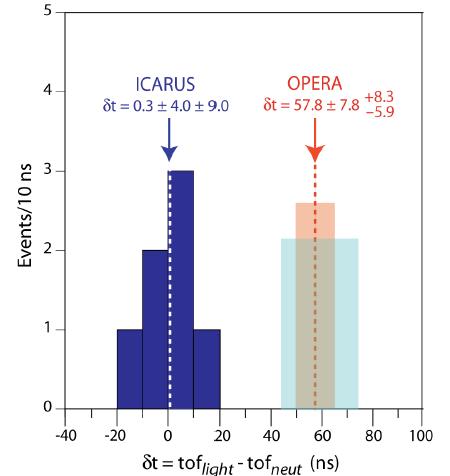
The ICARUS collaboration - operating a neutrino detector sitting not far from the OPERA experiment in the underground Laboratori del Gran Sasso in Italy - produced a
refutation of the superluminality of neutrinos a while ago. That refutation was based on studying the energy spectrum of the neutrinos in the CNGS beam, coming from CERN through a trip of 700 km under the Earth's crust: superluminal neutrinos should have lost some energy due to electroweak radiation, which was not borne out by the data.
In our modern culture, we have both the politicization of science and the scientization of politics. They sound similar but the goals are different - the first obviously seeks to inject political agendas into science while the second seeks to make a political objective seem more rational by mapping it to a science topology.
Quasars, powered by supermassive black holes, are among the brightest objects in the universe, outshining the total starlight of their host galaxies.
Quasar host galaxies are hard or even impossible to see because the central quasar far outshines the galaxy. Therefore, it is difficult to estimate the mass of a host galaxy based on the collective brightness of its stars. However, gravitational lensing candidates are invaluable for estimating the mass of a quasar's host galaxy because the amount of distortion in the lens can be used to estimate a galaxy's mass.
After marriage your well-being dips and after divorce it rises; after childbirth, relationship satisfaction stays permanently below its pre-birth level -– so says a meta-analysis of 2,159 studies, published this week in the Journal of Personality and Social Psychology. Sound dire? It is. But keep reading – the reasons for these dips and rises give us married-with-children guys hope.
People on the left - to international readers they go under the umbrella of 'liberals' in America, but run the gamut from social authoritarian progressives to activists to freedom-loving liberals in the traditional sense - are a lot less concerned about tolerance and diversity when it comes to differing viewpoints.
In areas where freshwater is scarce, recycling of wastewater seems to be common sense. Perhaps not, argues Amy Townsend-Small, assistant professor of geology and geography at the University of Cincinnati, and a team of researchers from the University of California, Irvine.
Their research shows that wastewater recycling processes may generate more greenhouse gases than traditional water-treatment processes. Townsend-Small, along with Diane E. Pataki, Linda Y. Tseng, Cheng-Yao Tsai and Diego Rosso, studied how different types of wastewater treatment affect emissions of one greenhouse gas, nitrous oxide. Nitrous oxide (N2O) is a long-lived and potent greenhouse gas, with a warming potential of about 300 times that of carbon dioxide.
Like vaccines and autism or genetically modified potatoes and immune systems or DDT causing cancer, some myths stick around so long they become truth despite any evidence - and cell phone radiation may be on that same track.
Yale School of Medicine researchers are not immune to jumping on the pop culture bandwagon. It's easy if you just want to find something vague like Attention Deficit Disorder. In an experiment, they exposed pregnant mice to radiation from a cell phone placed on an active phone call for the duration of the trial. The control group of mice was kept under the same conditions but with the phone deactivated.
Thanks to my awesome brother, I have now acquired and read the full text of the paper I
blogged about yesterday: "Purification and in vitro antioxidative effects of giant squid muscle peptides on free radical-mediated oxidative systems."
I was promptly horrified by the authors' two-sentence background about the animals whose skin they were studying:
UPDATE: I've learned more about how antioxidants work since writing this post.Maybe this is a sign that I've become cynical, but when I first read that peptides found in squid skin can slow aging, lower blood pressure, activate neurons, and reduce memory loss, I was like
pshaw, right!
The old saying goes, a picture is worth a thousand words. In this case, a picture is worth millions. Millions of tons of carbon dioxide that could be saved if we stopped throwing food into landfills, that is.
Food waste is a pet peeve of mine. Yes, we do it at my house, probably way too much, but there is only so much nagging one can do. I don't have the yard space to do composting - yes, I know, smelly hippies will insist I do it anyway but it isn't always practical. However, there is a 100% chance is it better to put it in the garbage disposal than in the garbage, so I do that whenever practical (so, not bones).
Check out the graphic below. Some of it we can all easily do, some of it is not so easy.