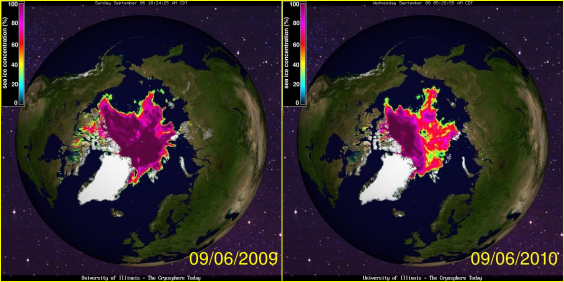
Arctic Ice September 2010 - Update #1
This is my first update to Arctic Ice September 2010.
The debate on hard and soft science seems to still be on – also here on Science2.0. As a representative of several hard sciences (mathematics, physics, theoretical astrophysics, geodesy...) I have always been annoyed by variations over the statement 'no, I want to save lives, therefore not do [hard]science' often presented with a moral indignation as toppings.

Remembering numbers is one of the most basic things we do from a young age - early on, a combination lock or a phone number and later any number of things such as ATM codes, social security numbers, and more.
In Western cultures, children learn to place numbers on a mental number line - smaller numbers to the left and spaced further apart than the larger numbers on the right. Then the number line changes to become more linear, with small and large numbers the same distance apart. Children whose number line has made this change are better at remembering numbers, according to a new study published in Psychological Science.
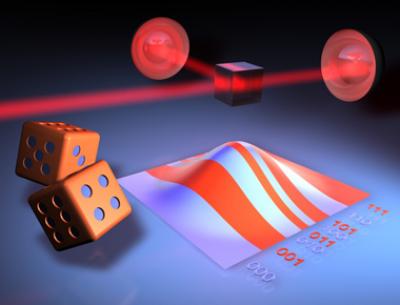
To physicists, nothing is really a coincidence. Even cats in quantum boxes can be explained in mathematical terms, not to mention roulette or the success or failure of an attack in Dungeons&Dragons, but researchers at the Max Planck Institute for the Physics of Light in Erlangen say they have constructed a device that is truly random and generates random numbers that cannot be predicted in advance.
The researchers exploit the fact that measurements based on quantum physics can only produce a special result with a certain degree of probability, that is, randomly. True random numbers are needed for the secure encryption of data and to enable the reliable simulation of economic processes and changes in the climate.
Paleontologists have released details about Concavenator corcovatus, a carnivorous humpbacked dinosaur discovered in Spain - and it oddly had both feathers and scales.
Concavenator corcovatus was a theropod dinosaur that lived during the Cretaceous period, about 130 million years ago. Concavenator corcovatus translates to 'hump-backed predator from Cuenca', where it was discovered.
"We hear a lot about bioterrorism and pandemics," says Sheldon H. Jacobson, a professor of computer science and pediatrics at University of Illinois at Urbana-Champaign,"but the fact of the matter is, the threat to routine immunization is one of the greatest threats we face. If we had problems with our vaccine supply chain, it would have the potential to cause more deaths than any of those other issues."
A million dollars is difficult to imagine but if someone is charging $2 instead of one, that gets attention. Likewise, a quote attributed to communist USSR despot Joesph Stalin is "A single death is a tragedy, a million deaths is a statistic."(1) And he should know, being responsible for 20 million deaths (starting with competitor Leon Trotsky) and so nestled comfortably between Mao and Hitler in world history, but is regarded favorably by some on left whereas a serial killer of a few is reviled by everyone.
A group says they have validated that large-scale tragedies don't connect people emotionally the same way smaller tragedies do, called a "scope-severity paradox".
Tuberculosis (TB) is a contagious disease of the lungs and other organs caused by Mycobacterium tuberculosis (or M. tuberculosis) and which infects roughly a third of the world's population. 5-10% of those in the infected population become sick or infectious at some point during their lifetime.
I have long told my more progressive brethren who have been happy about overarching judicial decisions they happened to like that activism is a double-edged sword. Certainly it's reasonable to 'cross that bridge' when society gets to it, but until then the repercussions are substantial.
In the instance of an injunction on embryonic stem cell research being upheld, it's not evil Republicans sticking it to stem cell research, though I have long contended they never did by simply restricting the human embryonic stem cell kind anyway - that law was signed by Clinton. Instead, it is a court and we have 50 solid years of aggressive judicial good works that has gone well beyond interpreting the Constitution, making it the most powerful branch of government.
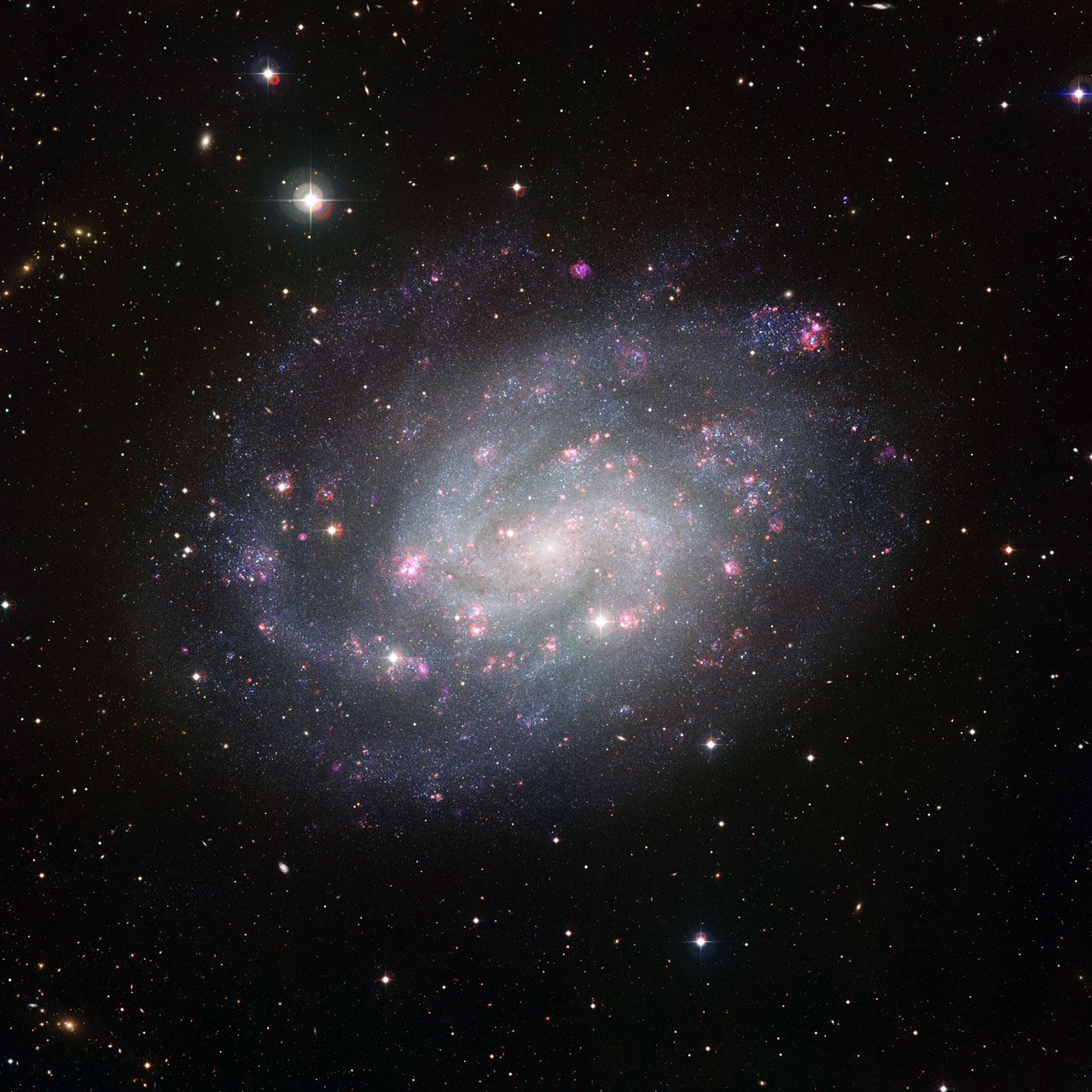
NGC 300 is one of the closest and most prominent spiral galaxies in the southern skies, about six million light-years away and bright enough it can be seen with binoculars. NGC 300 lies in the constellation of Sculptor with only a few bright stars, but is home to a collection of nearby galaxies that form the Sculptor Group, though recent distance measurements show that NGC 300 lies significantly closer to us than many of the other galaxies in the group and may be only loosely associated with them.
Compared to other galaxies, NGC 300 is remarkably normal, making it an ideal specimen for astronomers studying the structure and content of spiral galaxies such as our own.