





In almost everything, size matters.  And usually, being bigger helps.   I don't know anyone who couldn't use a larger refrigerator but University of Bristol physicists have done the unthinkable and made the smallest refrigerator ever.
Is there a pill that might inoculate us from smog?

Is there a gene we can target that would make us resistant to resurgent infectious diseases?

And is there a way to use genetic data to insulate new immigrants from some of the metabolic challenges of living in a new land of plenty?

Welcome to the slowly emerging world of environmental medicine and its inevitable outgrowth, environmental pharmaceuticals: compounds specifically suited for mitigating the physiological challenges of mega-city life in the 21st century.

The inchoate drive for such pills — disparate, proceeding in entrepreneurial fits and starts — is fueled by twin facts:
When nerve cells communicate with each other, they do so through electrical pulses.  Most everything in our bodies comes down to induction when you think about it.   

Since the early days of neuroscience, the accepted idea was that nerve cells simply sum up tiny action potentials generated by the incoming pulses and emit an action potential themselves when a threshold is reached but Moritz Helias and Markus Diesmann from the RIKEN Brain Science Institute (Japan) and Moritz Deger and Stefan Rotter from the Bernstein Center Freiburg (Germany) say they have figured out exactly what happens right before a nerve cell emits a pulse
Petermann Ice Island - Now There Are two

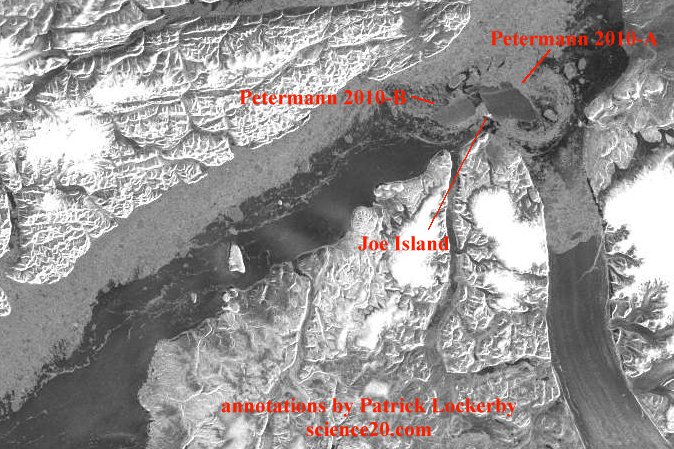
Petermann Ice Island (2010) has now broken into two parts.   The smaller island is about 80 km2.  It is the thinner of the two and is likely to melt away first.  Based on the labels already in use in comments1, I shall designate the larger island as Petermann 2010-A and the smaller one as Petermann 2010-B.


Petermann Ice Islands A and B
image source: http://ocean.dmi.dk/arctic/images/MODIS/Kennedy/201009091609.ASAR.jpg
In Australia this week a crucial battle begins to combat every Australian farmer’s nightmare, the worst locust plague in 40 years.

There is a $100 million national campaign in Australia to prevent a locust plague from wiping billions of dollars from the value of the Australian rural sector.

The public are being asked to help to pinpoint the locations of the young locusts or ‘hoppers’ because the "strike time" for spraying is limited to one month before they start flying in plagues, and devastating orchards, vineyards and pastures. See locust plague clip at http://www.youtube.com/watch?v=I8STQStqUzE&feature=related

It’s long been a peeve of mine that some computer programs are programmed to try to sound friendly, cheerful, or just colloquial. It seems out of place to me, forced, overly artificial. I don’t mean that I want all the output from computers to sound like the stilted science-fiction stuff, saying “affirmative” instead of “yes”, and the like. But neither do I ever want to see (or hear) things like “Oops!”, “Hurray!”, nor even “I’m sorry,” coming from my laptop, mobile phone, car, or washing machine.

Some examples:

It’s common when you’ve finished installing new software on your computer for the installation package to wrap up with a message like, “Congratulations!

Fish in a wind tunnel?   How else will you learn how they fly?

It turns out flying fish can remain airborne for over 40 seconds and cover distances of up to a quarter mile hitting a top speed up to 40 miles an hours, says Haecheon Choi, a mechanical engineer from Seoul National University, Korea.

Choi said a children's science book inspired him to look into the aerodynamics of flying fish, and a paper of his results appear in The Journal of Experimental Biology.  Choi and colleague Hyungmin Park posted similar results in a poster for the American Physical Society meeting in 2006.

22 scientists have published a study they say provides clear evidence about the effectiveness of Non-pharmacological Therapies in Alzheimer's disease and are calling on governments to make these useful treatments readily available.

 A cure for Alzheimer's is not in sight and available drugs have worthwhile but limited benefits the study says scientifically developed and rigorously tested Non-pharmacological Therapies can significantly improve the lives of people with dementia and their caregivers. 

They say he strongest evidence is for individualized intervention packages for family caregivers which can improve the well-being of caregivers and help delay admissions to care homes.

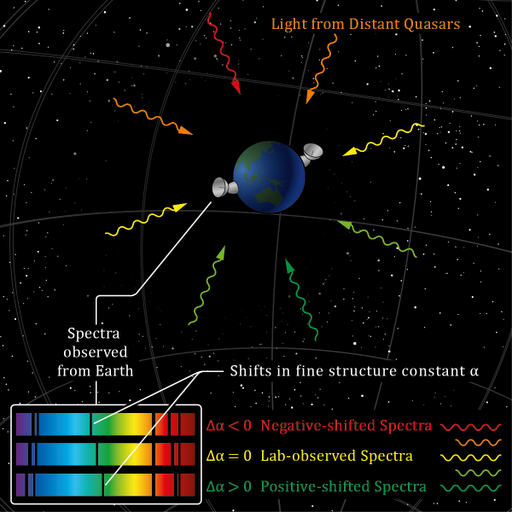
What happens to the laws of physics if a fundamental constant turns out to be not a constant after all?   The 'magic number' known as the fine-structure constant, called 'alpha' by physicists,  appears to vary throughout the universe, according to a team of astrophysicists.

That means the laws of physics would vary throughout the universe also.

The arXiv preprint describes how they determined that the fine-structure constant 'alpha' varies by measuring light from a quasar as it red-shifted due to universal expansion.
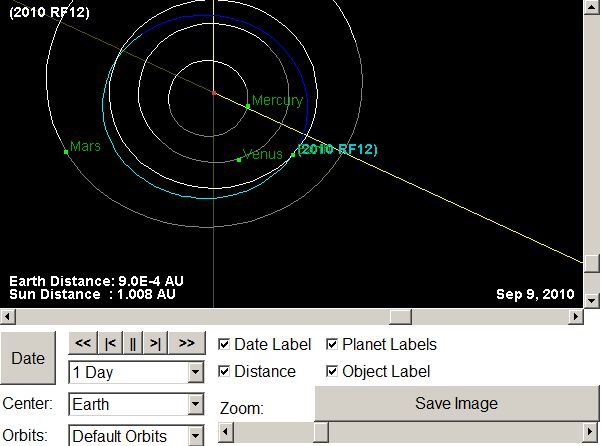
In case you do not easily panic, you may have missed the story that two asteroids were passing close to Earth yesterday.  Not to worry, it happens all of the time, but because their existence was only discovered Sunday by the Catalina Sky Survey, people were concerned.

The 50-foot 2010 RX30 came within 154,000 miles of Earth, just over halfway from here to the moon (0.6 lunar distances if you want to impress your friends), yesterday morning and then 2010 RF12, about 30 feet in size, came within 50,000 miles of Earth yesterday afternoon.