






Arctic Melt 2010 Is Faster Than Models Predicted

The National Snow And Ice Data Center - NSISC - reports:
Despite cool temperatures over most of the Arctic Ocean in January, Arctic sea ice extent continued to track below normal. By the end of January, ice extent dropped below the extent observed in January 2007.
...
While temperatures over much of the central Arctic Ocean were 1 to 3 degrees Celsius (2 to 5 degrees Fahrenheit) below normal, temperatures in the Kara and Barents seas were 3 to 5 degrees Celsius (5 to 9 degrees Fahrenheit) warmer than normal. Ice extent was far below normal in the Kara and Barents seas, keeping the total Arctic sea ice extent below average.
...
How Can Ice Work Like A Horse?

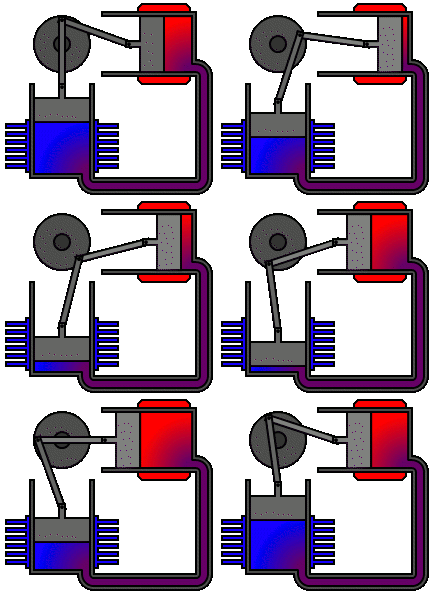
In this short series of articles about coal, engines and energy I am trying to show something of  the history behind our current knowledge of heat, energy and thermodynamics.  As discoveries were made about the nature of heat, improvements were made in the efficiency of engines.  Investigations into the theoretical maximum efficiency of any heat engine led ultimately to the discovery of the laws of thermodynamics. 

The laws of thermodynamics are of wide applicability to the understanding of how, through our profligate use of energy, we humans are having such a dramatic effect on our global environment.
Oh criminy, are we still confused? Didn't we go over this like a zillion times? Wasn't Deep-Sea News' excellent primer on how Humboldt Squid are Not The Same Thing as Giant Squid clear enough?

Sigh. Just let a few fishermen catch a few hundred Humboldt squid, and suddenly the headlines are blaring: GIANT SQUID INVADE CALIFORNIA ZOMG!1!!

Dirty Coal And Boring Science


There was a time when, through the proliferation of steam power, coal extraction in vast quantities became economically viable.  Throughout the U.K. coal was burned to make steam for locomotives, factories and ships.  It was the domestic fuel of choice.  The price of cheap coal was pollution: the skies over many cities were black with soot when coal was king.
... nothing surely was ever more dirty, inelegant, and disgusting than a common coal fire.
Marc Cenedella has excavated an old resume of da Vinci, the very definition of 'renaissance man' and  'genius'.  At the time, da Vinci was applying to work for the Duke of Milan.

Wired UK looks at his resume (Was Da Vinci the right man for the job?) and (being Wired) come to exactly the wrong conclusions.
To see the future, you must know the past: these nine words nicely summarize a syllogism which knows few exceptions. Turning to known data to check the power of one's extrapolations is a quite well-founded scientific approach. So if we are to try and guesstimate how much will the CDF and DZERO experiments manage to deliver in the next few years, we must check how well they delivered this far, by comparing results with early expectations.

But why bother ? Well, of course because there is a real challenge on: bookmakers need to tune the odds they offer!

Fermilab versus CERN
How To Model A Smoking Gun


Conspiracy theorists just love to get hold of a piece of new information and claim that it is the 'smoking gun'  that 'conclusively proves' their pet theory.  The psychology behind this mode of argument is so subtle that a 'smoking gun' proponent may not just fool many ordinary members of the public.  They may fool themselves also.


The Importance Of Context.
According to a study of how people evaluate and act on online health advice, information written by a doctor is considered more credible when it appears on a Web site than on a blog or a homepage. The findings, published in the Journal Communication Research, highlight the relative importance of different online sources to people who seek health information on the Internet.

"Most people look for health information online by keying disease symptoms into various search engines," said S. Shyam Sundar, distinguished professor of communications, Penn State. "But the results of that search could range from experts at the Mayo Clinic to somebody's personal blog."
In an article published this week in Science, Monash University biochemists say they have discovered the process by which bacteria developed into more complex cells and that this crucial evolutionary step happened much earlier than previously thought.

The team found that the cellular machinery needed to create mitochondria was constructed from parts pre-existing in the bacterium. These parts did other jobs for the bacterium, and were cobbled together by evolution to do something new and more exciting.

