Based on a survey of UK science journalists and 52 in-depth interviews with specialist reporters and senior editors in the national news media, researchers from the Cardiff School of Journalism, Media and Cultural Studies say that specialist science news reporting in the UK is in relatively good health, but also warn that a wider crisis in journalism poses a serious threat to the quality and independence of science reporting.
An international team of astronomers has viewed two distinct "tails" found on a long tail of gas that is believed to be forming stars where few stars have been formed before. The new observation was made by the Chandra X-ray Observatory and is detailed in a paper published this month in the Astrophysical Journal.
This gas tail was originally spotted by astronomers three years ago using a multitude of telescopes, including NASA's Chandra X-ray Observatory and the Southern Astrophysical Research telescope, a Chilean-based observatory in which MSU is one of the partners. The new observations show a second tail, and a fellow galaxy, ESO 137-002, that also has a tail of hot X-ray-emitting gas.
Researchers from the Max Planck Institute of Biochemistry have obtained 3-D images of the vesicles and filaments involved in communication between neurons. The effort was made possible a novel technique in electron microscopy, which cools cells so quickly that their biological structures can be frozen while fully active.
"We used electron cryotomography, a new technique in microscopy based on ultra-fast freezing of cells, in order to study and obtain three-dimensional images of synapsis, the cellular structure in which the communication between neurons takes place in the brains of mammals" Rubén Fernández-Busnadiego, lead author of the study, which appears in the Journal of Cell Biology
In a recently released report the National Research Council lays out several options NASA could pursue in order to detect more near-Earth objects (NEOs) – asteroids and comets that could pose a hazard if they cross Earth's orbit. While impacts by large NEOs are rare, a single impact could inflict extreme damage, raising the classic problem of how to confront a possibility that is both very rare and very important.
Far more likely are those impacts that cause only moderate damage and few fatalities. Conducting surveys for NEOs and detailed studies of ways to mitigate collisions is best viewed as a form of insurance, the report says. How much to spend on these insurance premiums is a decision that must be made by the nation's policymakers.
Research published in BMC Ecology suggests that genetics may provide valuable clues as to how to crack down on the animal smuggling trade, while also helping to safely reintroduce rescued apes into the wild. The population of chimpanzees across western Africa has decreased by 75% in the past 30 years, due in part to widespread chimp hunting, and new strategies are needed to curb this illegal activity.
Researchers have been comparing genetic sequences from rescued chimpanzees with those of their wild counterparts across several areas of the country and its border with Nigeria. In doing so, they hope to determine where the rescued chimps come from and thereby assess whether smuggling was a widespread problem, or if hunting hotspots existed.
As expected, this last round of information that corrected an error regarding the demise of the
Himalayan Glaciers is now being touted as the latest evidence of the lies surrounding global warming. Of course, the global warming "deniers" want to use this as evidence of deception, instead of acknowledging it as an error.
Instead of considering that it is the publication of such corrections which demonstrates how science works to resolve its mistakes and to validate its data, the global warming "deniers" just want to continue on their way with no more evidence than their beliefs.
I have no energy today to put together a detailed discussion of a brand new, exciting search for supersymmetric Higgs boson performed in data collected by the CDF experiment at the Tevatron proton-antiproton collider. All I can do for you is to show the interesting result of the search, and give you some very general ideas of what this is and why it is interesting. Maybe tomorrow or Saturday I will be able to pay more justice to the analysis.
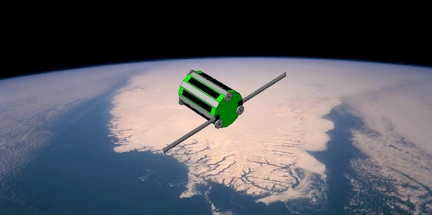
I enjoyed presenting on Project Calliope two weeks ago, at the 215th AAS meeting. I have a partial podcast of my talk in preparation, but in the meantime, here are the visual slides from my presentation (and also up as a PDF at
ProjectCalliope.com. The most important theme I covered was the shift from a tech mindset (build a crack engineering team) to a social mindset (gather a circle of interested people able to talk this up). Though the value of the talk was in the dialog, not the slides, this does provide a useful basic primer on the how and why of launching a personal picosatellite.
Project Calliope
Science&Social Media
Himalayan Hype : Reading Between The Lines
A recent IPCC news release admitting a small instance of bad science has triggered a flurry of news stories and blog articles based on worse science. The IPCC error in question took figures, not from the scientist concerned, Professor Syed Iqbal Hasnain, but from media reports of what he is claimed to have claimed. Those media reports appear to have a common source: a 1999 New Scientist article by Fred Pearce.
2009 was tied for the second warmest year on record, and in the Southern Hemisphere, last year was the warmest on record, according to a new analysis of global surface temperatures by NASA scientists.
Although 2008 was the coolest year of the decade because of a strong La Nina that cooled the tropical Pacific Ocean, 2009 saw a return to a near-record global temperatures as the La Nina diminished, according to the new analysis by NASA's Goddard Institute for Space Studies (GISS) in New York. The past year was a small fraction of a degree cooler than 2005, the warmest on record, putting 2009 in a virtual tie with a cluster of other years --1998, 2002, 2003, 2006, and 2007 -- for the second warmest on record.