Discussion of the rise in diagnosed autism is a controversial topic, and I applaud one company that is sidestepping the entire 'why' and 'who is at fault' issue and tackling it like good capitalists. MSNBC writes about Aspiritech's program for
training autistics in comp sci -- specifically the area of software testing, bug discovery, and data accuracy. They write:
This is an experiment to stir up reaction:
a significant proportion of the literature is misleading or false, tainting up to 20% of publications. What are the consequences?
1. The wastage of funds on research that is flawed and often misleading. Millions of dollars are spent on research every year worldwide.
2. This situation is unnecessary, unacceptable, and the antithesis of fundamental scientific principles.
3. Loss of public support for science. The longer the current situation continues, the more likely it is to damage the credibility of science and risk the loss of public funding.
No more sifting through unsanitary goat knuckles, searching for abstractions in tealeaves, shaking the Mattel magic eight ball, listening to Yellow Submarine backwards, or trudging India’s highlands in search of infamously reclusive gurus—instead, look no further for answers than Les Propheties, the 1555 work of Michel de Nostradame.
The stereotype of the nerdy computer scientist who stays up all night coding and has no social life may be driving women away from the field, and this stereotype can be brought to mind based only on the the environment in a classroom or office, according to a study published this month in the Journal of Personality and Social Psychology.
"When people think of computer science the image that immediately pops into many of their minds is of the computer geek surrounded by such things as computer games, science fiction memorabilia and junk food," said Sapna Cheryan, a University of Washington assistant professor of psychology and the study's lead author.
Even though the FDA doesn't actually know how many underage smokers choose flavored cigarettes, a new study claims that thrill-seeking teenagers are especially susceptible to fruit-flavored cigarettes and the federal government was right to outlaw the flavorful smokes last September.
"We found that those teens who gravitate toward novel experiences were especially drawn to cigarettes described as having an appealing, sweet flavor, such as cherry," says lead author Kenneth Manning with Colorado State University.
Your ability to resist that tempting cookie depends on how a big a threat you perceive it to be, according to a study in the Journal of Consumer Research.
University of Texas researchers studied techniques that enable us to resist food and other temptations. "Four experiments show that when consumers encounter temptations that conflict with their long-term goals, one self-control mechanism is to exaggerate the negativity of the temptation as a way to resist, a process we call counteractive construal," the researchers write.
University of Toronto quantum optics researchers have discovered new behaviors of light within photonic crystals that could lead to faster optical information processing and compact computers that don't overheat.
"We discovered that by sculpting a unique artificial vacuum inside a photonic crystal, we can completely control the electronic state of artificial atoms within the vacuum," says Ma, a PhD student under John's supervision and lead author of a study published in the Dec. 4 issue of Physical Review Letters. "This discovery can enable photonic computers that are more than a hundred times faster than their electronic counterparts, without heat dissipation issues and other bottlenecks currently faced by electronic computing."
Often promoted as a 'clean-burning' alternative to gasoline that could help break our oil addiction, ethanol would likely worsen health problems caused by ozone, especially in winter, according to research presented today at the American Geophysical Union meeting in San Francisco.
Applying emissions data to the Los Angeles area to model vehicle pollutants, researchers projected emissions for the year 2020, when more ethanol-powered vehicles will likely be in use
They estimated that vehicle emissions would be about 60 percent less than today, because automotive technology will likely continue to become cleaner over time. They investigated two scenarios, one that had all the vehicles running on E85 and another in which the vehicles all ran on gasoline.
According to four studies appearing in the latest issue of the Journal of Volcanology and Geothermal Research, the plumbing that feeds the Yellowstone supervolcano shows a plume of molten rock rising at an angle from the northwest at a depth of at least 410 miles, contradicting claims that there is only shallow hot rock moving like slowly boiling soup.
The research also indicates that the banana-shaped magma chamber of molten rock a few miles beneath Yellowstone is 20 percent larger than previously believed, so a future cataclysmic eruption could be even larger than thought.
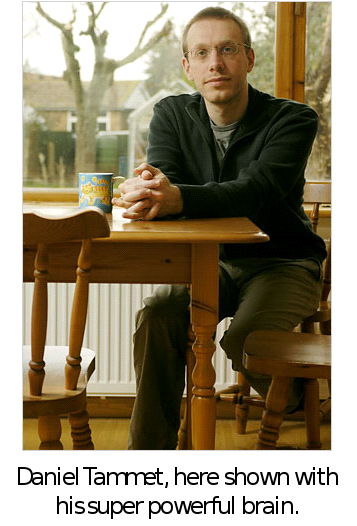
Daniel Tammet is an autistic savant and author of the recent book Embracing the Wide Sky: A Tour Across the Horizons of the Mind (Free Press). You may have heard of him. For example, most people first became aware of the existence of Iceland upon hearing that Tammet learned Icelandic in a week.
This is also the fellow that rattled off the first 22,514 digits of pi in five hours, enough for even the most exacting civil engineer, and far more accurate than the 19th century Texas town that passed an ordinance that pi would be approximated as 4. If ever there were a real human with superpowers, then Tammet fits the bill. Although stricken with adversity, his brain nevertheless is in certain respects blessed with something extra, smarter, almost magical.