


Sunday Science Book Club

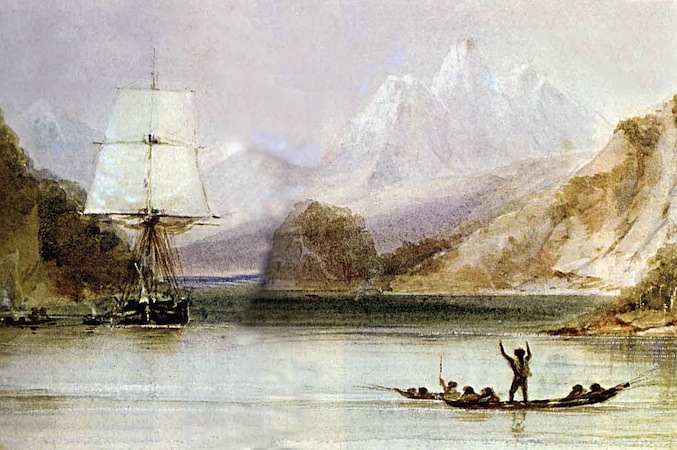
The Voyage of the Beagle, by Charles Darwin


Over vast expanses of time, powerful tectonic forces have massaged the western edge of the continent, smashing together a seemingly endless number of islands to produce what we now know as North America and the Pacific Northwest. Intuition tells us that the earth’s crust is a permanent, fixed outer shell – terra firma. Aside from the rare event of an earthquake or the eruption of Mount St. Helen’s, our world seems unchanging, the landscape constant. In fact, it has been on the move for billions of years and continues to shift each day.

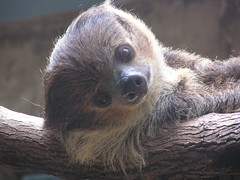
Ever wonder why the slow moving sloth has a slightly greenish hue? Ever consider the sloth at all? Well, perhaps not. Location, location, location, is the mantra for many of us in our macro world, but it is also true for the small world of algae.


Co-ordination of flight requires tremendous brainpower, and co-ordination of active flight, with the constant shift in the shape and location of massive wings, even more so. Nature is extremely parsimonious, not frittering away investment in any organ where it is not needed.

One of the key points that perpetually surfaces in the Intelligent Design debate is comparing animate with inanimate objects and attempting to draw comparisons or conclusions1.  This becomes more pronounced when we begin to consider the role of less tangible elements, like intelligence, and begin considering how such a thing would manifest in a machine.  In effect, it's the problem of determining what life is and how does it differ from everything else.

Often we look at complex machinery and associate meanings or parallels to biological systems, however this is an incorrect perspective.  No matter how sophisticated the machine is, it is invariably only a tool and as such needs to be examined from that viewpoint.
Biology consists of much detailed information regarding genetics, molecular biology, biochemistry, and a variety of other components.  This has provided a great deal of insight into how life functions, evolves, and reproduces.  However, there are other realms of biology that attempt to find order where perhaps none exists.  In discussions of topics like "selfish genes", or "kin selection", or Hamilton's rule, we are getting into areas where causation is being sought where none may specifically exist or at least, not of a general type.

Now we get to corn.  It seems that everything having to do with generating chemical energy, like methane and alcohol, making plastics is lumped under the moniker “biomass.” 

The fun with biomass is to follow the money.  Take biodiesel.  We just grow soybeans, rapeseed, sunflowers – whatever you want to make oil out of, press them and run diesel engines with it.

Cancer research took a fascinating step forward thanks to recent research by a collaborative group from Boston; a step that, if it pans out, could impact a wide swath of cancer drug development. The research is still in its early stages - mouse models - but the potential implications led to a great deal of media coverage. Just a few examples:


  • "Scientists have found a way to disarm a protein thought to play a key role in leukaemia and other cancers," from NHS (UK)


The Wall Street Journal has a piece on Tinkering Makes a Comeback Amid Crisis. They are talking about what is referred to by varied terms such as Do-It-Yourself (DIY), the Make movement, and simply Crafting.  The concept is 'build cool stuff, like machines and lasers and robots."

