While the scientific community, and most of the intelligent world, has widely accepted that the theory of natural selection is underlying mechanism of organic evolution, until recently our studies of evolutionary processes have been confined to the examples from a small plant orbiting an insignificant star in a mid-sized galaxy. From this limited viewpoint we know that evolution is intimately connected with life... but as scientists, we would love to expand the reaches of our database.
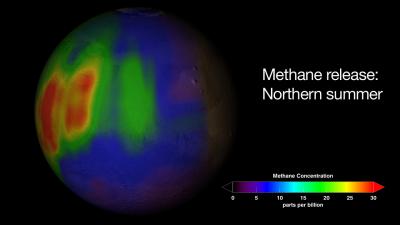
Scientists have achieved the first definitive detection of methane in the atmosphere of Mars, which would seem to indicate our reddish neighbor is biologically active. Or geologically active. Or both.
Wait, how can a bunch of smart people from NASA not know which?
It's because methane, four atoms of hydrogen bound to a carbon atom, is the main component of natural gas on Earth and is released by organisms as they (and we) digest nutrients but is also created in purely geological processes, like oxidation of iron.
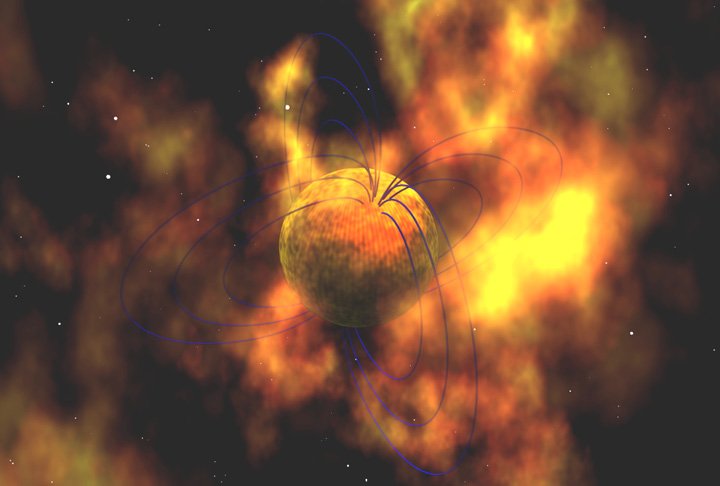
At 1014 gauss, atoms are compressed into tiny needles whose widths are only 1% of their lengths. X-ray photons readily undergo an exotic process where they change into matter and anti-matter particles briefly, before rejoining and turning back into light. Even at a distance of 1000 km, the slight polarization of water molecules would tear apart any Earth organism. So where do you find magnetic fields of such awe-inspiring strength? Attached to exotic objects in deep space, of course.
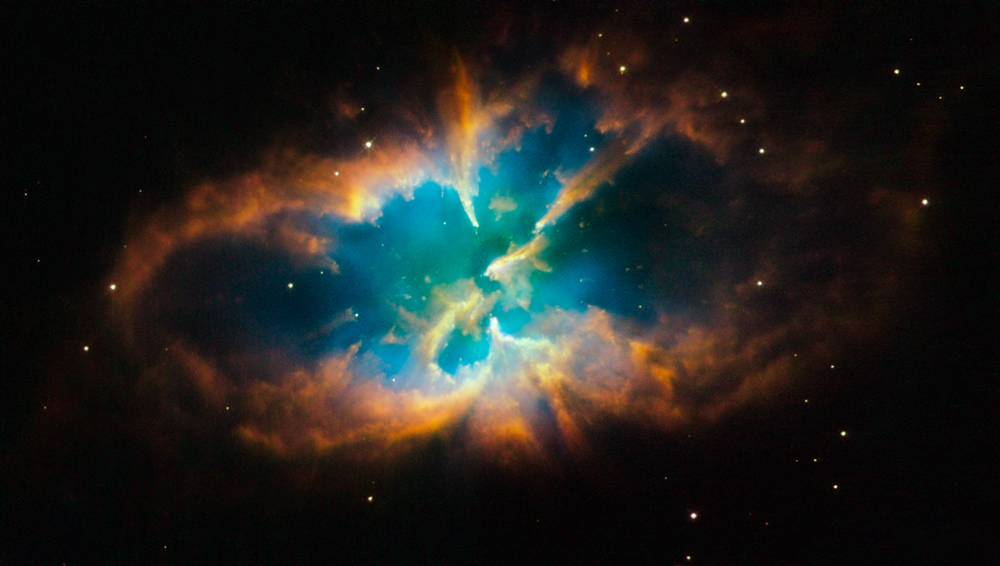
The unique planetary nebula NGC 2818 is nested inside the open star cluster NGC 2818A. Both the cluster and the nebula reside 10,400 light-years (3.2 kiloparsecs) away, in the southern constellation Pyxis, also called the Compass.
NGC 2818 is one of very few planetary nebulae in our galaxy located within an open cluster. Open clusters, in general, are loosely bound and they disperse over hundreds of millions of years. Stars that form planetary nebulae typically live for billions of years. Hence, it is rare that an open cluster survives long enough for one of its members to form a planetary nebula. This open cluster is particularly ancient, estimated to be nearly one billion years old.
Massive stars, those up to 120 times the mass of our sun, should blow away the clouds of gas and dust that instead feed their growth. Despite outward-flowing radiation pressure that exceeds the gravitational force pulling material inward, these huge stars get bigger, which hasn't made a lot of sense. Until now.
Using 3-D radiation hydrodynamics simulations, a group of researchers from Lawrence Livermore National Laboratory, University of California, Santa Cruz and UC Berkeley, discovered that these massive stars also tend to occur in binary or multiple star systems.
Rats whose mothers were fed alcohol during pregnancy are more attracted to the smell of liquor during puberty, say researchers writing in Behavioral and Brain Functions. They say rats exposed during gestation find the smell of alcohol on another rat’s breath during adolescence more attractive than animals with no prior fetal exposure.
Free-range chickens are more prone to disease than chickens kept in cages, according to a study published in Acta Veterinaria Scandinavica. This also applies to all chickens kept in litter-based housing systems.
Researchers led by Oddvar Fossum, at the National Veterinary Institute in Sweden, noted that during the switch in housing from battery cages to enriched cages and litter-based systems, including free-range, there was an increase in the number of chickens dying. During the study, the authors compared the causes of deaths in flocks of chickens kept in different types of housing across Sweden.
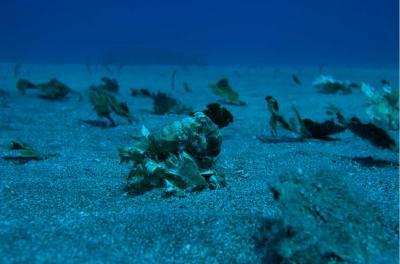
Uniform and mottle patterns are what most people recognize as camouflage and those patterns function by resembling the background. True background matching is not simple, though, and Roger T. Hanlon and colleagues say they are making one of the first efforts to quantify camouflage body patterns.
Although they have begun to compare camouflage tactics in many animals — large primates, amphibians, reptiles, fishes, insects — they are currently focusing on the cephalopods, which include squid, octopus, and cuttlefish. Remarkably, these soft-bellied mollusks are able to dynamically produce all three classes of camouflage body patterns (termed uniform, mottled, and disruptive).
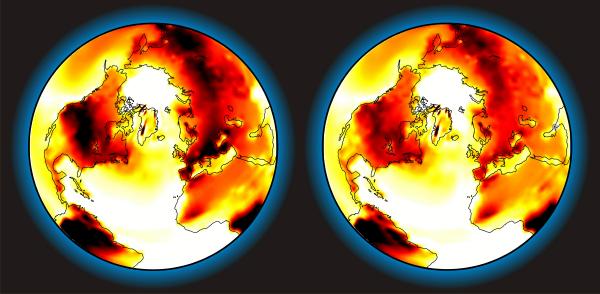
By carefully selecting which varieties of food crops to cultivate, much of Europe and North America could be cooled by up to 1°C during the summer growing season, say researchers from the University of Bristol, UK. This is equivalent to an annual global cooling of over 0.1°C, almost 20% of the total global temperature increase since the Industrial Revolution.
The growing of crops already produces a cooling of the climate because they reflect more sunlight back into space, compared with natural vegetation. Different varieties of the same crop vary significantly in their solar reflectivity (called 'albedo'), so selecting varieties that are more reflective will enhance this cooling effect. Since arable agriculture is a global industry, such cooling could be extensive.
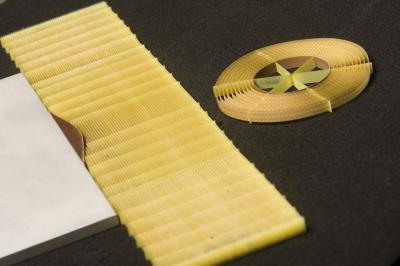
'Cloaking' devices bend electromagnetic waves, such as light, in such a way that it appears as if the cloaked object is not there. In the latest laboratory experiments by Duke researchers, a beam of microwaves aimed through the cloaking device at a "bump" on a flat mirror surface bounced off the surface at the same angle as if the bump were not present. Additionally, the device prevented the formation of scattered beams that would normally be expected from such a perturbation.
The underlying cloaking phenomenon is similar to the mirages seen ahead at a distance on a road on a hot day.