






A recent article in Discover Magazine was titled “A Universe Built For Us.”  The premise of the article is that the laws of the universe are exquisitely tuned for life - any small variations from the way things are, and life would not have been able to arise “Short of invoking a benevolent creator....”.  The article went on to explain that we live in a universe that seems ap

Individuals who get less than seven hours of sleep per night appear about three times as likely to develop respiratory illness following exposure to a cold virus as those who sleep eight hours or more, according to a report in the January 12 issue of Archives of Internal Medicine, one of the JAMA/Archives journals.

Studies have demonstrated that sleep deprivation impairs some immune function, according to background information in the article. Research indicates that those who sleep approximately seven to eight hours per night have the lowest rates of heart disease illness and death. However, there has previously been little direct evidence that poor sleep increases susceptibility to the common cold.
Two new studies show that commonly prescribed forms of postmenopausal hormone therapy may slightly accelerate the loss of brain tissue in women 65 and older beyond what normally occurs with aging. 

The studies' findings appear as companion papers in the Jan. 13 issue of Neurology. Both papers report on analyses from the Women's Health Initiative Memory Study, a substudy of the National Institutes of Health's (NIH's) landmark Women's Health Initiative (WHI) hormone therapy clinical trials.

Keep Britain Tidy today has named McDonald's as the most littered fast food brand in the country, meaning the people who litter are more likely to be throwing their wrappers on the streets than any other fast food brand.  It's no surprise, given McDonalds is the top fast food brand.

It's super-sized shame for the residents of ten city centers and suburbs/out-of-town locations across England.  But McDonalds isn't alone.   They made up more than a quarter of all fast food litter (29%), mostly burger wrappers, condiment packets and plastic straws.

In second place, as a group, were local chippie or kebab shops: Keep Britain Tidy found a huge amount of unbranded chip wrappings and packaging in all locations (21%).

The term 'invasive species' itself connotes very bad things but conservationists recently got an expensive lesson in the one thing they claim to understand; ecology is a system and making too many changes can have devastating repercussions.

Removing an invasive species from sub-Antarctic Macquarie Island, a World Heritage Site, has caused environmental devastation that will cost more than A$24 million to remedy, ecologists have revealed. Writing in the new issue of the British Ecological Society's Journal of Applied Ecology, they warn that conservation agencies worldwide must learn important lessons from what happened on Macquarie Island.

Harvard psychologist Steven Pinker's genome is being sequenced as part of the Personal Genome Project, and he's been gazing at the results, attempting to divine some meaning in the A''s, T's, G's and C's. He shares his musings in a Sunday Times Magazine essay that captures both the excitement of personal genomics and its pitfalls.

Personal Genomics and Disease
There's nothing quite like the frustration of an unexpected traffic jam. Many of us have been the victim of a sudden slowdown on the freeway, which lasts for a few miles before clearing up for no particular reason. Frustration isn't the only byproduct of bad traffic - by some estimates, traffic flow accounts for as much as one-third of global energy consumption and the resulting CO2 emissions. Improving the traffic situation, therefore, has the potential to greatly reduce our emissions of carbon dioxide as well as our emissions of swear words.
New information has shed light upon those mushrooms in your dinner, proving that they may add more to your health than just nutrition.  

Continued from Part 1

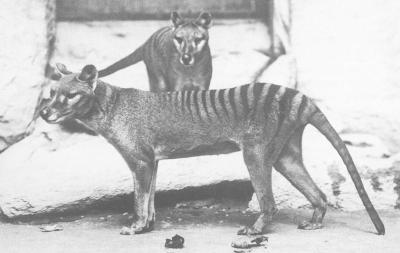
"Tasmanian Tiger" is a common name of the extinct thylacine species (Thylacinus cynocephalus), which is more closely related to kangaroos and koalas than to dogs or tigers.   In 1902, the National Zoo brought the endangered animal. By the mid-1930s, the thylacine was extinct, leaving behind only preserved museum specimens. In a new study, researchers used DNA sequencing to analyze preserved thylacines, including one brought to the National Zoo, making novel discoveries in thylacine genomics and the burgeoning field of "museomics."  Thylacines have played a central role in discussions about the possibility of bringing extinct species back to life, but despite the availability of many bones and other remains, previous attempts to read thylacine DNA had been unsuccessful.


