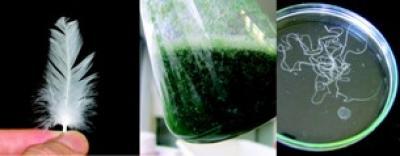
It's hard to imagine a future where people are nostalgic for polyester but it may be just a thing of the past. 38 million tons of synthetic fibers are made each year and some new advancements in regenerated protein make it possible to use environmentally sustainable clothing fiber instead.
So one day you may snuggle up in warm, cozy sweats made of chicken feathers or pants made of wheat - your blue jeans could be "green."
In Current Biology, Instituto Gubenkian de Ciencia researchers say they have provided insight into an old mystery in cell biology- and maybe it will offer up new clues to understanding cancer. Inês Cunha Ferreira and Mónica Bettencourt Dias, working with researchers at the universities of Cambridge, UK, and Siena, Italy, say they have unravelled the mystery of how cells count the number of centrosomes, the structure that regulates the cell's skeleton and controls the multiplication of cells, and is often transformed in cancer.
This research addresses an ancient question: how does a cell know how many centrosomes it has? It is equally an important question, since both an excess or absence of centrosomes are associated with disease, from infertility to cancer.
If you're sick of an
all chocolate diet and its miracle cure claims of 2007-2008 and you can't find blueberries or other
flavonoid foods that appeal to you, take heart that vitamin D is quickly becoming the "it" nutrient with claimed health benefits for diseases, including cancer, osteoporosis, heart disease and now diabetes. Like a Prius, it may not help but it can't hurt as long as you don't overdo it, like making people angry driving it in the HOV lane, so it's worth considering.
If you've made a New Year's resolution but you keep putting it off, you may not just be unclear on what the word 'resolute' means, you may have an issue putting tasks in concrete terms that make them feel like they need to be completed.
Procrastination is a curse, and a costly one. Putting things off leads not only to lost productivity but also to all sorts of hand wringing and regrets and damaged self-esteem. For all these reasons, psychologists would love to figure out what's going on in the mind that makes it so hard to actually do what we set out to do. Are we programmed for postponement and delay?
In 1943 the eminent physicist Erwin Schrodinger gave a series of lectures in Dublin that were later published in book form under the title What Is Life? Its success was considerable as it kick-started the new field of molecular biology, but Schrodinger deliberately avoided an investigation into a definition of life, believing that the time was not ripe.
Can you tell why this passage comparing Darwin's finches and humans is wrong?
Many paths lay open when the finches first arrived, and the smallest flights and trials of their descendants were rewarded. That is why they have traveled in more directions than any other creatures on the islands, that is why they have evolved farther and faster than any other creatures: because they got here early.
Our own line is now radiating farther, faster, and in more directions than any other single species in the history of the planet - and for a similar reason. We are the first creatures to arrive in the strange territory we now occupy. We stumbled into our new niche before any other creatures on the planet. We discovered it.
In his book, Wonderful Life: The Burgess Shale and the Nature of History, Stephen Jay Gould speculated about an experiment of ‘replaying life’s tape’, wherein one would go back in time, let the tape of life play again and see if ‘the repetition looks at all like the original.’ Evolutionary biology tells us that it wouldn’t look the same; the outcome of evolution is contingent on everything that came before. Scientists at the Instituto Gulbenkian de Ciência (IGC) in Portugal, New York University and the University of California Irvine say they have provided the first quantitative genetic evidence of why this is so.
If you're a mouse and you like fatty foods, we have good news for you. Researchers at the University of California, Berkeley have identified a new enzyme that helps control the breakdown of fat and the mice that have had this enzyme disabled remained lean despite eating a high-fat diet and losing a hormone that suppresses appetite.
The enzyme in the spotlight, adipose-specific phospholipase A2 (AdPLA), is found in abundance only in fat tissue. AdPLA sets off a chain of events that increases levels of a signaling molecule called prostaglandin E2 (PGE2), which suppresses the breakdown of fat. Mice that have no AdPLA have lower PGE2 levels and a higher rate of fat metabolism.
How did life begin? A pair of Scripps Research Institute scientists say they have taken a significant step toward answering that question because they have synthesized RNA enzymes that can replicate themselves without the help of any proteins or other cellular components - and the process proceeds indefinitely.
Is gardening one of your interests? If so and you live in central or northern Europe the 'killer slug' is probably one of your personal enemies. The slug, which attacks your herbs and vegetables relentlessly, seems immune to control measures.
The killer slug, suffocating lobster, globe trotting televisions and dangerous air particles are just some of the topics featured in EEA Signals 2009, a new annual publication from the European Environment Agency, launched today in Prague by Czech Environment Minister Bursik and Executive Director of the EEA, Professor Jacqueline McGlade.
The EEA, in partnership with its network of 32 member countries, monitors the environment across Europe.