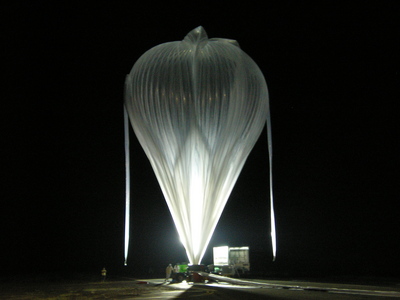
An experiment, carried out from a stratospheric balloon floating 35 km above the Brazilian jungle, to validate one of the instruments operating on the meteorological satellite MetOp was also used to support preparations for the candidate Earth Explorer TRAQ mission.
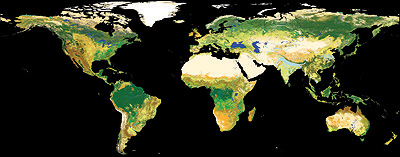
ESA’s global land cover map, which is ten times sharper than any previous global satellite map, is now available to the public online from the GlobCover website. It is the highest resolution land cover map that has been completely validated ever released.
Sixteen experts validated the map using more than 3 000 reference land cover points and showed it had an overall accuracy of 73% weighted by area for its 22 land cover classes. The map’s legend was developed using the United Nation Food and Agriculture Organisation’s (FAO) Land Cover Classification System (LCCS).
Teenage sexuality spiked in the 1970s and 1980s and then began to decline. Part of the reason is targeting alcohol, drugs and smoking. It turns out that while sexual behavior can vary considerably among teens, nonsexual risk behaviors are similar among them, according to study findings from the Journal of Adolescent Health .
Almost anything can be considered colloquially 'addictive' if you like it enough - computer games, Reese's Peant Butter Cups, reading Scientific Blogging articles and the best science blogs on the planet.
Clinical addiction is another issue, though, and Princeton University Professor Bart Hoebel and his team in the Department of Psychology and the Princeton Neuroscience Institute say they have evidence that sugar can be an addictive substance, wielding its power over the brains of lab animals in a manner similar to many drugs of abuse.
So now sugar addiction can overtake "I have a thyroid condition" as the number one excuse obese people use in America.
Earthquakes have aftershocks — not just the geological kind but the mental kind as well. Just like veterans of war, earthquake survivors can experience post-traumatic stress disorder, depression and anxiety.
In 1988, a massive earthquake in Armenia killed 17,000 people and destroyed nearly half the town of Gumri. Now, in the first multigenerational study of its kind, UCLA researchers studying survivors of that catastrophe have discovered that vulnerability to
PTSD, anxiety and depression runs in families.
We haven't always been warming. The circle of climate change has made 90% of the planet's history ice ages and many of those swings were sudden and dramatic. And it could happen that way again, within decades, says a new government report.
It contends that seas could rise rapidly if melting of polar ice continues to outrun recent projections and that an ongoing drought in the U.S. west could be the start of permanent drying for the region. Commissioned by the U.S. Climate Change Science Program, the report was authored by researchers from the U.S. Geological Survey, Columbia University's Lamont-Doherty Earth Observatory and other leading institutions. It was released at this week's meeting of the American Geophysical Union.
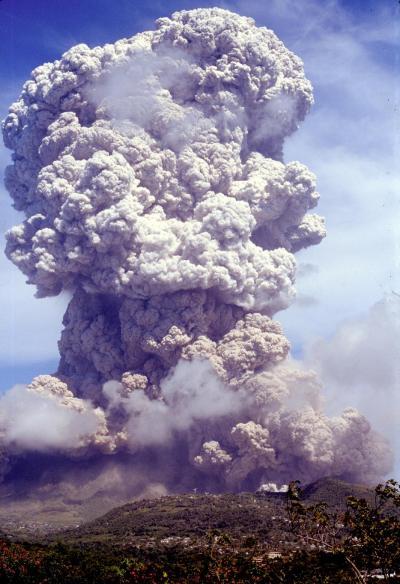
It sounds like a B movie starring Adrienne Barbeau (oops, that's "Amazon Women In The Avacado Jungle Of Death") but this international team of researchers have instead been collecting imaging data on the Soufriere Hills Volcano in Montserrat to understand the internal structure of the volcano and how and when it erupts.
"Using land-based measurement, we can see that over the time periods when the magma is erupting, the ground surface deflates into a bowl of subsidence and when the magma is sealed underground, the ground surface inflates like a balloon," says Barry Voight, professor emeritus of geosciences, Penn State. "The interesting thing is that much more magma is erupting than appears represented by the subsiding bowl."
A research team led by Professor Michael Chazan, director of the University of Toronto's Archaeology Centre, has discovered the earliest evidence of our cave-dwelling human ancestors at the Wonderwerk Cave in South Africa.
Stone tools found at the bottom level of the cave — believed to be 2 million years old — show that human ancestors were in the cave earlier than ever thought before. Geological evidence indicates that these tools were left in the cave and not washed into the site from the outside world.
Archaeological investigations of the Wonderwerk cave — a South African National Heritage site due to its role in discovering the human and environmental history of the area — began in the 1940s and research continues to this day.
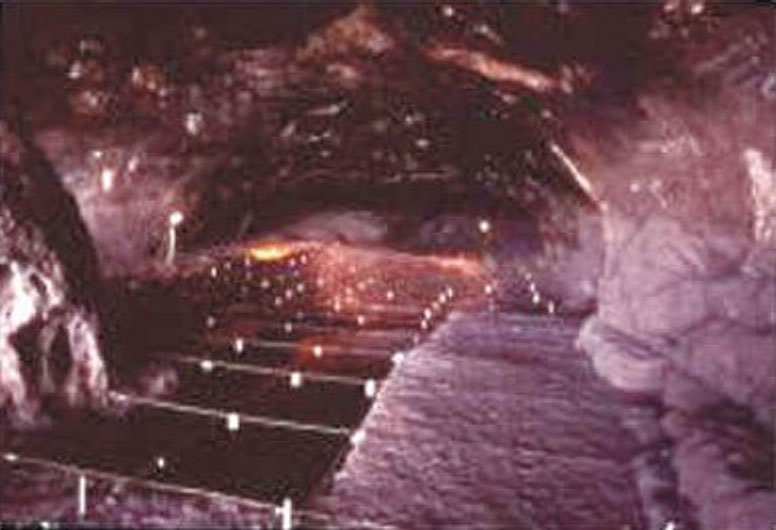
Deep inside the Frasassi cave system in Italy and more than 1,600 feet below the Earth's surface, divers found filamentous ropes of microbes growing in the cold water, according to a team of Penn State researchers.
The Frasassi cave system is located north of Rome and south of Venice in the Marche region. These limestone caves are like New Mexico's Carlsbad Caverns and Lechuguilla Cave, but in those caves, sulfur entered the caves from oil and gas reserves, while in Italy, the sulfur source is a thick gypsum layer below. Having sulfur in the environment allows sulfur-using organisms to grow.
Bursera simaruba has always been one of my favourite tree species. It’s a dry-season deciduous tree with compound leaves and a coppery peeling outer bark and a green (presumably photosynthetic) inner bark. It’s a conspicuous element of tropical dry forests in Trinidad and Tobago, Puerto Rico and parts of southern Florida (where they call it the ‘gumbo limbo’ tree). In all these places it’s the only representative of its genus. In my experience, Bursera was Bursera simaruba, so I was surprised when I came across a Bursera that was grown from seed collected in Costa Rica that was obviously not B. simaruba.