







Think you knew spent too much time pondering the wonders of beer in college? These Rice University students have you beat. They're using genetic engineering to create beer that contains resveratrol, a chemical in wine that's been shown to reduce cancer and heart disease in lab animals.

Rice's "BioBeer" will be entered in the International Genetically Engineered Machine (iGEM) competition Nov. 8-9 in Cambridge, Mass. It's the world's largest synthetic biology competition, a contest where teams use a standard toolkit of DNA building blocks -- think genetic LEGO blocks -- to create living organisms that do odd things.

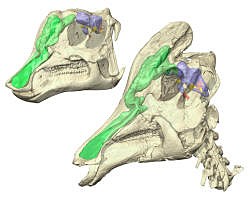
Paleontologists have long debated the function of the strange, bony crests on the heads of the duck-billed dinosaurs known as lambeosaurs. The structures contain incredibly long, convoluted nasal passages that loop up over the tops of their skulls.

Scientists at the University of Toronto, Ohio University and Montana State University now have used CT-scanning to look inside these mysterious crests and reconstruct the brains and nasal cavities of four different lambeosaur species.

At the annual meeting of the Society for Vertebrate Paleontology in Cleveland, Ohio, the team today announced new findings that suggest the crests were used for communication.

Eating too much fructose can induce leptin resistance, a condition that can easily lead to becoming overweight when combined with a high-fat, high-calorie diet, according to a new study with rats.

Although previous studies have shown that being leptin resistant can lead to rapid weight gain on a high-fat, high-calorie diet, this is the first study to show that leptin resistance can develop as a result of high fructose consumption. The study also showed for the first time that leptin resistance can develop silently, that is, with little indication that it is happening.

A team of researchers in Canada say they have made a bold stride in the struggle to detect dark matter - and it involves listening and WIMPS. The PICASSO collaboration has documented the discovery of a significant difference between the acoustic signals induced by neutrons and alpha particles in a detector based on superheated liquids.

Since neutron induced signals are very similar to dark matter induced signals, this new discovery published in the New Journal of Physics, could lead to improved background suppression in dark matter searches with this type of detector.

A Gecko's ability to climb sheer walls has long caught the attention of scientists and they've been trying for years to duplicate this strange talent. Major universities such as UC Santa Barbara, Georgia Institute of Technology and the University of Dayton have recently come to grips with materials that mimic a gecko's ability to stick. Some new research in Science on this is referenced below but there have been a few others over the last year also. With this recent research, the structural composition of the zoological magic behind the gecko's sticky feet has nearly been reproduced, and then comes the possibility to make it available for human use. This technology may take humans to new heights, literally ... sound like Spiderman anyone?

Physicists working to disprove "Lorentz invariance" -- Einstein's prediction that matter and massless particles will behave the same no matter how they're turned or how fast they go -- won't get that satisfaction from muon neutrinos, at least for the time being, says a consortium of scientists.

The test of Lorentz invariance, conducted by MINOS Experiment scientists and reported in the Oct. 10 issue of Physical Review Letters, started with a stream of muon neutrinos produced at Fermilab particle accelerator, near Chicago, and ended with a neutrino detector 750 meters away and 103 meters below ground. As the Earth does its daily rotation, the neutrino beam rotates too.

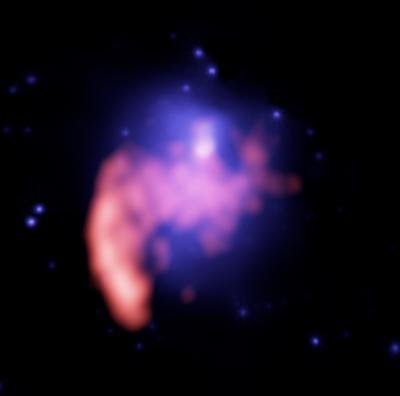
Scientists have detected long wavelength radio emissions from a colliding, massive galaxy cluster which, surprisingly, is not detected at the shorter wavelengths typically seen in these objects.

The discovery implies that existing radio telescopes have missed a large population of these colliding objects. It also provides an important confirmation of the theoretical prediction that colliding galaxy clusters accelerate electrons and other particles to very high energies through the process of turbulent waves.

This new population of objects is most easily detected at long wavelengths. Professor Greg Taylor of the University of New Mexico and scientific director of the Long Wavelength Array (LWA) points out, "This result is just the tip of the iceberg. When an emerging suite of much more powerful low frequency telescopes, including the LWA in New Mexico, turn their views to the cosmos, the sky will 'light up' with hundreds or even thousands of colliding galaxy clusters."

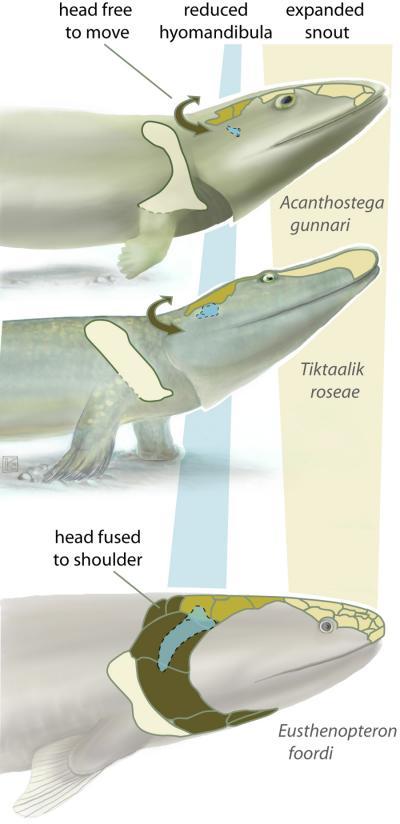
Newly exposed parts of Tiktaalik roseae--the intermediate fossil between fish and the first animals to walk out of water onto land 375 million years ago--are revealing how this major evolutionary event happened. A new study in Nature provides a detailed look at the internal head skeleton of Tiktaalik roseae and reveals a key intermediate step in the transformation of the skull that accompanied the shift to life on land by our distant ancestors.

A predator, up to nine feet long, with sharp teeth, a crocodile-like head and a flattened body, Tiktaalik's anatomy and way of life straddle the divide between fish and land-living animals. First described in 2006, and quickly dubbed the "fishapod," it had fish-like features such as a primitive jaw, fins and scales, as well as a skull, neck, ribs and parts of the limbs that are similar to tetrapods, four-legged animals.

Another multi-billion-dollar taxpayer bailout could lie ahead, this time to rescue a cash-strapped government program that insures pensions of 44 million American workers and retirees, a University of Illinois finance professor warns.

Jeffrey R. Brown says the troubled Pension Benefit Guaranty Corp., which steps in when private-sector employers with under funded defined-benefit plans go bankrupt, was $14 billion short of the cash it will need to cover pensions based on the latest estimates released a year ago.

But he predicts the shortfall will soar as a sour economy shutters more businesses and a plunging stock market carves into pension fund assets, with a government fix similar to this month's $700 billion Wall Street bailout as the likely solution.

People with autism-related disorders are less likely to make irrational decisions, and are less influenced by gut instincts, according to research funded by the Wellcome Trust. The study adds to the growing body of research implicating altered emotional processing in autism.

Decision-making is a complex process, involving both intuition and analysis: analysis involves computation and more "rational" thought, but is slower; intuition, by contrast, is much faster, but less accurate, relying on heuristics, or "gut instincts".

