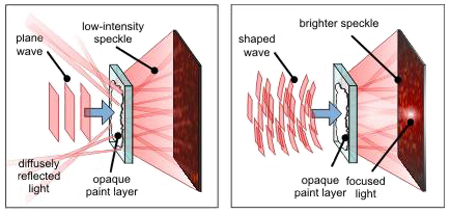






Materials such as milk, paper, white paint and tissue are opaque because they scatter light, not because they absorb it, but no matter how great the scattering, light was always able to get through the material in question, went the theory.

Researchers Ivo Vellekoop and Allard Mosk of the University of Twente have now shaped the waveform of light and confirmed this with experiments. By doing so they have found the predicted ‘open channels’ in material along which the light is able to move.

In materials that have a disordered structure, incident light is scattered in every direction possible. In an opaque layer, so much scattering takes place that barely any light comes out ‘at the back.’ However, even a material that causes a great deal of light scattering has channels along which light can propagate. This is only possible if the light meets strict preconditions so that the scattered light waves can reinforce one another on the way to the exit.

The perfect clean, renewable energy will utilize the sun's light energy for efficient conversion into fuels and electric power and so attention is focusing on one of the most ancient groups of organism, the cyanobacteria.

3.7 billion years ago photosynthesis evolved in cyanobacteria that used water molecules as a source of electrons to transport energy derived from sunlight, while converting carbon dioxide into oxygen. The light harvesting systems gave the bacteria their blue ("cyano") color, and paved the way for plants to evolve by "kidnapping" bacteria to provide their photosynthetic engines, and for animals by liberating oxygen for them to breathe, by splitting water molecules.

Humans are only now coming close to tweaking the photosynthetic reactions of cyanobacteria to produce fuels we want such as hydrogen, alcohols or even hydrocarbons, rather than carbohydrates.

The ostentatious, sometimes bizarre qualities that improve a creature's chances of finding a mate may also drive the reproductive separation of populations and the evolution of new species, say two Indiana University at Bloomington biologists.

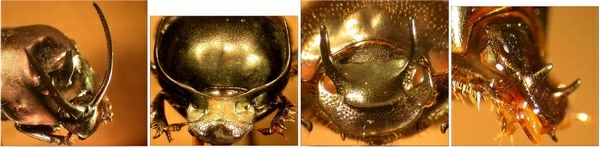
In the September 2008 issue of Evolution, Armin Moczek and Harald Parzer examine males from four geographically separated populations of the horned beetle species Onthophagus taurus. The beetles have diverged significantly in the size of the male copulatory organ, and natural selection operating on the other end of the animal -- horns atop the beetles' heads -- seems to be driving it.

Structures directly involved in mating are known as primary sexual characters, whereas combat structures like horns -- or seductive attributes like a cardinal's vibrant plumage or a bullfrog's deeply resonant baritone -- are known as secondary sexual characters.

Data from a recent study demonstrate the anti-inflammatory and pathogen protection benefits of Bifidobacterium infantis 35624 a probiotic bacterial strain of human origin.

New research in PLoS Pathogens says that the gastrointestinal benefits of probiotics extend to the entire body.

The inflammatory response is a key part of the immune system's battle against invaders. The normal response to infection is rapid and effective, however, the immune response may occasionally cause inflammation and damage to healthy tissue.

If you watched television broadcasts of the 2006 Winter Olympics in Torino, Italy, you likely got a bad impression of the Italian people, shows a new research study from BI Norwegian School of Management.

The Olympics is a venue that creates conflict in a country, they say, in that the competition to host the Games is increasingly tougher but the costs are staggering and the income from ticket sales, television rights, advertising, etc. does not even come close to covering all the expenses. An olympic championship attracts international attention, with international focus on both the organizing city and country but, as Chinese authorities are now painfully aware, the media attention in connection with hosting the Olympics can be a double-edged sword.

Troubled kids will always be a difficult area of social policy - in the 1980s the solution was thought to be introducing troubled kids to rural schools, but that tended to bring down the quality of the rural schools rather than raising troubled children up.

Yet it would be pessimistic and dooming some to permanent failure to make schools full of just troubled kids.

Still, the issue has not gone away. Troubled children hurt their classmates' math and reading scores and worsen their behavior, according to new research by economists at the University of California, Davis, and University of Pittsburgh.


It was two years ago that I first wrote about ocean dead zones. These are areas of the ocean that, due to a lack of oxygen, no longer sustain any life. While dead zones can happen naturally, they usually are caused by the results of human activity. A primary cause is nitrogen-rich nutrients from agricultural fertilizers that flow into coastal waters from rivers and streams.


Last week there was a report published in the Journal of Science that stated that the number of these ocean dead zones around the world has doubled every decade since the 1960s. There are now some 400 coastal areas that periodically or perpetually become dead due to oxygen starved bottom waters.

ScientificBlogger Matthew Brown had the chance to sit down with Dr. Judy Evans, a Consultant Plastic Surgeon in the UK, to talk about her award-winning Women In Medicine documentary on the BBC, her sex discrimination and victimization court case, and her life since returning to work after the trial. At the height of her career, she was suspended from her work in the UK's public health system when some of her male colleagues raised concerns about the integrity of her work. This suspension came within ten days after she gave her support to a Nigerian trainee—a black woman—who told Dr. Evans that she was the subject of racist remark from another surgeon. The lawsuit was finally settled in 2001, and since then Dr. Evans has been enjoying work in a private practice.

"One of the surgeons said to me, 'you would have to demonstrate that you would be prepared to be sterilized if you are serious about doing surgery..."


Dr. Judy Evans, performing surgery in Plymouth, UK. She talks about her BBC documentary, her sex discrimination case, and her life since then.
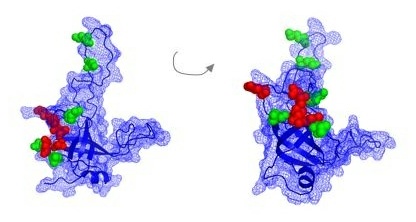

It may take just one or two proteins to polish off a simple cellular task, but life-or-death matters, such as caring for the ends of chromosomes known as telomeres, require interacting crews of proteins, all with a common goal but each with a specialized task.

Researchers at the Salk Institute for Biological Studies led by Vicki Lundblad, Ph.D., a Professor in the Molecular and Cell Biology Laboratory, have discovered that a protein that helps elongate chromosome ends—and hence saves cells from premature growth arrest—likely recognizes where to report to work through a common fold. Those findings are reported in the online edition of Nature Structure and Molecular Biology.

Soldiers in war live in danger danger – if their barracks is struck by a direct hit, it can be transformed into a clump of twisted metal in a matter of seconds. If they drive over a land mine, the vehicle can be blown sky high.

War is never safe but it’s possible to protect soldiers from at least some of the dangers. Tank steel and armored concrete provide good protection, but structures made from steel or concrete are quite heavy, and can be difficult to move. Aluminium, on the other hand, is a light product -- in a number of different ways.

One of the Norwegian University of Science and Technology’s three Centres for Research-based Innovation is called SIMLab (Structural Impact Laboratory).