








Researchers at Johns Hopkins say they have compelling evidence that some people with HIV who for years and even decades show extremely low levels of the virus in their blood never progress to full-blown AIDS and remain symptom free even without treatment, probably do so because of the strength of their immune systems, not any defects in the strain of HIV that infected them in the first place.

They say this finding renews promise of vaccine against AIDS and disproves the theory of a defective virus.

The theory about these so-called elite suppressors published in the Journal of Virology comes from rigorous blood and genetic studies of a monogamous, married, African-American couple in Baltimore, in which the wife was infected through sex with her husband more than a decade ago.

Diamonds from Brazil have provided the answers to a question that Earth scientists have been trying to understand for many years: how is oceanic crust that has been subducted deep into the Earth recycled back into volcanic rocks?

A team of researchers from the University of Bristol and the STFC Daresbury Laboratory, have gained a deeper insight into how the Earth recycles itself in the deep earth tectonic cycle way beyond the depths that can be accessed by drilling. The full paper on this research was published in Nature.

The Earth’s oceanic crust is constantly renewed in a cycle which has been occurring for billions of years. This crust is constantly being renewed from below by magma from the Earth’s mantle that has been forced up at mid-ocean ridges. This crust is eventually returned to the mantle, sinking down at subduction zones that extend deep beneath the continents. Seismic imaging suggests that the oceanic crust can be subducted to depths of almost 3000km below the Earth’s surface where it can remain for billions of years, during which time the crust material develops its own unique ‘flavour’ in comparison with the surrounding magmas. Exactly how this happens is a question that has baffled Earth scientists for years.

The unexplained bee disappearance known as Colony Collapse Disorder, CCD, is a problem that affects more than just honey producers. It may not seem like it, but bees play a big role in ice cream making. The domino-like process begins with the pollination of seeds for hay in order to feed the dairy producing cows for this internationally beloved dessert.

California has one fifth of the nations honey bees. More specifically, the state’s honeybees account for $6 billion of the $15 billion in commercial crop pollination value.

The CCD problem, involves the abandonment of the hive by adult bees. “The bees are not fleeing because of lack of food, but the ones left behind are dying because of lack of food and no other bees to keep them warm,” said Eric Mussen who is the extension apiculturist at U.C. Davis.

Schwarzkopf, makers of the gÖt2b line of hair care products, have introduced a hair gel called “gÖt2b Magnetik, With Phermones.” This hair gel contains a substance banned for use in international competition both inside and outside of the competitive season and could result in an athlete failing a drug test. In the worst case, use of this product could result in an athlete losing an Olympic gold medal. Why? The product contains androstadienone, a precursor of testosterone that is listed as a banned substance by the United States Anti-Doping Agency (USADA).

ScientificBlogger Matthew Brown had the chance to sit down with Professor Meg Urry, the Israel Munson Professor of Physics and Astronomy at Yale University. She gives readers a special understanding of the issues affecting women in science; she offers her opinion on why so few women have gone into physics, and gives advice for aspiring women physicists. These views have been colored by her own personal experiences as a student, a mother, and as a physicist successful at the highest level:

Before coming to Yale in 2001, she held a tenured position on the senior scientific staff at the Space Telescope Science Institute (STScI), which runs the Hubble Space Telescope for NASA. In 2007, she was elected the first woman Chair of the Department of Physics at Yale.

Researchers have tackled the problem of cooperation (and the related one of the evolution of altruism) for some time now. Initial game theory models suggested that cooperative animals would quickly be supplanted by selfish ones because of a cost to cooperation, as in the the so-called simple prisoners’ dilemma. In these situations, typically an individual can choose between an action that benefits everyone, but at a cost to oneself, and an action that clearly benefits the individual, but comes at the risk of greater loss if everyone adopts that strategy. It turns out that most of us would rather lose than share, a sad but to many not surprising commentary on the human condition. However, people eventually realized that cooperation makes the most sense in social groups, where phenomena such as kin and reciprocal altruism can take place. Sure enough, if the prisoners’ dilemma game is played iteratively, instead of in just one round, and if the players are allowed to keep track of what other players are doing (i.e., to build “reputations”) then it turns out that cooperating, even at a certain cost to oneself, is the winning long-term strategy.

The victory stance of a gold medalist and the slumped shoulders of a non-finalist are innate and biological rather than learned responses to success and failure, according to a University of British Columbia study using cross-cultural data gathered at the 2004 Olympic and Paralympic Games.

In the first study of its kind, UBC psychology researcher Jessica Tracy investigated how pride and shame are expressed across cultures, and among the congenitally blind. She compared the non-verbal expressions and body language of sighted, blind, and congenitally blind judo competitors representing more than 30 countries, among them Algeria, Taiwan, North Korea, the Ukraine and the United States.

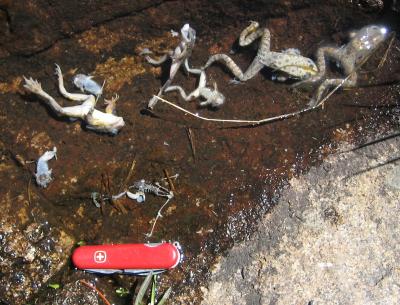
Amphibians, reigning survivors of past mass extinctions, are sending a clear, unequivocal signal that something is wrong, as their extinction rates rise to unprecedented levels, according to a paper published by the Proceedings of the National Academy of Sciences (PNAS). Humans are exacerbating two key natural threats – climate change and a deadly disease that is jumping from one species to another.

The authors confront the question of whether Earth is experiencing its sixth mass extinction and suggest that amphibians, as a case study for terrestrial life, provide a clear answer. "A general message from amphibians is that we may have little time to stave off a potential mass extinction," write co-authors Vance T. Vredenburg, assistant professor of biology at San Francisco State University, and David B. Wake, curator of herpetology in the Museum of Vertebrate Zoology at University of California, Berkeley, in the August 12 issue of PNAS.

Research led by UK and Australian scientists sheds new light on the role that our ancestors played in the extinction of Australia's prehistoric animals.

The study in the Proceedings of the National Academy of Sciences provides the first evidence that Tasmania's giant kangaroos and marsupial 'rhinos' and 'leopards' were still roaming the island when humans first arrived. The findings suggest that the mass extinction of Tasmania's large prehistoric animals was the result of human hunting, and not climate change as previously believed.

Scientists have long argued over the reasons behind the worldwide mass extinctions that took place towards the end of the last ice age. The main culprits are generally thought to be climate change or some form of human impact. People only arrived in Tasmania around 43,000 years ago, when the island became temporarily connected by a land bridge to mainland Australia. None of Tasmania's giant animals, known as 'megafauna' were known to have survived until this time. This appeared to clear humans of any involvement in the disappearance of the island's large megafauna.

Small, specially designed bits of ribonucleic acid (RNA) can interfere with cholesterol metabolism, reducing harmful cholesterol by two-thirds in pre-clinical tests, according to a new study by researchers at UT Southwestern Medical Center in collaboration with Alnylam Pharmaceuticals and the Massachusetts Institute of Technology.

In a study that appears on the Proceedings of the National Academy of Sciences, researchers found that a single dose of a small interfering RNA (siRNA), a chemical cousin of DNA, lowered cholesterol levels up to 60 percent in rodents, with the effects lasting for weeks. This result indicated that the RNA interference, or RNAi, mechanism could provide a new tactic for treating high cholesterol. Similar treatments in four nonhuman primates, conducted off-site by a certified contract research organization, produced an average 56 percent drop in low-density lipoprotein cholesterol levels in the animals’ blood.

