




Unless a researcher owns stock in a company whose drug is being tested, telling potential research volunteers about an investigator’s financial interests is unlikely to affect their willingness to volunteer, a new study shows. But many research volunteers put less trust in clinical trial leaders with financial conflicts.

For the study, Jeremy Sugarman, M.D., M.P.H., M.A., professor at the Johns Hopkins Berman Institute of Bioethics and The Johns Hopkins School of Medicine and his colleagues at Duke University School of Medicine and Wake Forest Schools of Medicine and Law recruited 3,623 adults with asthma or diabetes from a national database of individuals who are willing to participate in internet-based research. Overall, the recruits, almost all white, were well educated and had middle to high income levels. They were located in all regions of the United States.

Most of the respondents indicated that the financial disclosure was less important to their decision about participating than such factors as potential risks and benefits, and the purpose of the research.

Dog owners, who have noticed that their four-legged friend seem equally delighted to see them after five minutes away as five hours, may wonder if animals can tell when time passes.

Newly published research from The University of Western Ontario in London, Canada may bring us closer to answering that very question.

William Roberts and his colleagues in Western’s Psychology Department found that rats are able to keep track of how much time has passed since they discovered a piece of cheese, be it a little or a lot, but they don’t actually form memories of when the discovery occurred. That is, the rats can’t place the memories in time.

A team of researchers led by Danish professor Eske Willerslev shows that the ancestors of the North American Indians who came from Asia were the first people in America, and that they were of neither European nor African descent. It also shows that immigration to North America took place approximately 1,000 years earlier than assumed. These findings call for a revision of our understanding of the early immigration route to the American continent.

Willerslev, of the University of Copenhagen, and colleagues recently conducted DNA tests on samples of fossilized human feces found in deep caves in the Oregon desert and came to a conclusion sure to cause debate - the oldest of the droppings have been carbon-dated to be approximately 14,340 years old. Willerslev’s feces samples clearly contain two main genetic types of Asian origin that are unique to present-day North American Indians.

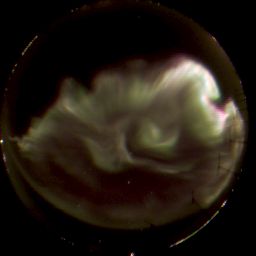
There are many interactions between the Sun and the Earth but one of the most dynamic events is a ‘substorm’ - an explosive reshaping of the Earth’s outer magnetic field.

To better understand substorms, scientists in Europe and North America are studying them from space using the Time History of Events and Macroscale Interactions during Substorms (THEMIS) satellites launched by NASA in 2007 and from the ground using a network of all-sky cameras.

University of Lancaster solar-terrestrial scientist Dr Emma Woodfield gave a talk at the Royal Astronomical Society National Astronomy Meeting in Belfast and presented the first few months of results from the Rainbow cameras newly installed in southern Iceland that complement this network.

Reshaping of the DNA scaffolding that supports and controls the expression of genes in the brain may play a major role in the alcohol withdrawal symptoms, particularly anxiety, that make it so difficult for alcoholics to stop using alcohol.

DNA can undergo changes in function without any changes in inheritance or coded sequence. These "epigenetic" changes are minor chemical modifications of chromatin -- dense bundles of DNA and proteins called histones.

"This is the first time anyone has looked for epigenetic changes related to chromatin remodeling in the brain during alcohol addiction," said Dr. Subhash C. Pandey, professor and director of neuroscience alcoholism research at the UIC College of Medicine and the Jesse Brown VA Medical Center in Chicago, the lead author of the study.

A new study by researchers at UC Davis shows how our very short-term "working memory," which allows the brain to stitch together sensory information, operates. The system retains a limited number of high-resolution images for a few seconds, rather than a wider range of fuzzier impressions.

Humans rarely move their eyes smoothly. As our eyes flit from object to object, the visual system briefly shuts off to cut down visual "noise," said Steven J. Luck, professor of psychology at the UC Davis Center for Mind and Brain. So the brain gets a series of snapshots of about a quarter-second, separated by brief gaps.

The working memory system smoothes out this jerky sequence of images by retaining memories from each snapshot so that they can be blended together. These memories typically last just a few seconds, Luck said.

The National Science Foundation (NSF) has awarded a $65 million grant to the University of Tennessee, Knoxville (UTK) to develop Kraken, a state of the art supercomputer. Kraken will enhance the computational power of the TeraGrid, the world's largest, most powerful and comprehensive distributed cyberinfrastructure for open scientific research.

"Like the gargantuan sea monsters Kraken, which inspired the naming of this supercomputer, the possibilities in scientific and engineering advances it enables are enormous, limited only by the confines of human imagination and vision beyond the frontiers of science," said NSF Director Arden L. Bement in a taped message that was played today at a luncheon in Knoxville.

Every two years NSF surveys and collects data on scientists and engineers, defined as people with a bachelor's degree or higher with science, engineering or related degrees or occupations.

NSF collects data on these individuals with three separate national surveys: the National Survey of College Graduates, the National Survey of Recent College Graduates, and the Survey of Doctorate Recipients. Collectively, these surveys are known as the Scientists and Engineers Statistical Data System, or SESTAT.

Anxiety gets a lot of bad press. Dwelling on the negative can lead to chronic stress and anxiety disorders and phobias, but evolutionarily speaking, anxiety holds functional value.

In humans, learning to avoid harm is necessary not only for surviving in the face of basic threats (predators or rotten food), but also for avoiding more complex social or economic threats, like enemies or questionable plans.

A team of psychologists at Stanford University have identified a region of the brain, the anterior insula, which plays a key role in predicting harm and also learning to avoid it. In a new study, Gregory Samanez-Larkin and colleagues scanned the brains of healthy adults while they anticipated losing money.

Preliminary results from DNA analysis of wolverine scat samples collected on the Tahoe National Forest do not match those of historic California wolverine populations, according to U.S. Forest Service scientists.

Geneticists with the agency’s Rocky Mountain Research Station recently began analyzing samples, when wildlife biologists with the Tahoe National Forest and California Department of Fish and Game began sending hair and scat samples they collected from wolverine detection sites on the national forest to a lab in Missoula, Mont.

The interagency effort began in March after an Oregon State University graduate student working on a cooperative project with the U.S. Forest Service’s Pacific Southwest Research Station photographed a wolverine, an animal whose presence has not been confirmed in California since the 1920s.

