








Scientists have long known that emotions and other personality traits and disorders run together in families but finding which genes are most important in controlling emotions has proven difficult. Humans and mice have similar numbers of genes, but mice are valuable because their genes can be deleted or added. Many researchers have begun to study mouse behaviors to try to link genes with complex behaviors.

A new report by Wang et al., found that male mice make high-frequency vocalizations during sexual interactions with female mice. These high-frequency calls are associated with approach behaviors, and with genes that control positive emotions.

Researchers in a large, multi-institutional study have found one gene variant that is linked to an increased risk of lung cancer.

The research team collected DNA from 1,154 smokers who have lung cancer and 1,137 smokers without lung cancer. Each DNA sample was analyzed at more than 300,000 points, looking for variations—known as single nucleotide polymorphisms, or SNPs for short—between those with cancer and those without. They then analyzed the top 10 SNPs in an additional 5,075 DNA samples from smokers with and without lung cancer.

Two of the 10 SNPs were consistently associated with lung cancer risk and both of them are located in chromosome 15 inside a region that contains genes for the nicotinic acetylcholine receptor alpha subunits 3 and 5, which already are suspected to play a role in lung cancer progression.

A few weeks ago I wrote a blog about a Chicago charter school.

I was naive enough to believe that if a group of ninth graders could not read it was unique to this Chicago school. Today I read a report by Christopher B. Swanson, Ph.D. titled "Cities in Crisis: A Special Analytical Report on High School Graduation." Dr. Swanson’s report clearly shows that we are in an academic crisis in the U.S.

In the first experiment of its kind conducted in nature, a University of British Columbia evolutionary biologist has come up with strong evidence for one of Charles Darwin’s cornerstone ideas – adaptation to the environment accelerates the creation of new species.

“A single adaptive trait such as color could move a population towards the process of forming a new species, but adaptation in many traits may be required to actually complete the formation of an entirely new species,” says UBC post-doctoral fellow Patrik Nosil. “The more ways a population can adapt to its unique surroundings, the more likely it will ultimately diverge into a separate species.”

Nosil studied walking-stick insects in the Santa Barbara Chaparral in southern California.

Using a new technique, two NASA scientists have identified the lightest known black hole. With a mass only about 3.8 times greater than our Sun and a diameter of only 15 miles, the black hole lies very close to the minimum size predicted for black holes that originate from dying stars.

"This black hole is really pushing the limits. For many years astronomers have wanted to know the smallest possible size of a black hole, and this little guy is a big step toward answering that question," says lead author Nikolai Shaposhnikov of NASA’s Goddard Space Flight Center in Greenbelt, Md.

Shaposhnikov and his Goddard colleague Lev Titarchuk presented their results on Monday, March 31, at the American Astronomical Society High-Energy Astrophysics Division meeting in Los Angeles, Calif. Titarchuk also works at George Mason University in Fairfax, Va., and the US Naval Research Laboratory in Washington, DC.
The tiny black hole resides in a Milky Way Galaxy binary system known as XTE J1650-500, named for its sky coordinates in the southern constellation Ara.

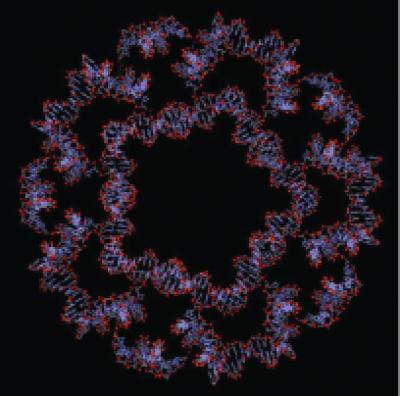
DNA, the stuff our genes are made of, is the building material of choice for nanoscale objects. A team led by Günter von Kiedrowski at the Ruhr University in Bochum has now made a dodecahedron (a geometric shape with twelve surfaces) from DNA building blocks. These objects are formed in a self-assembly process from 20 individual trisoligonucleotides, building blocks consisting of a “branching junction” and three short DNA strands.

A regular dodecahedron is a geometric shape made of 12 pentagons of equal size, three of which are connected at every vertex. This results in a structure with 30 edges and 20 vertices. In order to produce a hollow dodecahedral object from DNA, the researchers used 20 “three-legged” building blocks (three DNA strands connected together at one point). The centers of these building blocks represent the vertices of the dodecahedron. The three edges projecting from each vertex are formed when a single strand of DNA converts two neighboring bridging components into a double strand.

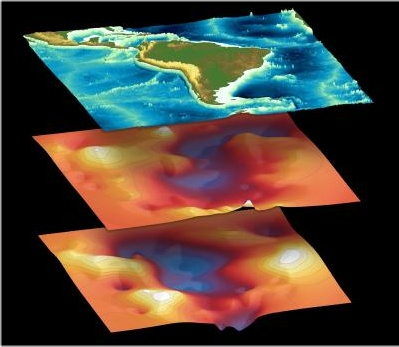
New research suggests that the geological staying power of continents comes partly from their losing battle with the Earth's oceans over magnesium. The research finds continents lose more than 20 percent of their initial mass via chemical reactions involving the Earth's crust, water and atmosphere. Because much of the lost mass is dominated by magnesium and calcium, continents ultimately gain because the lighter, silicon-rich rock that's left behind is buoyed up by denser rock beneath the Earth's crust.

The Earth's continents seem like fixtures, having changed little throughout recorded human history. But geologists know that continents have come and gone during the Earth's 4.5 billion years. However, there are more theories than hard data about some of the key processes that govern continents' lives.

We all know people who can seemingly eat whatever they want and not gain weight. Recent research from Tel Aviv University says a woman’s waistline may have less to do with rigorous exercise and abstaining from sweets than it does with the genes of her parents.

A new study by Prof. Gregory Livshits from the Sackler Faculty of Medicine at Tel Aviv University and colleagues from King’s College in London found a scientific link between the lean body mass of a woman and her genes. They’ve determined that thinness – like your smile or the color of your eyes – is an inheritable trait.

Scientists analysing the data from the European Venus Express spacecraft now orbiting Earth's prodigal twin planet have been piecing together an understanding of why the climate on both worlds is so different. Professor Fred Taylor of Oxford University presented the scenario in a talk at the RAS National Astronomy Meeting in Belfast on Wednesday 2nd April.

In the early stages of the Solar System, Venus seems to have evolved very rapidly compared to the Earth. Data from Venus Express supports the theory that the Earth’s twin once had significant volume of water covering the surface but it appears that these oceans were lost in a very short geological timescale. As a result of the loss of water, the geological evolution of the surface of Venus slowed right down because it was unable to develop plate tectonics like the Earth. Biological evolution was prevented altogether. Thus, in terms of Venus being another Earth in climate and habitability terms, it evolved too quickly at first, then too slowly.

Higher organisms do not have a “cost of complexity” — or slowdown in the evolution of complex traits — according to a report by researchers at Yale and Washington University in Nature.

Biologists have long puzzled over the relationship between evolution of complex traits and the randomness of mutations in genes. Some have proposed that a “cost of complexity” makes it more difficult to evolve a complicated trait by random mutations, because effects of beneficial mutations are diluted.

