UC Irvine scientists have discovered a cluster of galaxies in a very early stage of formation that is 11.4 billion light years from Earth – the farthest of its kind ever to be detected. These galaxies are so distant that the universe was in its infancy when their light was emitted.

The galaxy proto-cluster, named LBG-2377, is giving scientists an unprecedented look at galaxy formation and how the universe has evolved. Before this discovery, the farthest known event like this was approximately 9 billion light years away.

“When you observe objects this far away, you are actually seeing the universe as it was a very long time ago,” said Jeff Cooke, a McCue Postdoctoral Fellow in physics and astronomy at UCI and lead author of this study. “It is as if a timeline is just sitting out there in front of you. These galaxies represent what the universe looked like well before the Earth existed.”

The Netherlands Organization for Scientific Research has a couple of interesting things in the works, the first being next generation media storage. Dutch researcher Alexander le Fèbre has demonstrated that a field-emission current signal can be used to arrange the position of thousands of nanometre-sharp needles. These probes can be applied to write and read in new storage media with an extremely high density, using bits on a nanometre scale.

The development of the hard disk is reaching its technical limits because the entire disk is served by just a single head so the capacity of the disk and the reading and writing speed cannot expand much more in the future. Research into a memory based on probes from the University of Twente’s MESA+ research institute means able to control the position of each separate probe - essential for realizing a system with extremely high densities.

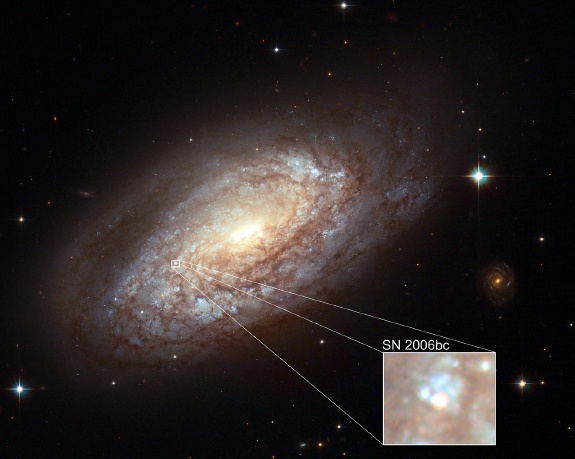
NGC 2397, pictured in this image from Hubble, is a classic spiral galaxy with long prominent dust lanes along the edges of its arms, seen as dark patches and streaks silhouetted against the starlight. Hubble’s exquisite resolution allows the study of individual stars in nearby galaxies.

Located nearly 60 million light-years away from Earth, the galaxy NGC 2397 is typical of most spirals, with mostly older, yellow and red stars in its central portion, while star formation continues in the outer, bluer spiral arms. The brightest of these young, blue stars can be seen individually in this high resolution view from the Hubble’s Advanced Camera for Surveys (ACS).

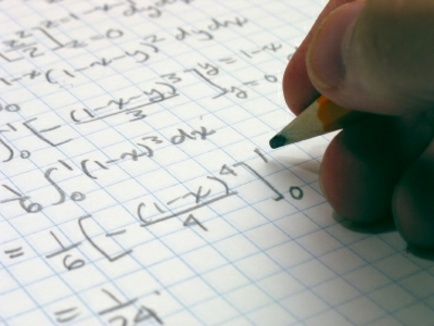
New Jersey Institute of Technolgy math professor Bruce Bukiet is once again opining on outcomes for this season’s Major League Baseball teams. His picks are based on a mathematical model he developed in 2000.

Bukiet’s main areas of research have involved mathematical modeling of physical phenomena, including detonation waves, healing of wounds, and dynamics of human balance. He has also applied mathematical modeling to sports and gambling, in particular for understanding baseball and cricket. Bukiet is an avid Mets fan but no one should hold that against him.

In Screw 'Sustainability' - And I Am Here To Tell You Why we discussed the fact that Mother Nature is a bloody bitch. She is the mother of catastrophe. She has nurtured brilliant innovations like cells and DNA but she has also given us 142 mass extinctions, 80 glaciations in the last two million years, a planet that may have once been a frozen iceball, and a klatch of global warmings in which the temperature has soared by 18 degrees in ten years or less.

Mother Nature has sunken the pleasant habitat of land creatures to the bottom of swamps and has lifted the havens of sea creatures --ocean bottoms -- to the mountain tops. She has very seldom given us a Garden of Eden, a green and sunny utopia in which she and we live together in harmony and peace.

Nature tosses us challenges and dares us to survive. More properly, she challenges us to thrive.

What’s more, evolution is all about breaking Mother Nature’s rules — defying gravity when a lizard stands, denying buoyancy when a fish controls its depth in the sea, and saying “no” to gravity when a bird has the audacity to fly. That audacity is Mother Nature’s way of feeling out new paths of growth and radical new possibilities. How do we know? Birds have been paid off big time for their insolence. There are four times as many species of birds as there are of us land-lubbing mammals. Each species represents another victory over nature, another corner of nature’s maze turned into a new niche. Each triumph is another of nature’s own victories in the breakthrough biz.

That's why talk about 'sustainability' today is riddled with problems — and with the seeds of self-defeat. The lowest periods in recorded human history have come when society tried to maintain a status quo.

It's well known that the left and right sides of the brain differ in many animal species and this is thought to influence cognitive performance and social behavior. For instance, in humans, the left half of the brain is concerned with language processing whereas the right side is better at comprehending musical melody.

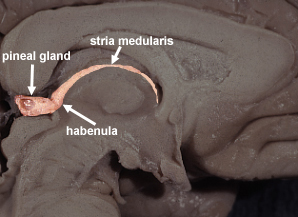
Researchers from University College London have pinpointed for the first time the left/right differences in how brains are wired at the level of individual cells. To do this, a research team led by Stephen Wilson looked at left and right-sided neurons (nerve cells) in a part of the brain called the habenula.

By causing habenular neurons to produce a bright green fluorescent protein they saw that they form remarkable "spiral-shaped" axons, the long nerve fibres that act as the nervous system's transmission lines.

Nitrous oxide, laughing gas, can't get any respect. Unlike carbon dioxide and methane, laughing gas has been largely ignored by world leaders as a worrying greenhouse gas but nitrous oxide must be taken more seriously, said Professor David Richardson from the University of East Anglia at the Society for General Microbiology’s 162nd meeting this week.

The potent gas is mainly coming from waste treatment plants and agriculture. Its release is increasing at the rate of 50 parts per billion or 0.25% every year. This means that it can be better controlled with suitable management strategies, but only if the importance of nitrous oxide (N2O) is widely recognised first.

“It only makes up 9% of total greenhouse gas emissions, but it’s got 300 times more global warming potential than carbon dioxide”, says Prof Richardson. “It can survive in the atmosphere for 150 years, and it’s recognised in the Kyoto protocol as one of the key gases we need to limit.”

"Awake", a film starring Hayden Christenson and Jessica Alba, is a psychological thriller about a horrifying phenomenon called "anesthetic awareness" where a patient's failed anesthesia leaves him fully conscious but physically paralyzed.

How common is it? Research shows that between one and three in every 1,000 patients experience some form of wakefulness during operations.

Some may not remember a period of consciousness during an operation – anesthetic drugs can interfere with recall – but they may still suffer subsequent psychological difficulties. In some cases patients aren't given enough of the sedative element of an anesthetic to keep them asleep.

Torn posters, tape and tomato skins may seem like strange research topics for physicists and applied mathematicians, but it's perfectly normal for a team of researchers from the Centre National de la Recherche Scientifique (CNRS) in Paris, the Universidad de Santiago, Chile, and MIT.

Such real-world applications are not only fun to study, but “we can really learn things that will be useful for industry and help us understand the everyday world around us. It is also a great way to motivate students to be interested in science,” says Pedro Reis, one of the authors of the paper and an applied mathematics instructor at MIT.

So they have tackled the issue of why wallpaper never comes off the way you want it. “You want to redecorate your bedroom, so you yank down the wallpaper. You wish that the flap would tear all the way down to the floor, but it comes together in a triangle and you have to start all over again,” said

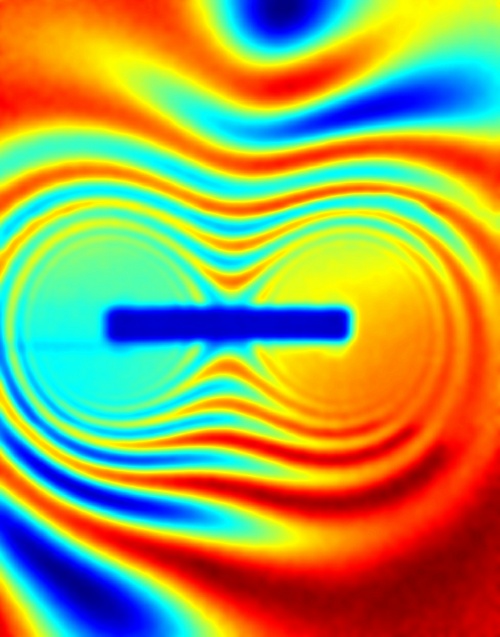
3-D images are very useful in medicine and now they're gaining ground in physics. Researchers from Hahn-Meitner-Institute (HMI) and the University of Applied Science in Berlin have succeeded in creating a direct, three-dimensional visualization of magnetic fields inside solid, non-transparent materials for the first time.

This could prove invaluable because to understand high temperature superconductivity it is vital to understand how magnetic flux lines are distributed and how these flux lines can be established in materials. With this new experimental setup, it is now possible to visualize magnetic domains in magnetic crystals three-dimensionally.

The researchers in the imaging group used neutrons, subatomic particles that have zero net charge, but do have a magnetic moment, making them ideal for investigating magnetic phenomena in magnetic materials.