If you had one hundred unlabeled DNA samples, taken from people all around the world, could you use that DNA to determine where the original donors came from?

With major improvements in genotyping technology, geneticists are now getting better and better at this game, and a recent paper in Science reports the largest study to date of human genetic diversity: 650,000 genetic differences scrutinized in nearly 1000 different individuals from 51 different populations.

Studies like this one lay important groundwork to help us understand how human genomes differ around the world, how differences in our genes and environments together make us healthy or sick, and how very ancient migrations led to the structure of today's human populations around the globe.

Twice in two days Botulinum toxin (Botox) has graced our front page, and it's not just because it makes Joan Rivers look like The Joker.

Yesterday we reported that Botox has helped infants with CHARGE Syndrome and today we discovered an article in Medical Hypotheses talking about its many beneficial effects.

Not bad press for an often fatal poison produced by a rare type of food poisoning bacteria.

Only two per cent of paediatric drug trials reported that they had established independent safety monitoring committees that can help lead to the early detection of adverse drug reactions, according to a major review in the April issue of Acta Paediatrica.

Child health researchers from the University of Nottingham, UK, carried out a detailed analysis of 739 international drug trials published between 1996 and 2002 to see what safety measures were in place and to monitor the levels of adverse drug reactions.

Just under three-quarters of the trials (74 per cent) described how safety monitoring was performed during the study, but only 13 studies (two per cent) had independent safety monitoring committees.

While significant gaps remain in our total knowledge of the extent of carbon dioxide’s sources, such as fires, volcanic activity and the respiration of living organisms, and its natural sinks, such as the land and ocean, it is known that more than 30 billion tons of extra carbon dioxide (CO2) is released into the atmosphere annually by human activities, mainly through the burning of fossil fuels.

According to the latest report by the Intergovernmental Panel on Climate Change (IPCC), this increase is predicted to result in a warmer climate with rising sea levels and an increase of extreme weather conditions. Predicting future atmospheric CO2 levels requires an increase in our understanding of carbon fluxes.

Using data from the SCIAMACHY instrument aboard ESA's Envisat environmental satellite, scientists have for the first time detected regionally elevated atmospheric carbon dioxide – the most important greenhouse gas that contributes to global warming – originating from manmade emissions.
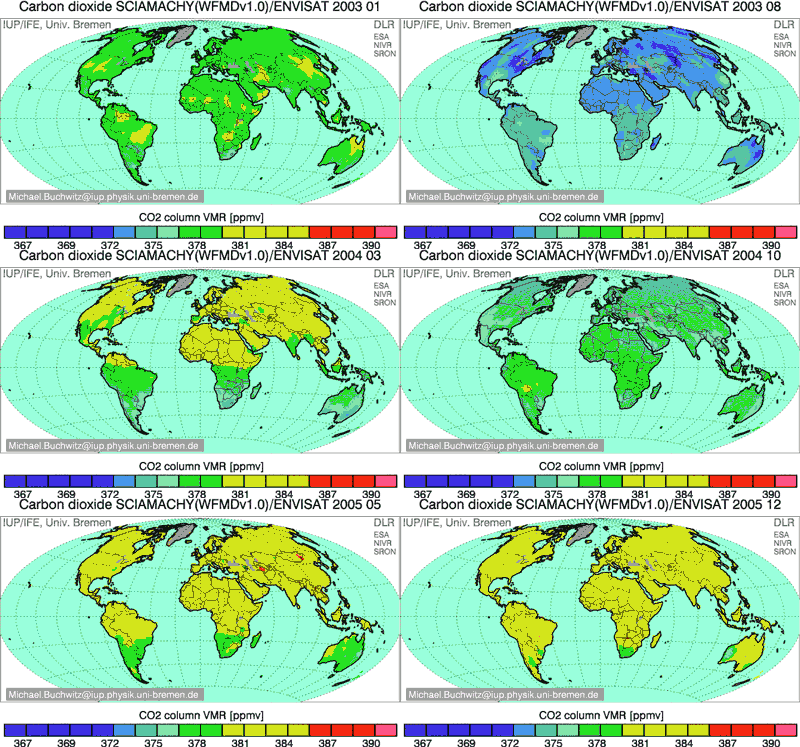

This animation of carbon dioxide (CO2) shows how our planet ‘breathes’. Each year huge amounts of CO2 are taken up by the growing vegetation in spring and summer and are to a large extent released again during the following autumn and winter when part of the vegetation dies and decays. This is seen in the animations by the up and down of the measured CO2 once per year. By looking carefully at the animation, it is possible to see that the CO2 levels are rising by about 0.5-1 percent from year to year. Dr. Michael Buchwitz and Oliver Schneising from the Institute of Environmental Physics (IUP) at the University of Bremen in Germany based produced this animation using Envisat SCIAMACHY observations from 2003 to 2005. Credits: IUP/IFE, Univ. Bremen

Scientists from North Carolina State University conducted larger-scale field trials and have shown that silencing a demethylase gene in burley tobacco plants significantly reduces harmful carcinogens in cured tobacco leaves.

The finding could lead to tobacco products, especially smokeless products, with reduced amounts of cancer-causing agents.

NC State's Dr. Ralph Dewey, professor of crop science, and Dr. Ramsey Lewis, assistant professor of crop science, teamed with colleagues from the University of Kentucky to knock out a gene known to turn nicotine into nornicotine. Nornicotine is a precursor to the carcinogen N-nitrosonornicotine (NNN). Varying percentages of nicotine are turned into nornicotine while the plant ages; nornicotine converts to NNN as the tobacco is cured, processed and stored.

'War is Hell' the saying goes and its stresses are great. That is why post-traumatic stress is most often associated with returning veterans of combat. But those are just the high profile cases, say a group of researchers in a new study.

The new study says a recent traumatic event is much more likely to result in post-traumatic stress disorder (PTSD) among adults who experienced trauma in childhood – and certain gene variations raise the risk considerably if the childhood trauma involved physical or sexual abuse, scientists have found.

“Untangling complex interactions between genetic variations and environmental factors can help us learn how to predict more accurately who’s at risk of disorders like PTSD. It can help us learn which prevention and treatment strategies are likely to work best for each person,” said NIMH Director Thomas R. Insel, M.D.

New findings about a protein called the nogo receptor are offering fresh ways to think about keeping the brain sharp.

Scientists have found that reducing the nogo receptor in the brain results in stronger brain signaling in mice, effectively boosting signal strength between the synapses, the connections between nerve cells in the brain. The ability to enhance such connections is central to the brain’s ability to rewire, a process that happens constantly as we learn and remember. The findings are in the March 12 issue of the Journal of Neuroscience.

A gluten-free vegan diet may improve the health of patients with rheumatoid arthritis, according to new research from the Swedish medical universit Karolinska Institutet. The diet also has a beneficial effect on several risk factors for cardiovascular disease.

Rheumatoid arthritis is associated with an increased risk of atherosclerosis (hardening of the arteries) and cardiovascular diseases. The underlying causes are unknown, but researchers suspect that the disturbed balance of blood fats seen in patients with rheumatoid arthritis may be part of the explanation.

A research team at Karolinska Institutet has shown in a new study that a gluten-free vegan diet has a beneficial effect on cardiovascular risk factors in people with rheumatoid arthritis. The effect was seen when a group of patients who kept to a gluten-free vegan diet for a year were compared with a control group which had followed ordinary dietary advice.

After nearly ten years of research and development, scientists at SUNY Downstate Medical Center in Brooklyn and Peking University in Beijing were awarded a United States patent for their virtual telemicroscope. This patented software permits off-site pathologists to diagnose cancer or other diseases in patients living in remote locations around the world.

Virginia M. Anderson, MD, associate professor of pathology at SUNY Downstate, and Jiang Gu, MD, PhD, dean and chairman of pathology at Peking University, developed the virtual microscope system, the only one of its kind capable of emailing electronic slides. Using their patent, the Chinese company Motic – a global leader in microscope manufacturing -- created a microscope with a robotic stage that scans whole slides at various magnifications and then creates compressed images that can be emailed all over the world.

If one didn’t wish to do something productive with one’s life, creationists would be a perennial source of amusement. Florida creationists, in this particular case. A new set of science standards has just been approved by the Board of Education of the orange juice and hanging chads State, and both sides are claiming victory, according to an article in Science dated 4 March 2008. How can that be?






