






When viruses enter cells they manufacture proteins to assist in growth and replication but the body’s immune system recognizes and attacks these non-native proteins. Human Papillomavirus (HPV)(1), which causes several types of cancer but is particularly associated with cervical cancer, has developed sneaky ways of hiding in the body, but researchers at the University of Leeds have found that its ability to trick the body’s first line of defence leaves it vulnerable to counter-espionage from a second defence system.

Professor Eric Blair(2) of the University’s Faculty of Biological Sciences and Dr Graham Cook(3) from the Leeds Institute for Molecular Medicine have been specifically looking at one of the proteins produced by HPV, called E7, and have discovered that it suppresses markers on the cell surface, making infected cells much less visible to T cells, one of the body’s key defense systems.

"March Madness", the annual tournament in college basketball to determine the national champion, impacts more than just sports fans. College basketball teams that make this year’s cut for the 'Sweet 16' may boost the number of students applying to their schools by as much as 3 percent next year, while the winner of the tournament, may see a 7 percent to 8 percent jump in applications, according to a new study.

Jaren Pope, assistant professor of agricultural and applied economics at Virginia Tech and his brother Devin Pope, an assistant professor at The Wharton School of the University of Pennsylvania, have co-authored a paper in Southern Economic Journal that finds a link between college sports success and college admissions around the country.

Experts estimate that $9 in productivity, health and other benefits are returned for every dollar invested in installing toilets for people in countries that today are off-track in meeting the UN Millennium Development Goal (MDG) for sanitation.

Achieving the sanitation goal – to simply halve the number of people without access to a toilet by 2015 – would cost $38 billion, less than 1% of annual world military spending. That investment, they say, would yield $347 billion worth of benefits – much of it related to higher productivity and improved health.

According to UN figures, meeting the sanitation MDG target would add 3.2 billion annual working days worldwide. Universal coverage would add more than four times as many working days.

A recent survey by the Harvard School of Public Health (HSPH) and Harris Interactive, as part of their ongoing series, Debating Health: Election 2008, finds that Americans are generally split on the issue of whether the United States has the best health care system in the world (45% believe the U.S. has the best system; 39% believe other countries have better systems; 15% don’t know or refused to answer) and that there is a significant divide along party lines.

Nearly seven-in-ten Republicans (68%) believe the U.S. health care system is the best in the world, compared to just three in ten (32%) Democrats and four in ten (40%) Independents who feel the same way.

A polyphenols-rich diet keeps the heart younger, according to a study by the FLORA Project, a European Commission funded research studying the effects of flavonoids, a variety of polyphenols, on human health.

"The biological and protective activities of various flavonoids have been extensively studied in vitro, on cell- based assays," says Marie-Claire Toufektsian, leading author of the study. "Nevertheless, this kind of approach has a major limitation: it is extremely difficult to assess precisely the nature of all flavonoids absorbed following consumption of plants present in a given meal. In other words, laboratory cultured cells alone are not sufficient to study a complex mechanism such as that of absorption of food flavonoids. That is why we need to turn attention on other features. The most obvious solution appeared to be to study the effects of this kind of polyphenols on experimental animals. The turning point started from plants: those rich in flavonoids made the case of researchers."

Healthy men who report lower levels of the nutrient folate in their diets have higher rates of chromosomal abnormalities in their sperm, according to a new study by researchers at the University of California, Berkeley, and the Lawrence Berkeley National Laboratory.

Women of child-bearing age are encouraged to maintain adequate levels of folate in their diet, but the new findings, to be published Thursday, March 20, in the journal Human Reproduction, provide evidence that what men eat may also affect reproductive health.

When did rabbits and hares diverge in evolution? The answer just got a little clearer. Last spring, Johns Hopkins anatomy professor Kenneth Rose was displaying the bones of a jackrabbit’s foot as part of a seminar when he noticed something familiar about the shape of the bones.

That led to the discovery of the oldest known record of rabbits. The fossil evidence in hand, found in west-central India, predates the oldest previously known rabbits by several million years and extends the record of the whole category of the animal on the Indian subcontinent by 35 million years.

A lemur is a monkey-like animal with a long tail and large eyes. Analysis of the first hand bones belonging to an ancient lemur has revealed a mysterious joint structure that has scientists puzzled.

Pierre Lemelin, an assistant professor of anatomy at the University of Alberta in Edmonton, Canada, and a team of fellow American researchers have analyzed the first hand bones ever found of Hadropithecus stenognathus, a lemur that lived 2,000 years ago.

The bones were discovered in 2003 in a cave in southeastern Madagascar, an island nation off the coast of Africa in the Indian Ocean. Hadropithecus is related to the modern-day sifaka, a type of lemur with acrobatic leaping skills.


The first handbones found of the ancient Hadropithecus lemur reveal a mystery arch by the little finger. Credit: Photo by Dr. Pierre Lemelin, University of Alberta.

Life on another planet? No, it's far too hot on HD 189733b for that, but the Hubble Space Telescope's first ever detection of an organic molecule in the atmosphere of a planet orbiting another star is big news. It's an important step in eventually identifying signs of life on a planet outside our Solar System.

Hubble found the tell-tale signature of methane in the atmosphere of the Jupiter-sized extrasolar planet HD 189733b. Under the right circumstances, methane can play a key role in prebiotic chemistry – the chemical reactions considered necessary to form life as we know it. Although methane has been detected on most of the planets in our Solar System, this is the first time any organic molecule has been detected on a world orbiting another star.

In oceanography studies, the iron needed to fertilize infrequent plankton blooms in High Nutrient, Low Chlorophyll (HNLC) regions was assumed to come almost entirely from wind-blown dust.

That's not the case in the North Pacific, say Phoebe Lam and James Bishop of the Earth Sciences Division at the Department of Energy's Lawrence Berkeley National Laboratory

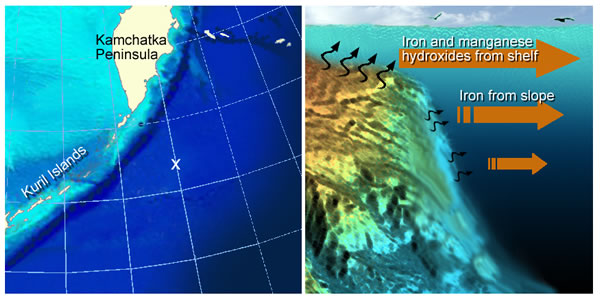
They report that the key source of iron in the Western North Pacific is not dust but the volcanic continental margins of the Kamchatka Peninsula and the Kuril Islands.


From a site at 47 degrees north latitude and 160 degrees east longitude in the Western North Pacific (marked X), iron and manganese found at depths of 100-200 meters originated hundreds of miles away, from the continental shelves of the Kamchatka Peninsula and Kuril Islands. Particulate and dissolved iron and manganese hydroxides came from the upper shelf, and, after further processing, more iron (now poor in manganese) came from deeper on the slopes.

