





Enzymes are biological catalysts that are made from a string of amino acids, which fold into specific three-dimensional protein structures. Without them, life would not exist. They are a valuable model for understanding the intricate works of nature. These molecular machines are responsible for initiating chemical reactions within the body. Millions of years of natural selection have fine-tuned the activity of such enzymes, allowing chemical reactions to take place millions of times faster.

In order to create artificial enzymes, a comprehensive understanding of the structure of natural enzymes, their mode of action, as well as advanced protein engineering techniques is needed. A team of scientists from the University of Washington, Seattle, and the Weizmann Institute of Science, Israel, made a crucial breakthrough toward this endeavor.

They have succeeded in creating a new type of enzyme for a reaction for which no naturally occurring enzyme has evolved.

Using classical coding, a single photon will convey only one of two messages - one bit of information. In dense coding, a single photon can convey one of four messages - two bits of information.

University of Illinois researchers say they have broken the record for the most amount of information sent by a single photon using the direction of “wiggling” and “twisting” of a pair of hyper-entangled photons. Doing so, they have beaten a fundamental limit on the channel capacity for dense coding with linear optics.

“Dense coding is arguably the protocol that launched the field of quantum communication,” said Paul Kwiat, a John Bardeen Professor of Physics and Electrical and Computer Engineering. “Today, however, more than a decade after its initial experimental realization, channel capacity has remained fundamentally limited as conceived for photons using conventional linear elements.”

Chemists at the University of California, San Diego have discovered that a chemical reaction in the atmosphere above major cities long assumed to be unimportant in urban air pollution is in fact a significant contributor to urban ozone—the main component of smog.

Their finding should help air quality experts devise better strategies to reduce ozone for US areas that exceed new standards announced last week by the Environmental Protection Agency and also benefit cities like Mexico City and Beijing that are grappling with major air quality and urban smog problems. More than 100 million people worldwide currently live in cities that fail to meet international standards for air quality.

Graphene, a single-atom-thick sheet of graphite, is a new material which combines aspects of semiconductors and metals.

University of Maryland physicists have shown that in graphene the intrinsic limit to the mobility, a measure of how well a material conducts electricity, is higher than any other known material at room temperature - and 100 times faster than in silicon.

A team of researchers led by physics professor Michael S. Fuhrer of the university's Center for Nanophysics and Advanced Materials, and the Maryland NanoCenter said the findings are the first measurement of the effect of thermal vibrations on the conduction of electrons in graphene, and show that thermal vibrations have an extraordinarily small effect on the electrons in graphene.

In baseball's golden age, pitchers had a higher mound and threw more complete games but careers were shorter. As salaries continue to rise there is greater concern about protecting the investments. A new study involving several Major League Baseball pitchers indicates that the height of the pitcher’s mound can affect the athlete’s throwing arm motion, which may lead to potential injuries because of stress on the shoulder and elbow.

The study was led by William Raasch, M.D., associate professor of orthopaedic surgery at the Medical College of Wisconsin in Milwaukee, who also is the head team physician for the Milwaukee Brewers. Major League Baseball funded the study in an effort to help prevent injuries among professional baseball players.

Since robots live in a binary world, it is difficult to program them in a way where they can understand the nuances and inflections of human speech among many different people.

A team of researchers from the Georgia Institute of Technology and Emory University may have made that unnecessary. They can instruct a robot to find and deliver things using something more direct than speech - a laser pointer.

El-E (pronounced like the name Ellie), a robot designed to help users with limited mobility with everyday tasks, autonomously moves to an item selected with a green laser pointer, picks up the item and then delivers it to the user, another person or a selected location such as a table. El-E, named for her ability to elevate her arm and for the arm's resemblance to an elephant trunk, can grasp and deliver several types of household items including towels, pill bottles and telephones from floors or tables.

In research that could lead to the prevention of up to one-fifth of birth defects in humans caused by genetic mutations, early stage fish embryos injected with a 'genetic patch' were able to develop normally.

Erik C. Madsen, Ph.D. student in the Medical Scientist Training Program at Washington University School of Medicine, made the discovery using a zebrafish model of Menkes disease, a rare, inherited disorder of copper metabolism caused by a mutation in the human version of the ATP7A gene. Zebrafish are vertebrates that develop similarly to humans, and their transparency allows researchers to observe embryonic development.

There are around 23,000 genes found in human DNA but perhaps 50 to 100 that have no counterparts in other species. Including the primate family known as hominoids increases that to several hundred unique genes.

If the genome is like an automobile, human-only genes are unlikely to be adding new wheels but they could, for example, be contributing a new anti-lock braking system: a regulatory function that fine-tunes essential processes originally established millennia ago in other species.

One hominoid-only gene, TBC1D3, can keep cellular growth factors active and helps turn on RAS, a protein that is active in a third of all human cancers and scientists at Washington University School of Medicine in St. Louis have produced the first detailed analysis of its cellular functions.

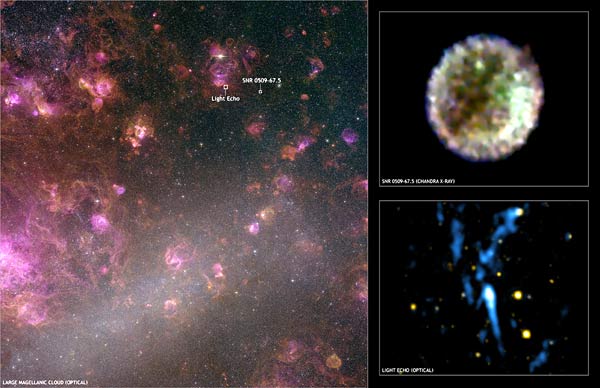
Astronomers using data from NASA’s Chandra X-ray Observatory, the Gemini Observatory and ESA’s XMM-Newton Observatory have made the best determination of the power of a supernova explosion long after it was visible from Earth.

By observing the remnant of a supernova that occurred about 400 years ago and a light echo from the initial explosion, the teams have established the validity of a new method for studying a type of supernova that produces most of the iron in the universe. The researchers studied the supernova remnant and the supernova light echo that are located in the Large Magellanic Cloud (LMC), a small galaxy about 160,000 light years from Earth


This combination of X-ray and optical images shows the aftermath of a powerful supernova explosion in the Large Magellanic Cloud (LMC), a small galaxy about 160,000 light years from Earth. The debris from this explosion (upper inset) shows the lowest energy X-rays are shown in red, the intermediate energies are green and the highest energies are blue. The light echo image (lower inset) shows light from the original supernova explosion that has bounced off dust clouds in the neighboring regions of the LMC (the light echoes are shown in blue and stars in orange). The large optical image shows emission lines of hydrogen (H-alpha) in red, singly-ionized sulfur in green and doubly-ionized oxygen in blue. The image highlights regions of star formation in the LMC, including supernova remnants and giant structures carved out by multiple supernovas. Credits:Chandra: NASA/CXC/Princeton/C.Badenes et al. MCELS: NOAO/AURA/NSF/S.Points, C.Smith & MCELS team. Light echo: NOAO/CTIO/Harvard/A.Rest et al.

The F-35 is a supersonic, multi-role, 5th generation stealth fighter. Three F-35 variants derived from a common design, developed together and using the same sustainment infrastructure worldwide, will replace at least 13 types of aircraft for 11 nations initially, making the Lightning II the most economical fighter program in history.

The program is on schedule to deliver aircraft to the U.S. military services beginning in 2010. The first test aircraft has completed 35 flights and has exceeded performance expectations. The inaugural flight of the first short takeoff/vertical landing F-35B is on schedule for mid-2008. All 19 test aircraft are in production flow or on the flightline, and assembly has begun on the first two production F-35s.

