







By adding a few modifications to their successful wastewater fuel cell, researchers have coaxed common bacteria to produce hydrogen in a new, efficient way.

Bruce Logan and colleagues at Penn State University had already shown success at using microbes to produce electricity. Now, using starter material that could theoretically be sourced from a salad bar, the researchers have coaxed those same microbes to generate hydrogen.

By tweaking their design, improving conditions for the bacteria, and adding a small jolt of electricity, they increased the hydrogen yield to a new record for this type of system.


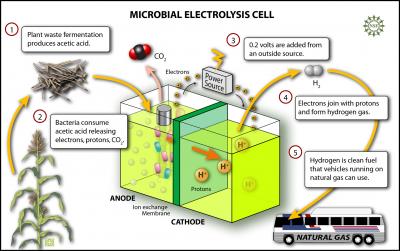
This illustration shows how the new electrolysis cell functions.

New research reveals that the families of patients who died in the intensive care unit (ICU) had higher satisfaction of care ratings than families of patients who survived their time in the ICU.

The study in the November issue of CHEST shows that while the families of ICU survivors and nonsurvivors were equally satisfied with the treatment that their loved one received, the families of non-survivors were two to three times more likely to give higher ratings regarding family-centered aspects of care. In contrast, the families of ICU survivors were shown to be less pleased with their overall ICU experience.

“For several years, our research team has focused on improving the quality of care delivered to critically ill patients and their families.

Last week, this article, Kidney Transplants From Extended Criteria Non-Beating Heart Donors Double Risk Of Death In Elderly brought the issue of of the risks of extended criteria organs into focus. It sounds like a bad thing that a higher-risk organ would double the risk of death.

Not necessarily, says a new report from Wake Forest University Baptist Medical Center.

New research has found that a drug used to treat severe forms of acne, Roaccutane (Accutane in the US), reduces the availability of the chemical serotonin, low levels of which have been linked to aggression and clinical depression.

The researchers had previously reported that the drug caused depressive behaviour in mice but, until now, the mechanism by which this might happen was unknown.

Using cells cultured in a laboratory, scientists from the University of Bath (UK) and University of Texas at Austin (USA) were able to monitor the effect of the drug on the chemistry of the cells that produce serotonin.

Some people just don't express emotions. It used to be considered strictly cultural, a society's image manifested in physical expectations, but now true inability to express emotions (alexithymia) is thought to be hereditary.

The largest study so far has provided new data in the current issue of Psychotherapy and Psychosomatics. The role of genetic and environmental factors for developing alexithymia is still unclear, and the aim of this study was to examine these factors in a large population-based sample of twins.

The Toronto Alexithymia Scale-20 (TAS-20) was included in a mail survey of 46,418 individuals born between 1931 and 1982 and registered with the Danish Twin Registry. The response rate was 75.3%.

A diet low in carbohydrates may help stunt the growth of prostate tumors, according to a new study led by Duke Prostate Center researchers. The study, in mice, suggests that a reduction in insulin production possibly caused by fewer carbohydrates may stall tumor growth.

“This study showed that cutting carbohydrates may slow tumor growth, at least in mice,” said Stephen Freedland, M.D., a urologist at Duke University Medical Center and lead researcher on the study.

Several studies demonstrated that alcohol-dependent patients show altered responses to alcohol-related cues. It is assumed that the regular association of these cues with the ingestion of alcohol leads to conditioned reactions, motivating reward or relief craving and instigating drug intake.

A group of German investigators has reported on this phenomenon in the current issue of Psychotherapy and Psychosomatics. They used an innovative method for studying this issue: the measurement of startle reflex, which is the eyeblink response to a sudden loud noise, that is normally inhibited by a pleasant foreground and potentiated when unpleasant stimuli are presented.

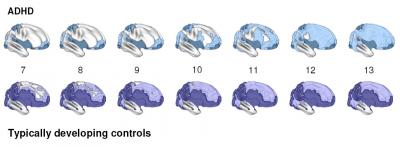
In youth with attention deficit hyperactivity disorder (ADHD), the brain matures in a normal pattern but is delayed three years in some regions, on average, compared to youth without the disorder, an imaging study by researchers at the National Institutes of Health’s (NIH) National Institute of Mental Health (NIMH) has revealed.

The delay in ADHD was most prominent in regions at the front of the brain’s outer mantle (cortex), important for the ability to control thinking, attention and planning. Otherwise, both groups showed a similar back-to-front wave of brain maturation with different areas peaking in thickness at different times.

Chimpanzees crave roots and tubers even when food is plentiful above ground, according to a new study that raises questions about the relative importance of meat for brain evolution. The study documents a novel use of tools by chimps to dig for tubers and roots in the savanna woodlands of western Tanzania.

The chimps’ eagerness for buried treats offers new insights in an ongoing debate about the role of meat versus potato-like foods in the diet of our hominid ancestors, said first author Adriana Hernandez-Aguilar, who collected the field data for her doctoral research at the University of Southern California.

The debate centers on the diet followed by early hominids as their brain and body size slowly increased towards a human level.

Two papers in the latest issue of the American Journal of Clinical Nutrition provide more support for the idea that omega-3s improve brain function.

The first was a cross-sectional study involving about 2000 persons 70-74 years old in Norway. Their fish consumption was measured and they took a battery of cognitive tests. The more fish you ate, the better your score on every test, even after adjustment for several things.

