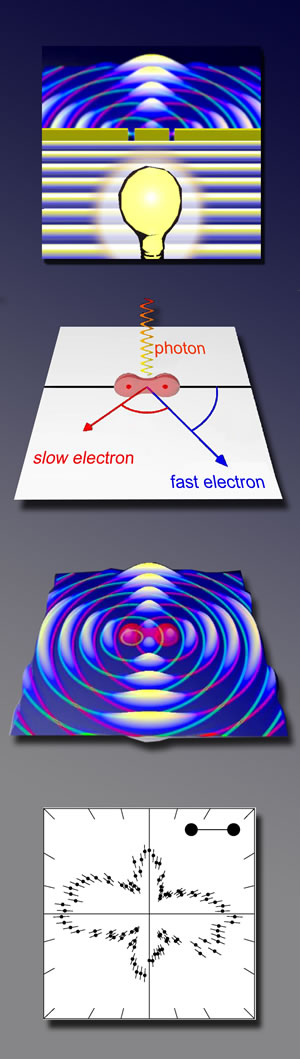





The big world of classical physics mostly seems sensible: waves are waves and particles are particles, and the moon rises whether anyone watches or not. The tiny quantum world is different: particles are waves (and vice versa), and quantum systems remain in a state of multiple possibilities until they are measured -- which amounts to an intrusion by an observer from the big world -- and forced to choose: the exact position or momentum of an electron, say.

On what scale do the quantum world and the classical world begin to cross into each other? How big does an "observer" have to be? It's a long-argued question of fundamental scientific interest and practical importance as well, with significant implications for attempts to build solid-state quantum computers.

People who have a mother with Alzheimer’s disease appear to be at higher risk for getting the disease than those individuals whose fathers are afflicted, according to a new study by NYU School of Medicine researchers.

The study is published in this week’s online edition of the Proceedings of the National Academy of Sciences. It is the first to compare brain metabolism among cognitively normal people who have a father, a mother, or no relatives with Alzheimer’s disease, and to show that only individuals with an affected mother have reduced brain metabolism in the same brain regions as Alzheimer’s patients.

Over the last two decades a number of studies have shown that people with the disease have significant reductions in brain energy metabolism in certain regions of the brain.

Is there such a thing as being too safe on the Internet?

A team of researchers from the St Vincent’s Campus in Sydney have developed a novel way to control the extreme weight loss, common in late stage cancer, which often speeds death.

The findings, published in Nature Medicine, suggest it may soon be possible to prevent this condition, giving people the strength to survive treatment and improve their chances of recovery.

The team of researchers from the Centre for Immunology at St Vincent’s Hospital and the University of New South Wales and the Garvan Institute of Medical Research have shown that most common cancers produce large amounts of a molecule known as MIC-1, which in turn targets receptors in the brain that switch off appetite.

Foregoing food for a day each month is one of the religious practices of members of the Church of Jesus Christ of Latter-Day Saints (LDS or Mormons), who have lower rates of heart disease than other Americans, researchers reported at the American Heart Association’s Scientific Sessions 2007.

“People who fast seem to receive a heart-protective benefit, and this appeared to also hold true in non-LDS people who fast as part of a health-conscious lifestyle,” said Benjamin D. Horne, Ph.D., M.P.H., study author and director of cardiovascular and genetic epidemiology at Intermountain Medical Center and adjunct assistant professor of biomedical informatics at the University of Utah in Salt Lake City.

Is there any point other than public relations in dispatching emergency field hospitals knowing they won't arrive in time to save lives that are in emergency situations? International donors want aid based on local needs but if only one third of needs assessments contain information about the local population or their health needs, is the humanitarian aid being applied effectively?

The first academic thesis in Sweden on international health assistance in disaster zones shows that international assistance is often sent to disaster areas without any prior needs assessment having been made of the affected population.

Dr Johan von Schreeb has carried out needs assessments in a number of disaster situations.

Photosynthesis converts light energy into chemical energy in plants, algae, phytoplankton and some species of bacteria and archaea. Photosynthesis in plants involves an elaborate array of chemical reactions requiring dozens of protein enzymes and other chemical components. Most photosynthesis occurs in a plant’s leaves.

Now University of Illinois researchers have built a plant that produces more leaves and fruit without needing extra fertilizer using a computer model that mimics the process of evolution. Theirs is the first model to simulate every step of the photosynthetic process.

The research findings appeared in Plant Physiology and will be presented today at the BIO-Asia 2007 Conference in Bangkok, Thailand.

Eating too much fructose and glucose can turn off the gene that regulates the levels of active testosterone and estrogen in the body, shows a new study in mice and human cell cultures that’s published this month in the Journal of Clinical Investigation. This discovery reinforces public health advice to eat complex carbohydrates and avoid sugar.

Table sugar is made of glucose and fructose, while fructose is also commonly used in sweetened beverages, syrups, and low-fat food products. Estimates suggest North Americans consume 33 kg of refined sugar and an additional 20 kg of high fructose corn syrup per person per year.

Glucose and fructose are metabolized in the liver. When there’s too much sugar in the diet, the liver converts it to lipid.

A tiny “electronic nose” that MIT researchers have engineered with a novel inkjet printing method could be used to detect hazards including carbon monoxide, harmful industrial solvents and explosives.

Led by MIT professor Harry Tuller, the researchers have devised a way to print thin sensor films onto a microchip, a process that could eventually allow for mass production of highly sensitive gas detectors.

“Mass production would be an enormous breakthrough for this kind of gas sensing technology,” said Tuller, a professor in the Department of Materials Science and Engineering (MSE), who is presenting the research at the Composites at Lake Louise Conference in Alberta, Canada, on Oct. 30.

Known until now as a simple number in a catalogue, NGC 134, the 'Island in the Universe' that was observed by the European Commissioner for Science and Research Janez Potočnik on a visit to ESO's Very Large Telescope at Paranal is replete with remarkable attributes, and the VLT has clapped its eyes on them.

Just like our own Galaxy, NGC 134 is a barred spiral with its spiral arms loosely wrapped around a bright, bar-shaped central region.

One feature that stands out is its warped disc. While a galaxy's disc is often pictured as a flat structure of gas and stars surrounding the galaxy's centre, a warped disc is a structure that, when viewed sideways, resembles a bent record album left out too long in the burning Sun.

