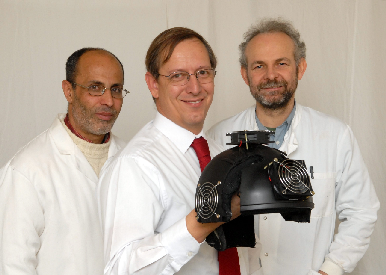






Pioneering research at the University of Sunderland has shown that regular exposure to safe low level infra-red light can improve learning performance and kick-start the cognitive function of the brain.

The results are a scientific breakthrough as to date medical treatments for dementia can only slow down brain deterioration and now human trials are to start to see if the treatment could provide a cure to illnesses like Alzheimers.

Independent research carried out at Sunderland has demonstrated that low power infra-red (1072nm) can improve the learning performance. The low levels of infra-red light used are completely safe and occur naturally in sunlight.

In transportation, road traffic contributes the most to global warming, aviation is second, railways are negligible and shipping actually has a net cooling effect on the earth’s climate, according to a study published recently.

But we can't simply switch to shipping and cure global warming. Shipping emits large portions of SO2 and NOx, which both have cooling effects, but this effect will diminish as the gases don’t live long in the atmosphere. After a few decades, the long-lived CO2 will dominate, giving shipping a warming effect in the long run.

From Bora Zivkovic's A Blog around the Clock:

You’re more likely to give things a favorable evaluation when you’re happy and a negative evaluation when you’re sad. But how does mood influence your choices among items?

A new study in the February issue of the Journal of Consumer Research people finds that consumers in a good mood are more likely than unhappy consumers to choose the first item they see, especially if all the choices are more or less the same.

“It is surprising that little research has been done to examine how affect influences comparisons and choices,” say Cheng Qiu (University of Hong Kong) and Catherine W. M. Yeung (National University of Singapore).

We've been waiting for a good personal jet pack system since seeing Sean Connery strap on that Bell-Textron thing in the opening sequence of Thunderball.

Thunderbolt Aerosystems founder Carmelo "Nino" Amarena must have seen that movie too because when he decided to try and shorten the grueling commute to his Bay Area office, he came up with what he says is a practical and economical personal air vehicle - one that won't blow up on your back like those hydrogen peroxide-powered prototypes of the early 1960s.

Don't get too excited just yet if you're a big guy. While the new version can stay aloft for up to 75 seconds, a 300% increase over what other systems offer, and go 65 MPH, it's limited to a 160 lb. man and a laptop. See it in action here:

SAO PAULO, Brazil, January 25 /PRNewswire/ --

A report called "Deadly Brew," aired on Thursday, Jan. 24 by Bloomberg Television, is a dangerously misleading and out-of-context representation of Brazil's sugar and ethanol industry, according to the Brazilian Sugarcane Industry Association (UNICA).

"The report relies on isolated incidents, flawed data and unsubstantiated allegations. Not surprisingly, it arrives at unbalanced and inappropriate conclusions that bear no resemblance to the industry as it is today," says UNICA President and CEO Marcos Jank.

A new report by the Arizona Arts, Sciences, and Technology Academy (AASTA) found that research in astronomy, planetary sciences, and space sciences (APSS) pumped over $250 million into Arizona’s economy in 2006 alone.

That's real money but it's not all balloons and ponies for Arizona. There are threats to that economic engine and it's what you can probably guess - the instability of federal funding and competition from other locations - but it's also things you might not guess, like light pollution from residential and commercial development and lingering memories of environmental and political activism.

The results are in. Jiri Gut from the Rosenthal group has run 2 of our Ugi products and they both show inhibition of falcipain-2 (EXP165) and Plasmodium falciparum (EXP166) in the micromolar range. To put this in context the activities are roughly 2 orders of magnitude lower than the positive control used for the enzyme inhibition and chloroquine for the parasite. But it is a start.

The new Center for Vaccine Awareness and Research at Texas Children’s Hospital announced that it will implement the nation’s first major “cocoon strategy” vaccination program to protect newborn infants from the life-threatening infection pertussis, more commonly known as whooping cough.

In the most recent edition of the Lancet, Cambridge scientists Drs. Oliver Jones and Julian Griffin highlight the need to research the possible link between persistent organic pollutants (POPs, a group which includes many pesticides) and insulin resistance, which can lead to adult onset diabetes.

In their commentary, Dr Jones and Dr. Griffin cite peer reviewed research, including that of Dr. D. Lee, et al, which demonstrated a very strong relationship between the levels of POPs in blood, particularly organochlorine compounds, and the risk of type 2 diabetes.

