





Scientists have discovered two species of groundwater amphipods that are found solely in Iceland. These finding can only be explained by these animals surviving glaciations in some kind of refugium under the glaciers.

Many scientists believe that the ice ages exterminated all life on land and in freshwater in large parts of the Northern Hemisphere, especially on ocean islands such as Iceland. Scientists at Holar University College and the University of Iceland have challenged that belief, at least when looking at groundwater animals.

They have discovered two species of groundwater amphipods in Iceland that are the only animals species found solely in Iceland.

Researchers at the University of Pennsylvania School of Medicine are the first to observe and measure the internal motion inside proteins, or its “dark energy.” This research, appearing in the current issue of Nature has revealed how the internal motion of proteins affects their function and overturns the standard view of protein structure-function relationships, suggesting why rational drug design has been so difficult.

The situation is akin to the discussion in astrophysics in which theoreticians predict that there is dark matter, or energy, that no one has yet seen,” says senior author A. Joshua Wand, PhD, Benjamin Rush Professor of Biochemistry.

A typical human mouth teems with as many as 700 different species of microbes. A handful of these have been specifically implicated in promoting gum disease, dental cavities, and bad breath, but for the most part, the make-up of this complex ecosystem and its impact on human health remain largely unexplored.

A new device created by Howard Hughes Medical Institute (HHMI) researchers, however, may make some of the most reclusive members of this and other microscopic communities much more accessible for laboratory study.

Ice loss from glaciers and ice caps is expected to cause more global sea rise during this century than the massive Greenland and Antarctic ice sheets, according to a new University of Colorado at Boulder study.

The researchers concluded that glaciers and ice caps are currently contributing about 60 percent of the world’s ice to the oceans and the rate has been markedly accelerating in the past decade, said Emeritus Professor Mark Meier of CU-Boulder’s Institute of Arctic and Alpine Research, lead study author. The contribution is presently about 100 cubic miles of ice annually -- a volume nearly equal to the water in Lake Erie -- and is rising by about three cubic miles per year.

The genetic makeup of any species is more like customized open source code than something that is fixed and can be easily documented. The parts of our 'code' that have withstood the test of time and the parts have undergone rapid evolutionary change has been difficult to assess.

Staying with the metapohor, an international team of researchers has developed a simple method to comb whole genomes for all the software fixes and security patches accumulated over time. In a first trial run, the scientists catalogued the genetic variations in 23 strains of the mustard weed Arabidopsis thaliana that were collected from the wild all over the world.

Game over. Computer scientists at the University of Alberta have solved checkers, the popular board game with a history that dates back to 3,000 B.C.

After 18-and-a-half years and sifting through 500 billion billion (a five followed by 20 zeroes) checkers positions, Dr. Jonathan Schaeffer and colleagues have built a checkers-playing computer program that cannot be beaten. Completed in late April this year, the program, Chinook, may be played to a draw but will never be defeated.

"This is a tremendous achievement—a truly significant advance in artificial intelligence," said Dr.

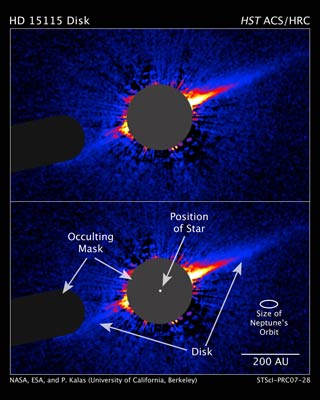
Astronomers have found a debris disk around HD 15115. As seen from Earth, the edge-on disk resembles a needle sticking out from the star.

Astronomers think the disk's odd imbalanced look is caused by dust following a highly elliptical orbit about the star. The lopsided disk may have been caused by the gravity of planets sweeping up debris in the disk or by the gravity of a nearby star.

The observations were made by Paul Kalas, James Graham, and Michael P. Fitzgerald, all from the University of California at Berkeley.


The disk, seen edge-on, is the dense blue line extending from the star to the upper right and lower left of the image.

A singing computer scientist wants to use cutting-edge technology to create Europe's first successful Internet choir.

Dr Barry Cheetham, a senior lecturer in The School of Computer Science at The University of Manchester, is seeking to combine his academic expertise in communications, networks and digital signal processing with his love of choral singing.

He is looking for funding to drive forward a project that will bring together amateur and semi-professional singers across Europe for seamless and polished live performances.


Credit: Barry Cheetham

A new National Science Foundation (NSF) report finds the number of U.S. science and engineering (S&E) articles in major peer-reviewed journals flattened in the 1990s, after more than two decades of growth, but U.S. influence in world science and technology remains strong.

The report, Changing U.S. Output of Scientific Articles: 1988 - 2003, finds changes occurred despite continued increases in funding and personnel for research and development. Flattening occurred in nearly all U.S. research disciplines and types of institutions.

In contrast, emerging Asian nations had large increases in publication numbers, reflecting their growing expertise in science and technology. European Union totals also went up.

Although the addition of nutrients to soil helps to maximize crop production, fertilizer can leech nutrients, polluting the water supply. A recent study by researchers at the University of Minnesota shows alternative cropping practices may help to protect the environment by reducing high nitrate levels in surface and ground water caused by conventional fertilizer use.

Nitrogen is one of the most important elements required in agricultural systems for plant and animal production. While treatment with the correct amount of nitrogen-based fertilizer optimizes crop yield and minimizes environmental damage, too much nitrogen can lead to nitrate loss.

