






From the viewpoint of biology, learning and education can be defined as the processes of forming neuronal connections in response to external environmental stimuli, and of controlling or adding appropriate stimuli, respectively.

Computers can't do that but researchers in Japan have shown how they can control electronic devices simply by reading brain activity.

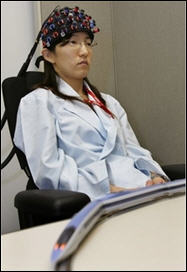
The "brain-machine" developed by Hitachi Inc. recently analyzed changes in the Akiko Obata's blood flow and translated those into electric signals which linked to a mapping device that controlled a toy train.


Akiko Obata wears the brain machine and controls a model train in Hatoyama, Japan

Nanobiotechnology holds a lot of promise and people have often speculated how it will impact the world of medicine. Unfortunately promising nanostructured systems so far have turned out to be extremely toxic to humans.

Now a group of researchers at the University of Michigan Nanotechnology Institute for Medicine and Biological Sciences have devised a multifunctional nanoparticle platform comprising nanoparticles synthesized within dendrimers equipped with targeting molecules and dyes. These dendrimer nanoparticle systems are able to seek out and specifically bind to cancer cells.

Buckyballs, or fullerenes, are nanoparticles containing 60 carbon atoms.

Bacteria called Dehalococcoides Ethenogenes, discovered in Ithaca sewage sludge in 1997 by James Gossett, Cornell professor of civil and environmental engineering, are now in wide use to detoxify some carcinogenic chemicals but they could be used for a lot more.

These bacteria remove chlorine atoms from molecules and leave less-toxic compounds behind in toxic waste like perchloroethylene (PCE) and trichloroethylene (TCE).

But D. ethenogenes strains work well at some sites and not so well at others, and nobody knows why.


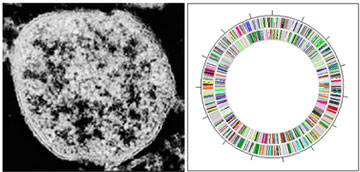
The bacterium Dehalococcoides ethogenes can extract chlorine from chemicals to help clean up toxic wastes. Its genome (charted at right) consists of 1,640 genes.

A diet rich in omega-3 polyunsaturated fatty acids found in certain fish or fish oil, nuts, seeds, and vegetable oils may help lower prostate cancer risk in individuals with a genetic predisposition to cancer.

While many genetic mutations are known to predispose to cancer, it has remained unclear whether dietary fat can modulate the risk of developing cancer in genetically predisposed individuals. Some studies suggest that a diet rich in omega-3 polyunsaturated fatty acids reduces cancer incidence.

Haptics means “of or relating to the sense of touch”. Haptics Technolofy refers to the technology that connects the user to a computerized system via the sense of touch by applying forces, vibrations and/or motions to the user.

Perhaps people do not realize it, but haptic technology is already in our lives. Vibrating phones, gaming controllers and force-feedback control knobs in cars, like BMW’s iDrive, are examples of this technology. These days, you can turn your phone ring tone off, put it in your purse and still feel that someone is calling you when you get a vibration. On the other hand, the Nintendo Wii video game console has been a new revolution for game lovers. The controller, called Wii, provides vibrations (i.e.

Scientists at the Alaska Stable Isotope Facility can tell you whether marijuana came from Mexico or the Matanuska Valley. Soon they'll even be able to tell you whether it was grown indoors or out.

A few more years and enough samples and they hope to have something even more precise: an elemental fingerprint that could tell police where and under what conditions a sample of marijuana was grown.

"There are scientists already doing this for drugs like heroin and cocaine," said Matthew Wooller, Alaska Stable Isotope Facility director. "The potential is there for being able to do this for marijuana as well."

Human resistance to a retrovirus that infected chimpanzees and other nonhuman primates 4 million years ago ironically may be at least partially responsible for the susceptibility of humans to HIV infection today.

These findings, reported by a team of researchers at Fred Hutchinson Cancer Research Center in the June 22 issue of Science, provide a better understanding of this modern pandemic infection through the study of an ancient virus called Pan troglodytes endogenous retrovirus, or PtERV1.

"This ancient virus is a battle that humans have already won. Humans are not susceptible to it and have probably been resistant throughout millennia," said senior author Michael Emerman, Ph.D., a member of the Human Biology and Basic Sciences divisions at the Hutchinson Center.

Using mathematical theory, UC Irvine scientists have shed light on one of cancer’s most troubling puzzles -- how cancer cells can alter their own genetic makeup to accelerate tumor growth. The discovery shows for the first time why this change occurs, providing insight into how cancerous tumors thrive and a potential foundation for future cancer treatments.

UCI mathematicians Natalia Komarova, Alexander Sadovsky and Frederic Wan looked at cancer from the point of view of a tumor and asked: What can a tumor do to optimize its own growth" They focused on the phenomenon of genetic instability, a common feature of cancer in which cells mutate at an abnormally fast rate.

The extinction of many large mammals at the end of the Ice Age may have packed an even bigger punch than scientists have realized. To the list of victims such as woolly mammoths and saber-toothed cats, a Smithsonian-led team of scientists has added one more: a highly carnivorous form of wolf that lived in Alaska, north of the ice sheets.

Wolves were generally thought to have survived the end-Pleistocene extinction relatively unscathed. But this previously unrecognized type of wolf appears to have vanished without a trace some 12,000 years ago.

The study combined genetic and chemical analyses with more conventional paleontological study of the morphology, or form, of the fossilized skeletal remains.

