Banner
Here's Where Your Backyard Was 300 Million Years Ago

We may use terms like "grounded" and terra firma to mean stability and consistency but geology...

Convergent Evolution Cheat Sheet Now 120 Million Years Old

One tenet of natural selection is a random walk of genes but nature may be more predictable than...

Synchrotron Could Shed Light On Exotic Dark Photons

There are many hypothetical particles proposed to explain dark matter and one idea to explore how...

The Pain Scale Is Broken But This May Fix It

Chronic pain is reported by over 20 percent of the global population but there is no scientific...

User picture.
News StaffRSS Feed of this column.

News Releases From All Over The World, Right To You... Read More »

Blogroll

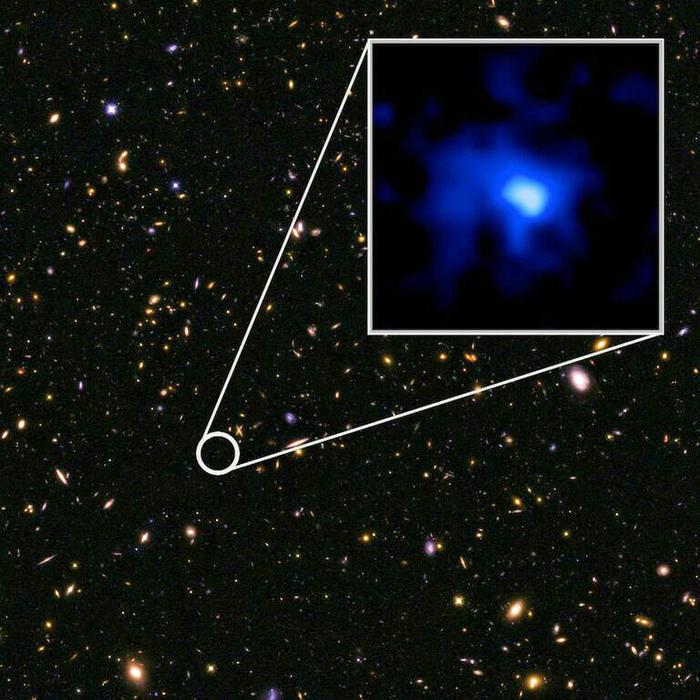
Astronomers have reported an exceptionally luminous galaxy from when the universe was only 5% of its present age - more than 13 billion years in the past.

The galaxy, EGS-zs8-1, was originally identified based on its particular colors in images from NASA's Hubble and Spitzer telescopes and the team determined its exact distance from Earth using the powerful MOSFIRE instrument on the W.M. Keck Observatory's 10-meter telescope in Hawaii. It is the most distant galaxy currently measured and one of the brightest and most massive objects in the early universe. 

If you have ever wondered why you need to snack more at night and many people don't, there may be a neuroscience answer:  areas of the brain that get a satiety "food high" may not get it in the evening. 

In a new study, exercise professors and a neuroscientist used MRI to measure how the  brains of college students respond to high- and low-calorie food images at different times of the day. Functional MRI took pictures of the brain activity of study subjects while they viewed images of food. The participants viewed 360 images during two separate sessions held one week apart--one during morning hours and one during evening hours.

Genome editing using CRISPR/Cas system has enabled direct modification of the mouse genome in fertilized mouse eggs, leading to rapid, convenient, and efficient one-step production of knockout mice without embryonic stem cells.

In contrast to the ease of targeted gene deletion, the complementary application, called targeted gene cassette insertion or knock-in, in fertilized mouse eggs by CRISPR/Cas mediated genome editing still remains a tough challenge.

To understand how transposable elements, DNA sequences capable of moving independently,  shape genomes, where they are maintained over generations, it is vital to discover the mechanisms behind their targeted integration.

Researchers from the Laboratoire Pathologie et Virologie Moléculaire (CNRS/Inserm/Université Paris Diderot), Institut de biologie intégrative de la cellule and the University of Minnesota have identified an interaction between two proteins that is essential for the integration of a transposable element into a specific area of the yeast genome. The results emphasize the role of these mobile DNA sequences in the evolution and adaptation of organisms, and their potential value for gene therapy.
A group of researchers analyzed a marine sponge called Halichondrin okadai  because they were curious why it inhibited the replication of organisms around it.

They found that a mesylate eribulin substance had been applied to patients with breast cancer patients in the stage of metastasis, when the disease spreads to other parts of the body, and that it inhibited tumor growth.

Researchers are reporting that pancreatic cancer rates are highest in countries with the least amount of sunlight, due to a combination of heavy cloud cover and high latitude.