Banner
Here's Where Your Backyard Was 300 Million Years Ago

We may use terms like "grounded" and terra firma to mean stability and consistency but geology...

Convergent Evolution Cheat Sheet Now 120 Million Years Old

One tenet of natural selection is a random walk of genes but nature may be more predictable than...

Synchrotron Could Shed Light On Exotic Dark Photons

There are many hypothetical particles proposed to explain dark matter and one idea to explore how...

The Pain Scale Is Broken But This May Fix It

Chronic pain is reported by over 20 percent of the global population but there is no scientific...

User picture.
News StaffRSS Feed of this column.

News Releases From All Over The World, Right To You... Read More »

Blogroll

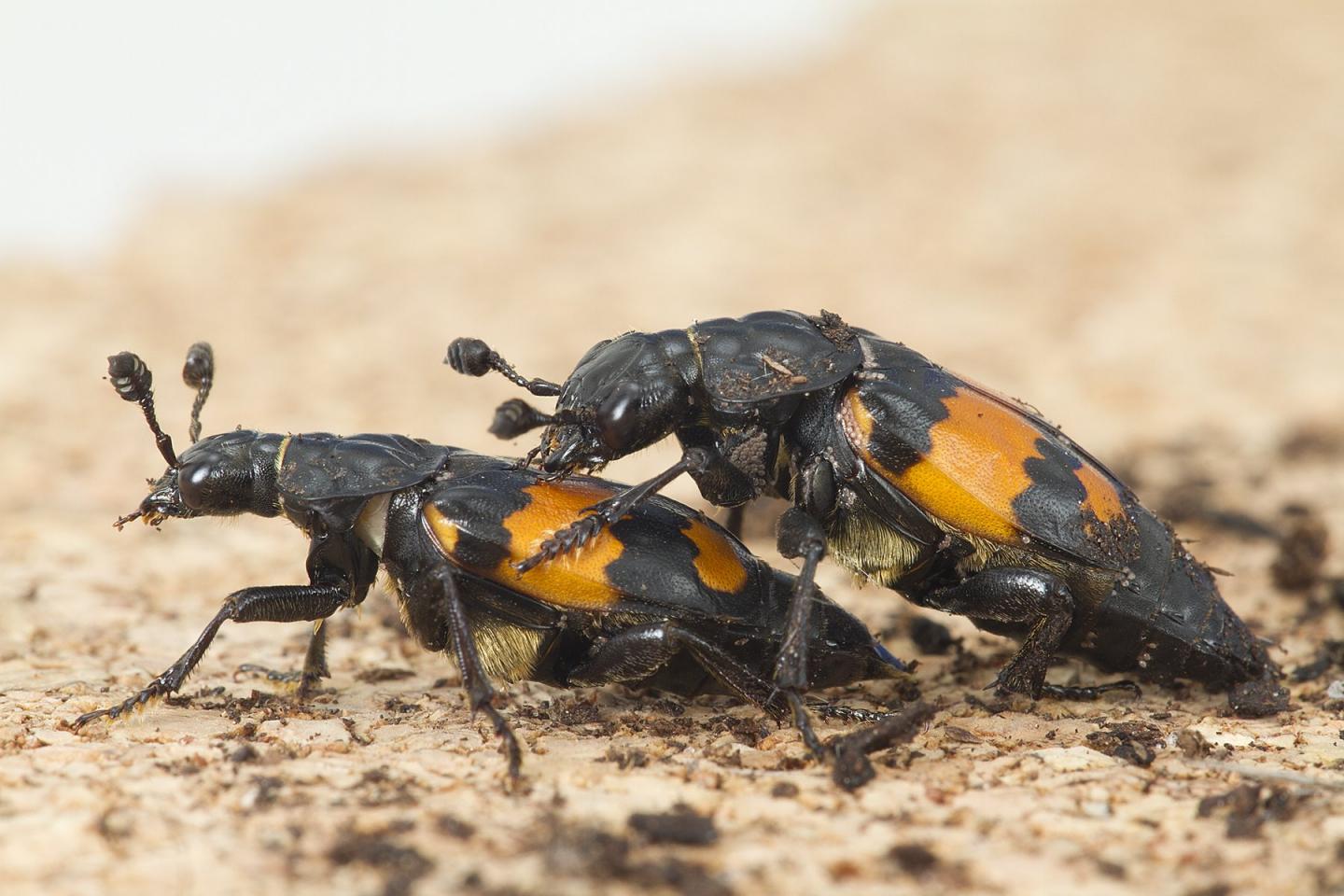
Males that mate more often are more insecure about their social status than those mating less, according to new research on the behaviour of burying beetles.

The study provides new evidence that the social sensitivity of male behavior is linked to how often male beetles mate.

Male burying beetles actively compete with each other for access to breeding resources such as dead mice, and when they find a suitable carcass will emit pheromones as a signal to attract females. But the emission of pheromones may also attract other males, leading to competition. Success in competition is determined by size: the larger you are compared to your rival, the more likely you will win out.

Researchers from Manchester, working with scientists in California, have found that certain molecules long thought to promote cancer growth, in fact suppress tumours, suggesting that therapeutic approaches should aim to restore, rather than block, their activity.

The protein kinase C (PKC) family of molecules are enzymes that facilitate a range of cellular processes, including cell survival, proliferation, migration and death. In the 1980s it was found that PKCs were activated by cancer-causing phorbol esters, and led to the conclusion that PKCs themselves induced the development of tumours.

Nearly three out of four Chinese adults have poor cardiovascular health, with poor diet and growing rates of obesity compounding the risks associated with continuing high rates of smoking, according to a new survey published in the Journal of the American College of Cardiology.

The 2010 China Noncommunicable Disease Surveillance Group collected cardiovascular health data from a nationally representative sample of more than 96,000 men and women in the general Chinese population. According to estimates derived from the survey results, just 0.2 percent of Chinese men and women enjoy "ideal" cardiovascular health as defined by the American Heart Association's seven health behaviors/health factors.

In an analysis of about 2,600 hospitalizations for severe sepsis, readmissions within 90 days were common, and approximately 40 percent occurred for diagnoses that could potentially be prevented or treated early to avoid hospitalization, according to a study in the March 10 issue of JAMA.

The prevalence of type 2 diabetes among 25,000 patients with familial hypercholesterolemia (a genetic disorder characterized by high low-density lipoprotein [LDL] cholesterol levels) was significantly lower than among unaffected relatives, with the prevalence varying by the type of gene mutation, according to a study in the March 10 issue of JAMA.

Computers that function like the human brain could soon become a reality thanks to new research using optical fibres made of speciality glass.

The research, published in Advanced Optical Materials, has the potential to allow faster and smarter optical computers capable of learning and evolving.

Researchers from the Optoelectronics Research Centre (ORC) at the University of Southampton, UK, and Centre for Disruptive Photonic Technologies (CDPT) at the Nanyang Technological University (NTU), Singapore, have demonstrated how neural networks and synapses in the brain can be reproduced, with optical pulses as information carriers, using special fibres made from glasses that are sensitive to light, known as chalcogenides.