Banner
Here's Where Your Backyard Was 300 Million Years Ago

We may use terms like "grounded" and terra firma to mean stability and consistency but geology...

Convergent Evolution Cheat Sheet Now 120 Million Years Old

One tenet of natural selection is a random walk of genes but nature may be more predictable than...

Synchrotron Could Shed Light On Exotic Dark Photons

There are many hypothetical particles proposed to explain dark matter and one idea to explore how...

The Pain Scale Is Broken But This May Fix It

Chronic pain is reported by over 20 percent of the global population but there is no scientific...

User picture.
News StaffRSS Feed of this column.

News Releases From All Over The World, Right To You... Read More »

Blogroll

Muscles necessary for breathing need a greater amount of oxygen in women than in men, according to a study published today in The Journal of Physiology.

Researchers found that at submaximal and maximal exercise intensities, respiratory muscles (muscles necessary for breathing, such as the diaphragm and muscles surrounding the ribcage) consume a greater amount of oxygen in women compared with men. This means that women use more energy when breathing because a significantly greater part of total oxygen is directed to the respiratory muscles.

Crops and other plants are constantly faced with adverse environmental conditions, such as rising temperatures (2014 was the warmest year on record) and lessening fresh water supplies, which lower yield and cost farmers billions of dollars annually.

Drought is a major environmental stress factor affecting plant growth and development. When plants encounter drought, they naturally produce abscisic acid (ABA), a stress hormone that inhibits plant growth and reduces water consumption. Specifically, the hormone turns on a receptor (special protein) in plants when it binds to the receptor like a hand fitting into a glove, resulting in beneficial changes - such as the closing of guard cells on leaves, called stomata, to reduce water loss - that help the plants survive.

There is no time to waste when it comes to stroke. The more time that passes between stroke onset and treatment, the worse the outcome is for the patient. A study designed to test the benefits of early administration of magnesium sulfate suggests that stroke patients may not have to wait until they get to the hospital for treatment -- paramedics may be able to start therapy as soon as stroke is suspected. Although the drug did not improve outcome in stroke patients, the study demonstrated the feasibility of early therapy in the ambulance. The results were published in the New England Journal of Medicine and the study was funded by the National Institute of Neurological Disorders and Stroke (NINDS), part of the National Institutes of Health.

The folks in Boston might feel like they are having a run of bad weather now, but it's nothing like the intense hurricanes, fueled by warmer oceans, that frequently pounded the region during the first millennium, from the peak of the Roman Empire into the height of the Middle Ages, according to a new study.
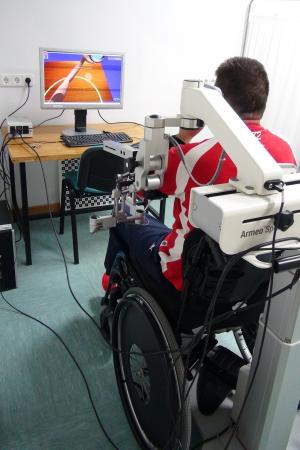
People who suffer motor disability may soon get a high-technology boost from neurorobotics, neuroprosthetics and virtual reality.

The HYPER research project, with a budget of 5 million euros and the participation of the IK4 R&D Alliance under the coordination of the Spanish National Scientific Research Council (CSIC), has been running since 2010 and has led to the development of systems that facilitate new rehabilitation therapies and ways to compensate for gait in patients who have had spinal cord injuries or cerebral strokes.

Various prototypes have been developed and one of them is undergoing a preliminary clinical validation process with 10 patients with spinal cord injuries at the National Hospital for Paraplegics in Toledo.
High-powered microwave devices are designed to transfer energy to targets via ultra-high-frequency radio waves, in civil applications, such as radar and communication systems, heating and current drive of plasmas in fusion devices, and acceleration in high-energy linear colliders.

They can also be used for military purpose in directed-energy weapons or missile guidance systems.