Banner
Here's Where Your Backyard Was 300 Million Years Ago

We may use terms like "grounded" and terra firma to mean stability and consistency but geology...

Convergent Evolution Cheat Sheet Now 120 Million Years Old

One tenet of natural selection is a random walk of genes but nature may be more predictable than...

Synchrotron Could Shed Light On Exotic Dark Photons

There are many hypothetical particles proposed to explain dark matter and one idea to explore how...

The Pain Scale Is Broken But This May Fix It

Chronic pain is reported by over 20 percent of the global population but there is no scientific...

User picture.
News StaffRSS Feed of this column.

News Releases From All Over The World, Right To You... Read More »

Blogroll

Older people are continuing to enjoy active sex lives well into their seventies and eighties, according to new research from The University of Manchester and NatCen Social Research.

More than half (54%) of men and almost a third (31%) of women over the age of 70 reported they were still sexually active, with a third of these men and women having frequent sex - meaning at least twice a month - according to data from the latest wave of the English Longitudinal Study of Ageing (ELSA).

The paper, lead authored by Dr. David Lee, an Age UK Research Fellow at The University of Manchester's School of Social Sciences and entitled Sexual health and wellbeing among older men and women in England, is published in the American academic journal, Archives of Sexual Behavior.

A new study by researchers heightens concerns over the detrimental impact of the apolipoprotein E (APOE) ε4 allele -- the most prevalent genetic risk for Alzheimer's disease -- upon cognition, olfaction, and metabolic brain indices in healthy urban children and teens.

A new study led by scientists at the Woods Hole Oceanographic Institution (WHOI) points to the deep ocean as a major source of dissolved iron in the central Pacific Ocean. This finding highlights the vital role ocean mixing plays in determining whether deep sources of iron reach the surface-dwelling life that need it to survive.

"Our study is a long-term view--over the past 76 million years--of where iron has been coming from in the central Pacific," says Tristan Horner, a postdoctoral fellow in the Marine Chemistry and Geochemistry Department at WHOI and lead author of the paper to be published February 3, 2015, in Proceedings of the National Academy of Sciences.

The American pika, a small animal with a big personality that has long delighted hikers and backpackers, is disappearing from low-elevation sites in California mountains, and the cause appears to be climate change, according to a new study.

Researchers surveyed 67 locations with historical records of pikas and found that the animals have disappeared from ten of them (15 percent of the sites surveyed). Pika populations were most likely to go locally extinct at sites with high summer temperatures and low habitat area, said Joseph Stewart, a graduate student at UC Santa Cruz and first author of a paper reporting the new findings, published January 29 in the Journal of Biogeography.

Last month, we got treated to three of Jupiter's moons - Europa, Callisto and Io - parading across the giant gas planet's banded face.

There are four Galilean satellites - named after the 17th century astronomer Galileo Galilei who discovered them among the  first observations ever made with a telescope. They complete orbits around Jupiter ranging from two to seventeen days in duration and can commonly be seen transiting the face of Jupiter and casting shadows onto its layers of cloud. Seeing three of them transiting the face of Jupiter at the same time is less common, occurring only once or twice a decade in most cases. It last happened in 2013.
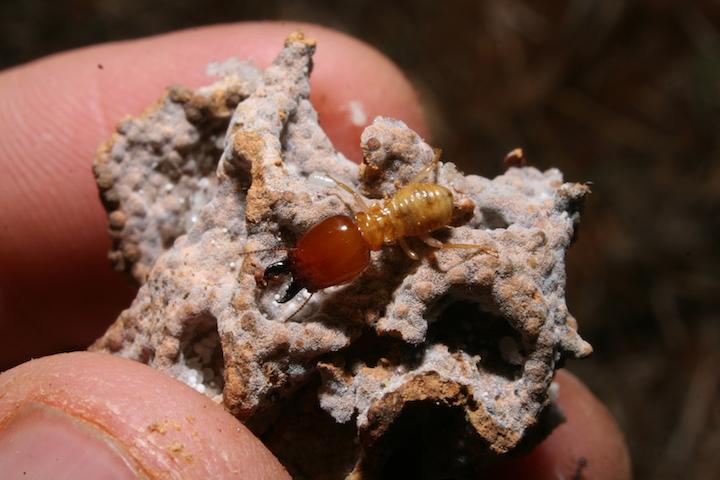
If you own a home, termites are the enemy, but if you want to hold back a desert, their large dirt mounds can be crucial to protecting semi-arid ecosystems and agricultural lands.

That's obviously important for feeding people and insert obligatory global warming reference here, because it means those areas could be a lot more resilient to changing climates than climate scientists believe.