Banner
Here's Where Your Backyard Was 300 Million Years Ago

We may use terms like "grounded" and terra firma to mean stability and consistency but geology...

Convergent Evolution Cheat Sheet Now 120 Million Years Old

One tenet of natural selection is a random walk of genes but nature may be more predictable than...

Synchrotron Could Shed Light On Exotic Dark Photons

There are many hypothetical particles proposed to explain dark matter and one idea to explore how...

The Pain Scale Is Broken But This May Fix It

Chronic pain is reported by over 20 percent of the global population but there is no scientific...

User picture.
News StaffRSS Feed of this column.

News Releases From All Over The World, Right To You... Read More »

Blogroll

A generation ago, there were awareness campaigns to tell people with an irregular heartbeats to go to the emergency room to prevent possible heart attacks.

It worked. People now go to the emergency room as they have been told but with the gradual government takeover of health care there is sudden concern about the costs of these visits. Atrial fibrillation is the most common kind of arrhythmia or irregular heartbeat and can lead to blood clots, stroke, heart failure and other heart-related complications. 

At the American Heart Association's Scientific Sessions 2014, researchers analyzed patients from the Nationwide Emergency Department Data who visited the emergency department with AF listed as the first diagnosis in 2006-11. They found:

Since the year 2000, mortality rates for heart disease declined by almost 4 percent even as higher blood pressure and obesity role, according to a new paper in JAMA.

Matthew D. Ritchey, D.P.T., of the Centers for Disease Control and Prevention (CDC), Atlanta, and colleagues examined the contributions of heart disease subtypes, such as coronary HD (CHD) mortality, to overall heart disease (HD) mortality trends during 2000-2010. 

Up to 50 percent of patients with heart failure have normal or near-normal ejection fraction, termed heart failure with preserved ejection fraction (HFPEF).

The risk of death in HFPEF may be as high as in heart failure with reduced ejection fraction (HFREF), but there is no proven therapy.

Beta-blockers improve outcomes in HFREF and may be beneficial in HFPEF, but data are sparse and inconclusive, and beta-blockers are currently not indicated for treating HFPEF, according to background information in the article.

Breathing secondhand marijuana smoke could damage your heart and blood vessels as much as secondhand cigarette smoke, according to preliminary research presented at the American Heart Association's Scientific Sessions 2014.

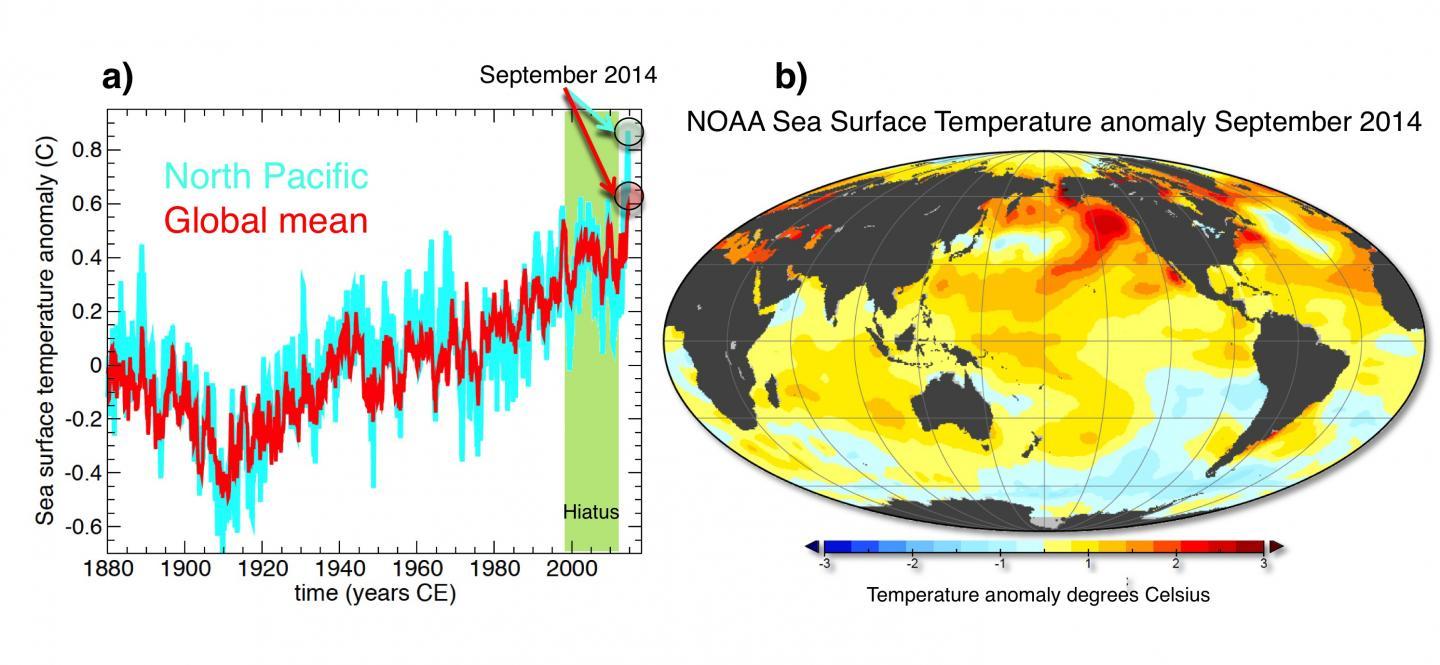
From 2000-2013 the global ocean surface temperature did not rise in spite of increasing greenhouse gas concentrations. This Global Warming Hiatus generated a lot of public and scientific interest and no small amount of skepticism about the accuracy of the numerical models created by climate scientists. But data is another matter entirely and as of April 2014 ocean warming has picked up speed again, according to a new analysis of ocean temperature datasets.  

When two
giant LIGO detectors
are switched on in the US next year, they will help scientists pick up the faint ripples of black hole collisions millions of years ago, known as gravitational waves. 

Black holes cannot be seen, but scientists hope the revamped detectors, which act like giant microphones, will find remnants of black hole collisions - and theoretical physicists hope experimentalists will give validation for their numerical model.