Banner
Here's Where Your Backyard Was 300 Million Years Ago

We may use terms like "grounded" and terra firma to mean stability and consistency but geology...

Convergent Evolution Cheat Sheet Now 120 Million Years Old

One tenet of natural selection is a random walk of genes but nature may be more predictable than...

Synchrotron Could Shed Light On Exotic Dark Photons

There are many hypothetical particles proposed to explain dark matter and one idea to explore how...

The Pain Scale Is Broken But This May Fix It

Chronic pain is reported by over 20 percent of the global population but there is no scientific...

User picture.
News StaffRSS Feed of this column.

News Releases From All Over The World, Right To You... Read More »

Blogroll
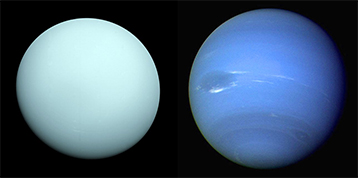
A team of researchers has proposed a solution to the problematic chemical composition of Neptune and Uranus, perhaps providing clues for understanding their formation.

Uranus and Neptune, which post-Pluto are considered the outermost planets in the Solar System by the International Astronomical Union, each have a mass approximately fifteen times that of the Earth and consist of up to 90% ice, with highly enriched in carbon. 
A human child can look at a cartoon picture of a chicken and recognize it is a chicken, but that is a show-stopper for machine learning. Unless it matches a cartoon chicken programmed in, it will not understand cartoon chicken-ness.

Devi Parikh of Virginia Tech has been given $92,000 of unrestricted funding by Google to work directly with Google researchers and engineers as they explore how to best teach machines from visual abstractions. Obviously if anything comes of it, that will be a real bargain.


Image: freepik.com
There is less saline in Nordic Seas but that can't be blamed on more Arctic waters due to global warming. Instead, it is that the Gulf Stream has provided less salt.

 The Nordic Seas have freshened substantially since 1950. This has happened at the same time as there has been observed increased river runoff and net ice melting in the Arctic. The concurrence of a less saline ocean and Arctic freshwater input has given the climate research community reason for concern, but a new study finds that the source of fresher Nordic Seas since 1950 is rooted in the saline Atlantic, as opposed to Arctic freshwater that is the common inference.

In a region where modern humans are believed to have originated roughly 200,000 years ago,    DNA from the skeleton of a man who lived 2,330 years ago has a DNA profile that places it among the 'earliest diverged' – oldest in genetic terms – found to-date. 

Somehow the group broke off early in human evolution and became geographically isolated so the skeleton is modern, but its DNA is old.

Epigenetics has been used and abused in many ways - can it tell researchers that an expectant mother had no electricity for a few days?

In January of 1998, what came to be called the North American Ice Storm of 1998 occurred. It knocked out power for days in cities and weeks in remote areas, impacting up to 4 million people. It was so worrisome that the government, concerned about panic among peaceful Canadians, deployed nearly 25 percent of its armed forces to keep peace in Quebec.

We know our bodies don't just change in size, which makes it an effective metric in a world in motion.

Psychologists have found that people tend to perceive their dominant hand as staying relatively the same size even when it's magnified, lending support to the idea that we use our hand as a constant perceptual "ruler" to measure the world around us.

To size up the world around us, we need to be able to translate the information that comes in through our eyes into units that are relevant to our everyday lives. The body is a particularly effective metric because it allows us to relate information about object size to actions that we're able to perform on or with the object.