Banner
Here's Where Your Backyard Was 300 Million Years Ago

We may use terms like "grounded" and terra firma to mean stability and consistency but geology...

Convergent Evolution Cheat Sheet Now 120 Million Years Old

One tenet of natural selection is a random walk of genes but nature may be more predictable than...

Synchrotron Could Shed Light On Exotic Dark Photons

There are many hypothetical particles proposed to explain dark matter and one idea to explore how...

The Pain Scale Is Broken But This May Fix It

Chronic pain is reported by over 20 percent of the global population but there is no scientific...

User picture.
News StaffRSS Feed of this column.

News Releases From All Over The World, Right To You... Read More »

Blogroll

Boron deficiency is a common cause of reduced crop yields in places like Missouri and the eastern half of the United States. It is common for corn and soybean farmers to supplement their soil with boron and now researchers at the University of Missouri have found that boron plays an integral role in development and reproduction in corn plants.

The researchers anticipate that understanding how corn uses the nutrient can help farmers make informed decisions in boron deficient areas and improve crop yields.


For patients with advanced Parkinson disease who have involuntary movements, deep brain stimulation has been found to be an effective treatment for reducing motor disability and improving quality of life. 

Some recent studies suggest that
deep brain stimulation
plus medical therapy is better than medical therapy alone for patients with  Parkinson disease and early motor complications. Most clinical studies have excluded patients older than 75 years of age, although no specific age cutoff has been set. 

Feeling stressed out? Blame your great-grandparents.

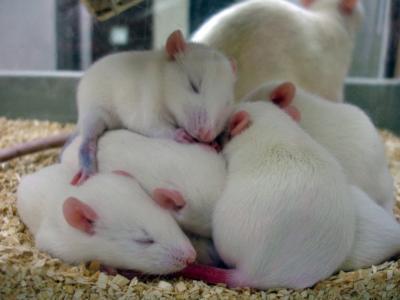
Psychologists have linked ancestral exposure by a common fungicide, vinclozolin, to the stress levels of rats generations later. Epigenetically. Vinclozolin is a fungicide commonly used by farmers to ward off rots, molds and blights. 

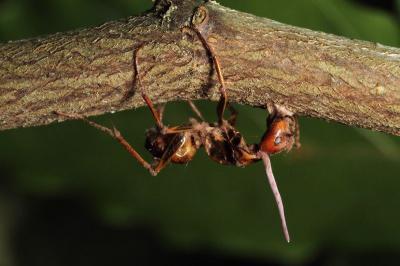
A parasitic fungus that reproduces by manipulating the behavior of ants emits a cocktail of behavior-controlling chemicals when encountering the brain of its natural target host, but not when infecting other ant species, a new study shows.

The findings, which suggest that the fungus "knows" its preferred host, provide new insights into the molecular mechanisms underlying this phenomenon, according to researchers.

"Fungi are well known for their ability to secrete chemicals that affect their environment," noted lead author Charissa de Bekker, a Marie Curie Fellow in Penn State's College of Agricultural Sciences, and Ludwig Maximilian of the University of Munich. "So we wanted to know what chemicals are employed to control so precisely the behavior of ants."

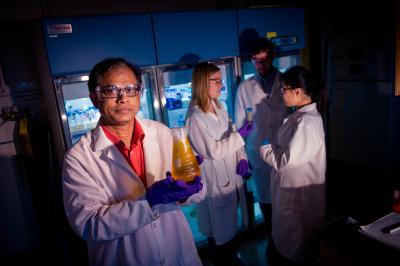
A certain type of biomolecule, called a glycoconjugate,  is built like a nano-Christmas tree. Its many branches are bedecked with sugary ornaments that get all the glory. That's because, according to conventional wisdom, the glycoconjugate's lowly "tree" basically holds the sugars in place as they do the important work of reacting with other molecules.

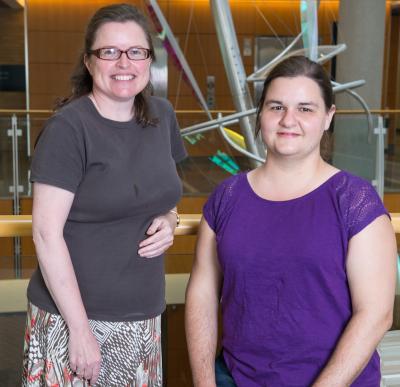
A chemist at Michigan Technological University has discovered that the tree itself — the scaffold — is a good deal more than a simple prop.