Banner
Here's Where Your Backyard Was 300 Million Years Ago

We may use terms like "grounded" and terra firma to mean stability and consistency but geology...

Convergent Evolution Cheat Sheet Now 120 Million Years Old

One tenet of natural selection is a random walk of genes but nature may be more predictable than...

Synchrotron Could Shed Light On Exotic Dark Photons

There are many hypothetical particles proposed to explain dark matter and one idea to explore how...

The Pain Scale Is Broken But This May Fix It

Chronic pain is reported by over 20 percent of the global population but there is no scientific...

User picture.
News StaffRSS Feed of this column.

News Releases From All Over The World, Right To You... Read More »

Blogroll

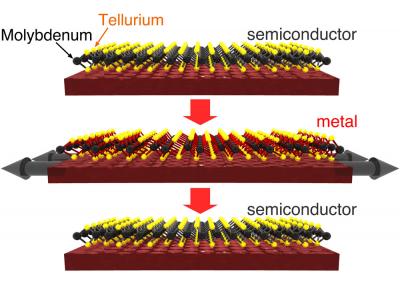
Stanford researchers envision a crystal that can form a monolayer three atoms thick. Their computer simulations show that this crystal, molybdenum ditelluride, can act like a switch: its crystal lattice can be mechanically pulled and pushed, back and forth, between two different atomic structures -- one that conducts electricity well, the other that does not. 

The switchable material is formed when one atomic layer of molybdenum atoms gets sandwiched between two atomic layers of tellurium atoms. Molybdenum and tellurium are elements that are currently used as additives for making alloys, such as steel. Tellurium is also a component of many modern solar cells.

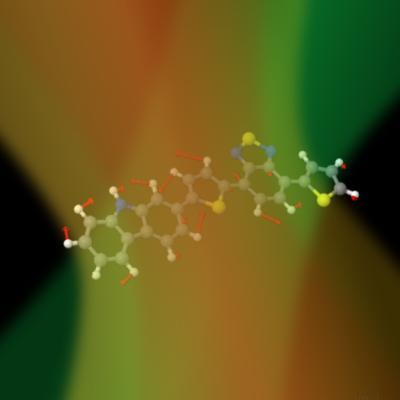
We all have some idea how solar panels work by now; a photovoltaic cell gets bombarded by photons from the sun, which knocks loose electrons that flow as electricity, hopefully while wasting as little energy in the form of heat as possible.

Beyond that, it's a topic of research in order to try and create panels that are less damaging to the environment while hoping to protect the environment.

Oddly, that might mean plastic. 

The dominant hypothesis for the reason that northern Europeans developed light skin is that they needed to absorb more ultraviolet (UV) light to make more vitamin D, which is vital for healthy bones and immune function.

Not so, says a U.C. San Francisco dermatologist.  Peter Elias, MD, and colleagues write in Evolutionary Biology that changes in the skin's function as a barrier to the elements made a greater contribution than alterations in skin pigment in the ability of northern Europeans to make vitamin D. They write that genetic mutations compromising the skin's ability to serve as a barrier allowed fair-skinned Northern Europeans to populate latitudes where too little ultraviolet B (UVB) light for vitamin D production penetrates the atmosphere.

Though the central coast of California is some of the best farmland in the world, organic farmers who don't want to use modern science have a difficult time producing crops for their $35 billion and growing in corporate customers.

Yet science can help there also. Cover crops can provide weed and erosion control so scientifically determining the best method for establishing a uniform and dense cover crop stand as soon as possible after planting is a critical first step.

A child's illness and hospitalization is stressful for children and their parents and also clinicians. 

20 years ago, the Four Habits Model of Highly Effective Clinicians, a core set of communication skills developed to help physicians communicate with patients, was co-created by Regenstrief Institute sociologist Richard Frankel, Ph.D. A new study reports that the Four Habits Model can successfully prepare inexperienced nurses for emotionally difficult conversations with parents of pediatric patients. 

If you own an electric car, you spend a lot of time thinking about where you will recharge it - and how long it will take. In Silicon Valley, where electric cars are the newest fad, charge rage is leading to lost productivity due to hostile emails about someone being hooked up to a parking lot charger for too long. Being stuck on 880 is bad enough without being stranded too.

Chemists say they have synthesized a new material that could show the way forward to lithium-sulfur batteries and that could mean actually driving somewhere meaningful.