Banner
Here's Where Your Backyard Was 300 Million Years Ago

We may use terms like "grounded" and terra firma to mean stability and consistency but geology...

Convergent Evolution Cheat Sheet Now 120 Million Years Old

One tenet of natural selection is a random walk of genes but nature may be more predictable than...

Synchrotron Could Shed Light On Exotic Dark Photons

There are many hypothetical particles proposed to explain dark matter and one idea to explore how...

The Pain Scale Is Broken But This May Fix It

Chronic pain is reported by over 20 percent of the global population but there is no scientific...

User picture.
News StaffRSS Feed of this column.

News Releases From All Over The World, Right To You... Read More »

Blogroll

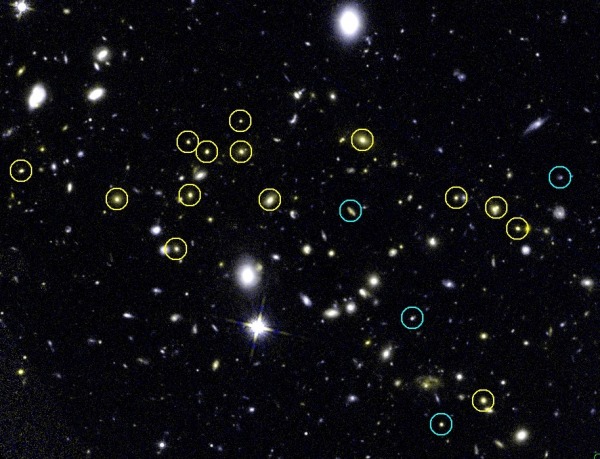
The structures and star populations of massive galaxies appear to change as they age, but much about how these galaxies formed and evolved remains mysterious. Many of the oldest and most massive galaxies reside in clusters, enormous structures where numerous galaxies are found concentrated together. Galaxy clusters in the early universe are thought to be key to understanding the lifecycles of old galaxies, but to date astronomers have located only a handful of these rare, distant structures.

New research from a team led by Carnegie's Andrew Newman has confirmed the presence of an unusually distant galaxy cluster, JKCS 041. It is published in the Astrophysical Journal

WASHINGTON, May 21, 2014—Dark alleys might not feel so dangerous someday thanks to a new ultra-thin type of lens, which could pave the way to making smaller and cheaper heat-sensing imagers. A team of French researchers has found a way to make a thermal infrared (IR) camera with a lens made of silicon, a much less expensive material than is commonly used today.

Washington, DC (May 22, 2014) — Patients with a certain form of kidney disease may have a reduced risk of cancer compared with patients with other kidney diseases, according to a study appearing in an upcoming issue of the Journal of the American Society of Nephrology (JASN).

Polycystic kidney disease (PKD) is a kidney disorder passed down through families in which many cysts form in the kidneys, causing them to become enlarged. It's thought to have cancer-like features, but cancer risk has never been compared between PKD patients and others with kidney disease. Cancer risk is also elevated in people who have received a kidney transplant, due to the immunosuppressive drugs they must take.

Scientists at the U.S. Department of Energy's Argonne National Laboratory have discovered a previously unknown phase in a class of superconductors called iron arsenides. This sheds light on a debate over the interactions between atoms and electrons that are responsible for their unusual superconductivity.

"This new magnetic phase, which has never been observed before, could have significant implications for our understanding of unconventional superconductivity," said Ray Osborn, an Argonne physicist and coauthor on the paper.

BETHESDA, MD – May 23, 2014 – A new approach to studying microbes in the wild will allow scientists to sequence the genomes of individual species from complex mixtures. It marks a big advance for understanding the enormous diversity of microbial communities —including the human microbiome. The work is described in an article published May 22 in Early Online form in the journal G3: Genes|Genomes|Genetics, published by the Genetics Society of America.

"This new method will allow us to discover many currently unknown microbial species that can't be grown in the lab, while simultaneously assembling their genome sequences," says co-author Maitreya Dunham, a biologist at the University of Washington's Department of Genome Sciences.

Conventional oil and gas development in northern Pennsylvania altered bird communities, and the current massive build-out of shale-gas infrastructure may accelerate these changes, according to researchers in Penn State's College of Agricultural Sciences.
The commonwealth's Northern Tier -- one of the largest blocks of Eastern deciduous forest in the entire Appalachian region -- is an important breeding area for neotropical migrant songbirds. These diminutive, insect-eating creatures, which breed in Pennsylvania and winter in Central and South America, contribute greatly to the health of forests.