Banner
Here's Where Your Backyard Was 300 Million Years Ago

We may use terms like "grounded" and terra firma to mean stability and consistency but geology...

Convergent Evolution Cheat Sheet Now 120 Million Years Old

One tenet of natural selection is a random walk of genes but nature may be more predictable than...

Synchrotron Could Shed Light On Exotic Dark Photons

There are many hypothetical particles proposed to explain dark matter and one idea to explore how...

The Pain Scale Is Broken But This May Fix It

Chronic pain is reported by over 20 percent of the global population but there is no scientific...

User picture.
News StaffRSS Feed of this column.

News Releases From All Over The World, Right To You... Read More »

Blogroll

Home can sometimes literally be in the kitchen.

A Puerto Rican community - in Connecticut of all places - creates cuisine authentic it has caught the attention of scientists.

Like immigrants throughout history who ventured forth with their favorite plants in tow, the Puerto Ricans of Hartford maintain cuisine as an important component of their identity. But this strong relationship to food has had a profound impact on human health by reshaping environmental biodiversity, influencing the diets of neighbors, and preserving elements of culture, according to botanists David W. Taylor and Gregory J. Anderson.

Without knowing it, organisms search for the next “winning” strategy in evolution. Mutation plays a key role in the evolution of new, and sometimes successful, traits. It's a lot like rock-paper-scissors - roshambo.(1)
A study by has determined that, on average nationally, minorities are exposed to 38 percent higher levels of nitrogen dioxide (NO2) outdoor air pollution compared to white people.

Nitrogen dioxide comes from sources like vehicle exhaust and power plants. Breathing NO2 is linked to asthma symptoms and heart disease. The Environmental Protection Agency has listed it as one of the seven key air pollutants it monitors. The researchers studied NO2 levels in urban areas across the country and compared specific areas within the cities based on populations defined in the U.S. Census as “nonwhite” or “white.”
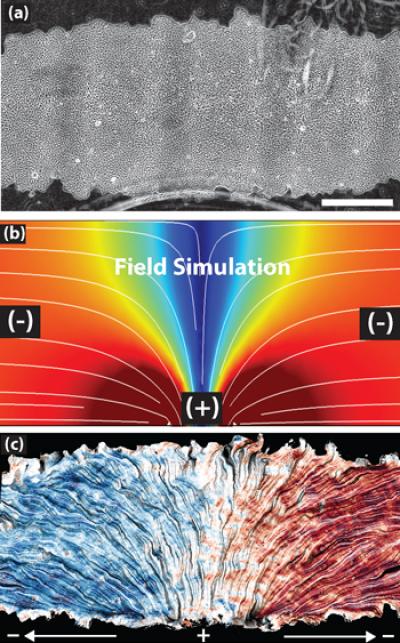
Researchers have used an electrical current to orchestrate the flow of a group of cells, an achievement that could establish the basis for more controlled forms of tissue engineering and for potential applications such as "smart bandages" that use electrical stimulation to help heal wounds.

In the experiments, the researchers used single layers of epithelial cells, the type of cells that bind together to form robust sheathes in skin, kidneys, cornea and other organs. They found that by applying an electric current of about five volts per centimeter, they could encourage cells to migrate along the direct current field. 
Kids know it is wrong to steal stuff - they also seem to know it's wrong to steal an idea. They just discover it a little later.

University of Washington psychologist Kristina Olson and colleagues discovered that preschoolers often don't view a copycat negatively but by the age of 5 or 6, they do. It holds true even across cultures that typically view intellectual property rights in different ways, like in Germany where they violate international trademarks and hold a Science 2.0 conference and, worse, charge people to attend.

Researchers at the University of California, San Diego School of Medicine have identified a mechanism that explains why people with the hepatitis C virus get liver disease and why the virus is able to persist in the body for so long.

The hard-to-kill pathogen, which infects an estimated 200 million people worldwide, attacks the liver cells' energy centers – the mitochondria – dismantling the cell's innate ability to fight infection. It does this by altering cells mitochondrial dynamics.

The study, published in today's issue of the Proceedings of the National Academy of Sciences, suggests that mitochondrial operations could be a therapeutic target against hepatitis C, the leading cause of liver transplants and a major cause of liver cancer in the U.S.