Banner
Pilot Study: Fibromyalgia Fatigue Improved By TENS Therapy

Fibromyalgia is the term for a poorly-understood condition where people experience pain and fatigue...

High Meat Consumption Linked To Lower Dementia Risk

Older people who eat large amounts of meat have a lower risk of dementia and cognitive decline...

Long Before The Inca Colonized Peru, Natives Had A Thriving Trade Network

A new DNA analysis reveals that long before the Incan Empire took over Peru, animals were...

Mesolithic People Had Meals With More Tradition Than You Thought

The common imagery of prehistoric people is either rooting through dirt for grubs and picking berries...

User picture.
News StaffRSS Feed of this column.

News Releases From All Over The World, Right To You... Read More »

Blogroll

Synthetic surfaces, popularly called Astroturf since the Houston Astrodome made it famous, were introduced in the 1960s to reduce strain on the playing surface and thus reduce field maintenance.

But it was linked to an increase in injuries, one example in football parlance being "turf toe". 

Third generation artificial surfaces behave more like grass and soil but continue to be associated with injuries to the foot, ankle, toe, knee and even concussions. Characteristics of the play surface directly affect how much energy is absorbed by the athlete upon impact and that means shoes are important.

A tiny fossil, the nearly complete skeleton of a bird that would have fit in the palm of your hand and weighed less than an ounce, offers clues to the precursors of swift and hummingbird wings. The fossil
discovered in Wyoming
is unusual in having exceptionally well-preserved feathers, which allowed the researchers to reconstruct the size and shape of the bird's wings in ways not possible with bones alone.

The paleontologists spotted the specimen, which was collected at the Green River Formation, while they were working at the Field Museum of Natural History in Chicago and named it Eocypselus rowei, in honor of John W. Rowe, Chairman of the Field Museum's Board of Trustees.

Are 'smart' objects the future?

People certainly like so-called smart phones, and almost every home in America has a computer, and making everything 'smart' might be a future trend, say humanities scholars at Penn State University.

 As sensors and computers increasingly become smaller and cheaper, smart objects will appear in more homes and offices and not be hidden or shielded from interacting with people, according to the researchers. For example, smart refrigerators could talk or send tweets to signal when certain food items are almost out, or when expiration dates are nearing.

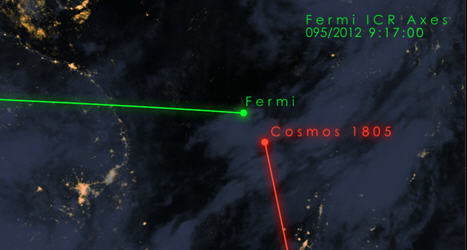
Imagine being the project scientist for a NASA experiment and getting an email telling you that a 3,100 lb. defunct spy satellite dating back to the Cold War might crash into your baby?

That's what happened to Julie McEnery of NASA's Fermi Gamma-ray Space Telescope,  which maps the highest-energy light in the universe, a year ago. When she checked her email on March 29th, 2012,  she had an automatically generated report from NASA's Robotic Conjunction Assessment Risk Analysis (CARA) saying that in about a week Fermi might be hit by Cosmos 1805. 

In the modern regulatory environment, start-ups and smaller companies tend to be less well-known. The costs are increasingly high and its hard to get venture capital funding without  knowing how long it can take to clear government hurdles so if things look promising, companies are acquired instead. 

But some are sticking it out and they are trying to gain momentum as they advance their technologies and produce significant clinical data on the road to eventual commercialization of their technologies. 

As planets age the general rule is that they become darker and cooler - but Saturn is an exception. Why it looks so young for its age has been a space science topic since the late 1960s but a paper in Nature Geoscience says it has some answers.