Banner
Pilot Study: Fibromyalgia Fatigue Improved By TENS Therapy

Fibromyalgia is the term for a poorly-understood condition where people experience pain and fatigue...

High Meat Consumption Linked To Lower Dementia Risk

Older people who eat large amounts of meat have a lower risk of dementia and cognitive decline...

Long Before The Inca Colonized Peru, Natives Had A Thriving Trade Network

A new DNA analysis reveals that long before the Incan Empire took over Peru, animals were...

Mesolithic People Had Meals With More Tradition Than You Thought

The common imagery of prehistoric people is either rooting through dirt for grubs and picking berries...

User picture.
News StaffRSS Feed of this column.

News Releases From All Over The World, Right To You... Read More »

Blogroll

Four new studies have found that when a woman's goal is to be romantically desirable, she is less likely to go into majors and activities related to science, technology, engineering and math (STEM).  The studies were undertaken to determine why women, who have achieved parity in education, getting more Ph.D.s than men, and also in the workplace, continue to be underrepresented at the highest levels of STEM fields.

They found converging support for the idea that when romantic goals are activated women (but not men) show less interest in STEM fields and more interest in feminine fields, such as the humanities, education and social sciences.  

Lead author Lora E.

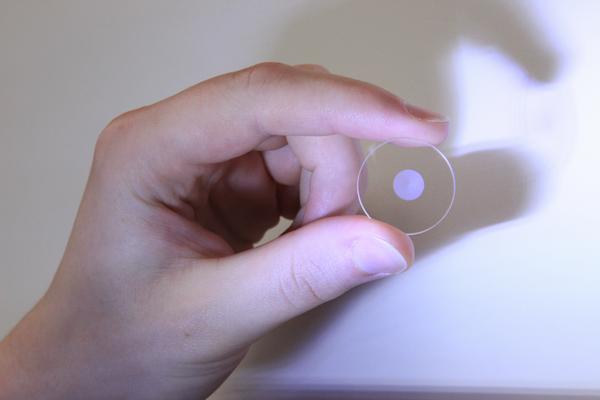
New nano-structured glass optical elements could significantly reduce the cost of medical imaging.

In their Applied Physics Letters paper, the team describes how they have used nano-structures to develop new monolithic glass space-variant polarization converters. These millimeter-sized devices generate ‘whirlpools’ of light enabling precise laser material processing, optical manipulation of atom-sized objects, ultra-high resolution imaging and maybe even table-top particle accelerators. 

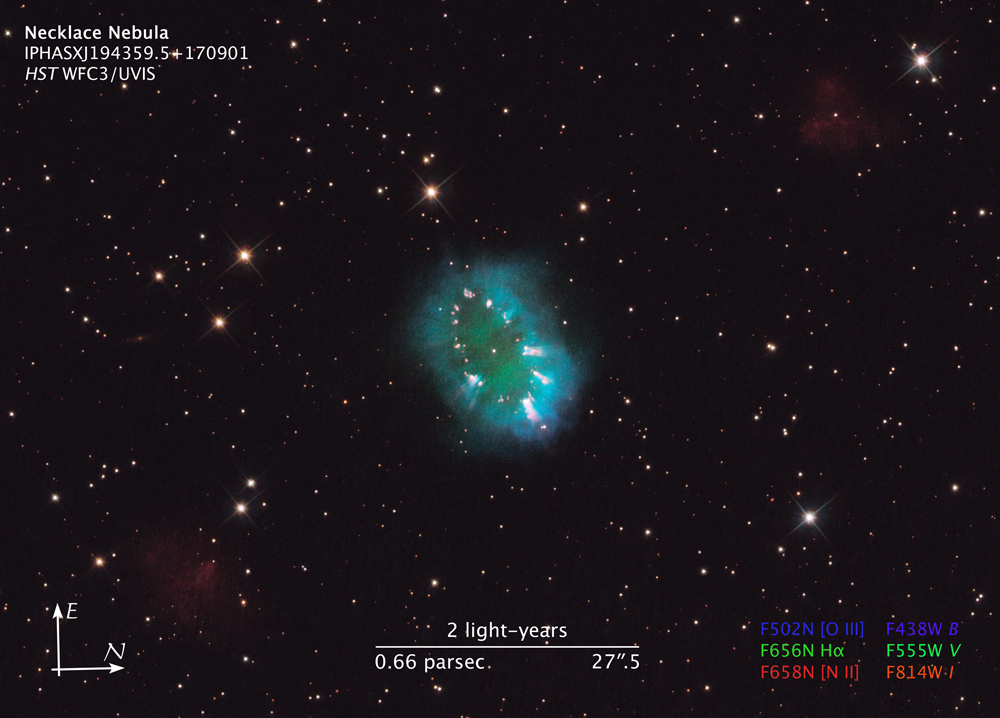
A giant cosmic necklace glows brightly in this NASA Hubble Space Telescope image of an object named (surprise) the Necklace Nebula, a recently discovered planetary nebula which is the glowing remains of an ordinary, Sun-like star. 

The nebula consists of a bright ring, measuring 12 trillion miles across, dotted with dense, bright knots of gas that resemble diamonds in a necklace. The knots glow brightly due to absorption of ultraviolet light from the central stars.

The Necklace Nebula is located 15,000 light-years (4,600 parsecs) away in the constellation Sagitta (the Arrow). In this composite image, taken on July 2, 2011, Hubble's Wide Field Camera 3 captured the glow of hydrogen (blue), oxygen (green), and nitrogen (red).

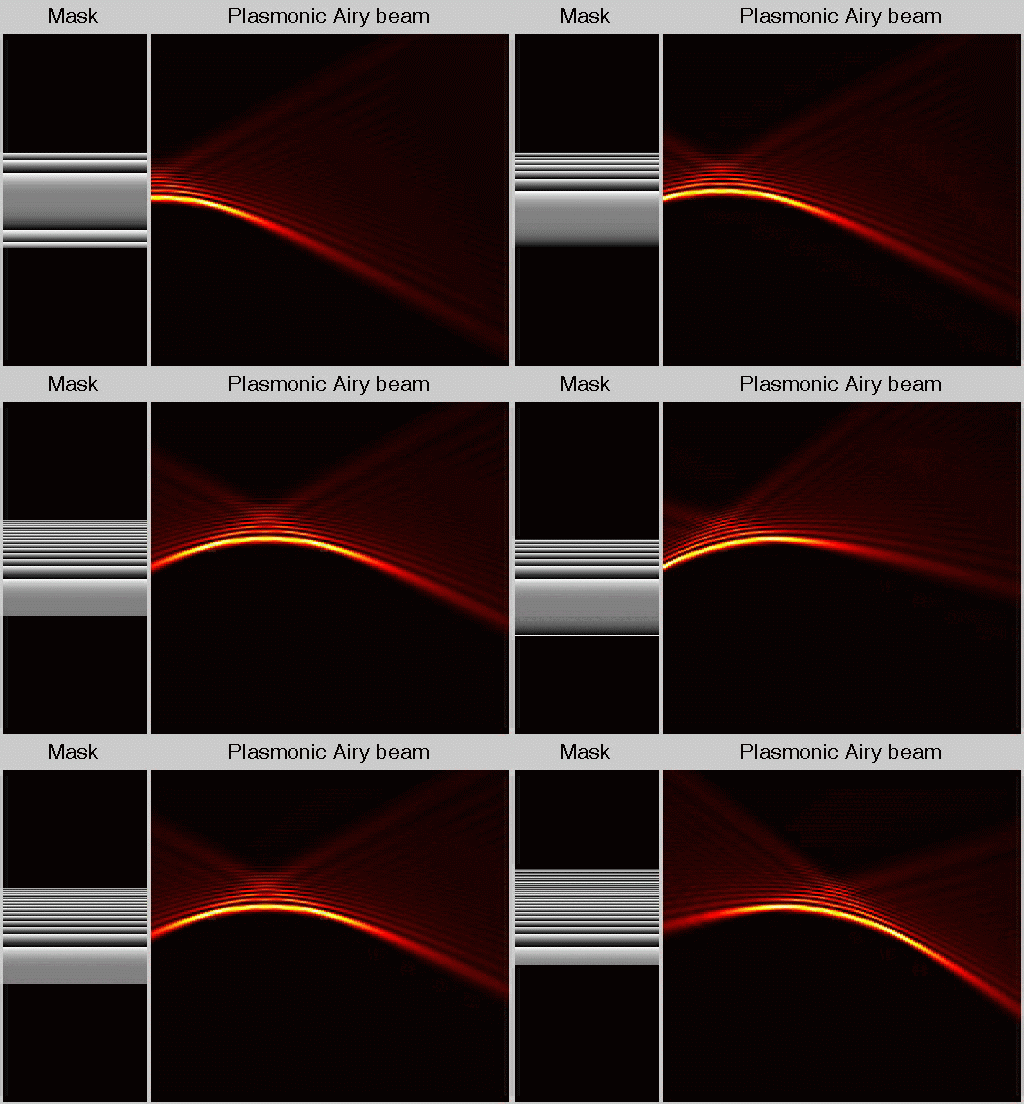
One of the earliest lessons science students learn is that a beam of light travels in a straight line and fan out, or diffract, as they travel. Recently it was discovered that light rays can travel without diffraction in a curved arc in free space. These rays of light were dubbed “Airy beams,” after the English astronomer Sir George Biddell Airy, who studied what appears to be the parabolic trajectory of light in a rainbow.

Now, scientists with the Lawrence Berkeley National Laboratory have demonstrated the first technique that provides dynamic control in real-time of the curved trajectories of Airy beams over metallic surfaces.

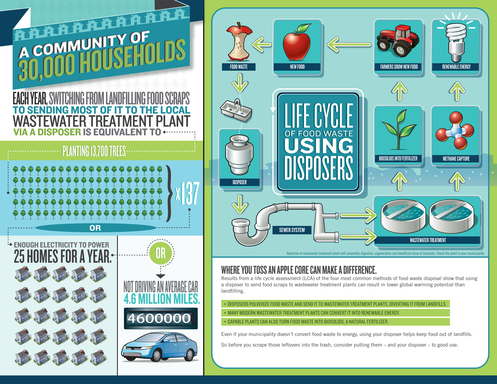
Assuming you don't have the space for a smelly compost heap but want to be as environmentally responsible as possible, what’s the most responsible way to dispose of a banana peel, or any other food waste?

A new study about the impact of various food waste disposal systems says putting it into a garbage disposer results in lower global warming potential than putting it in the trash and sending it to a landfill.

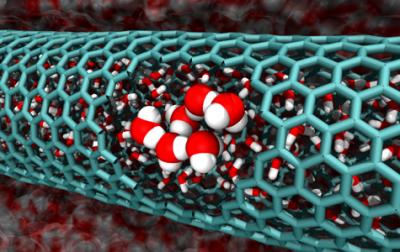
There are rules in making presentations to people - in wine sales, for example, as we outlined in The Science Of Wine And Cheese, you buy on bread and sel on cheese because eating cheese is the way people get the most positive taste.   In science, if the audience wants to be inspired, talk about large motion in space and show Hubble pictures.   If they like the 'physics is soooo weird' kind of science, go small.  There are always strange and unexpected things at the nanoscale, even for the most common materials such as water.