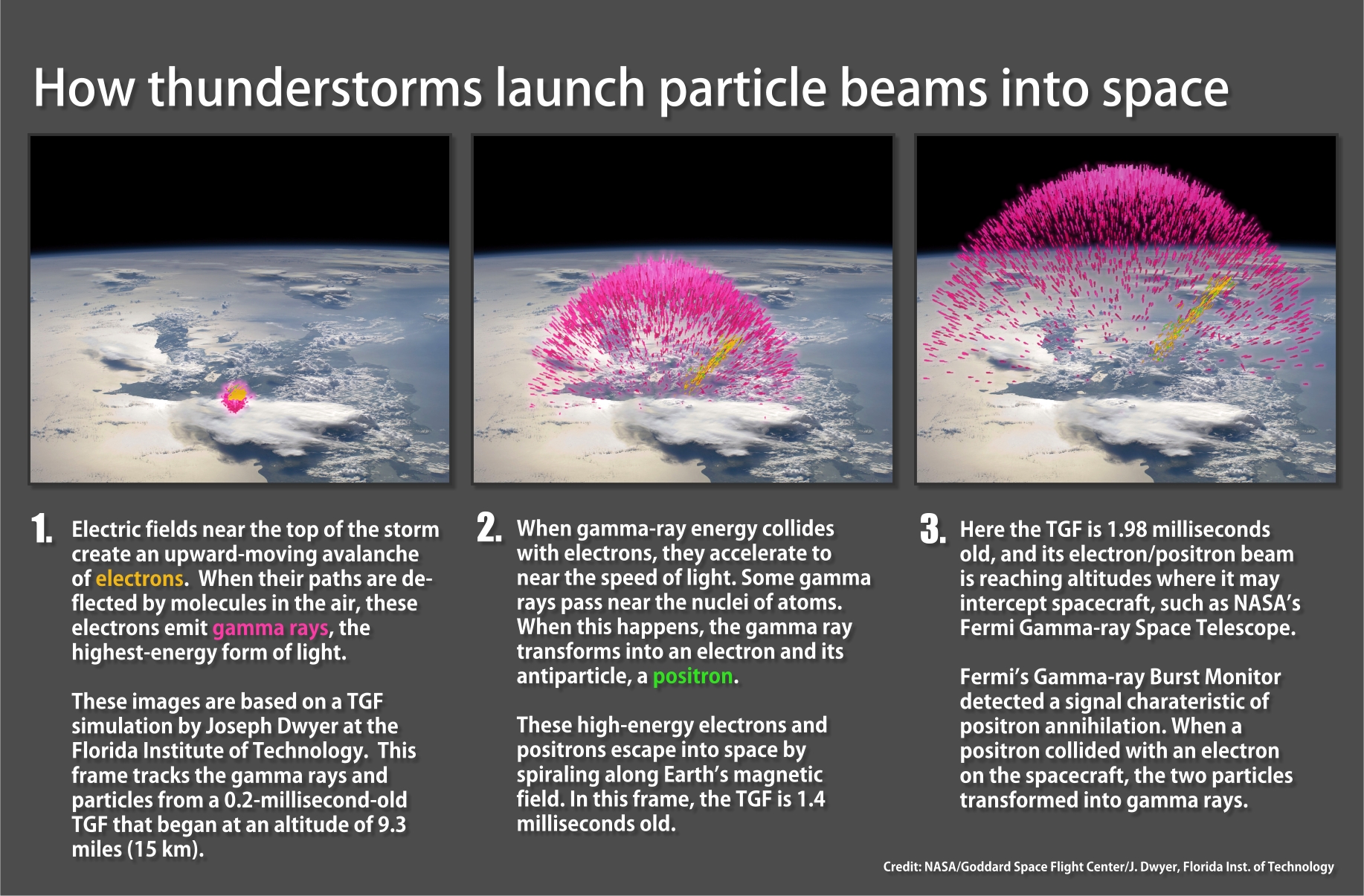
The Fermi Gamma-ray Space Telescope has detected beams of antimatter launched by thunderstorms, which act like enormous particle accelerators and can emit gamma-ray flashes called TGFs - and also high-energy electrons and positrons. TGFs are produced inside thunderstorms and shown to be associated with lightning. It is estimated that about 500 such flashes occur daily worldwide, but most go undetected.
Scientists now think that most TGFs produce particle beams and antimatter.
Hanny's Voorwerp, a strange, glowing green cloud of gas that has mystified astronomers since its discovery in 2007, has gotten a better look by Hubble. The cloud of gas is lit up by the bright light of a nearby quasar and shows signs of ongoing star formation.
Hanny's Voorwerp (Hanny's Object in Dutch) is a mysterious, glowing green blob of gas is floating in space near a spiral galaxy - the size of the Milky Way.
Why haven't antioxidant therapies yielded more positive results? The answer may be that Nrf2, a protein that plays an important role in some antioxidant therapies, may not be as effective due to additional mechanisms that cause it to promote atherosclerosis - clogging of the arteries.
Nrf2 has been thought to be an important drug-therapy target for diseases such as cancer because it can induce chemopreventive activity by attaching to specific sequences of DNA, leading to the release of numerous antioxidant and anti-inflammatory genes and enzymes that can decrease or inhibit the effects of carcinogens.
Without question nanotechnology is a key component in our energy future. In recent years, developers have been investigating light-harvesting thin film solar panels made from nanotechnology and promoting efficiency metrics which they say make the technology marketable but a researcher has challenged recent "charge" measurements for increasing solar panel efficiency.
While we need to invest in the future, we need to make sure there is no hype that promises to increase efficiencies in thin film panels.
Neurons within the brain's neocortex behave much like people in social networks, with a small population of highly active members who give and receive more information than the majority of other members, says Alison Barth, associate professor of biological sciences at Carnegie Mellon in new research. By identifying these neurons, scientists could increase understanding of the neocortex, thought to be the brain's center of higher learning.
The compound resveratrol found in grapes displays not only antioxidant but other positive properties, according to a study published this week in the Journal of Biological Chemistry.
Resveratrol stimulates the expression of adiponectin, a hormone derived from cells that manufacture and store fat, the research team found. Adiponectin has a wide range of beneficial effects on obesity-related medical complications, said senior author Feng Liu, Ph.D., professor of pharmacology at the University of Texas Health Science Center at San Antonio and member of the Barshop Institute of Longevity and Aging Studies at the Health Science Center.


 Pilot Study: Fibromyalgia Fatigue Improved By TENS Therapy
 High Meat Consumption Linked To Lower Dementia Risk
 Long Before The Inca Colonized Peru, Natives Had A Thriving Trade Network
 Mesolithic People Had Meals With More Tradition Than You Thought