Banner
Pilot Study: Fibromyalgia Fatigue Improved By TENS Therapy

Fibromyalgia is the term for a poorly-understood condition where people experience pain and fatigue...

High Meat Consumption Linked To Lower Dementia Risk

Older people who eat large amounts of meat have a lower risk of dementia and cognitive decline...

Long Before The Inca Colonized Peru, Natives Had A Thriving Trade Network

A new DNA analysis reveals that long before the Incan Empire took over Peru, animals were...

Mesolithic People Had Meals With More Tradition Than You Thought

The common imagery of prehistoric people is either rooting through dirt for grubs and picking berries...

User picture.
News StaffRSS Feed of this column.

News Releases From All Over The World, Right To You... Read More »

Blogroll
Most are unaware of it but the evolutionary arms race between plants and plant diseases is always happening around us.  Fungi are a major cause of plant diseases and are responsible for large-scale harvest failure in crops like maize and other cereals all over the world.  

Researchers analyzed the genetic make-up of Sporisorium reilianum, an important maize parasite. Based on a comparison with the genome of a related fungal species, they succeeded in identifying new genes in maize infestation. 
Everyone has heard of "Fahrenheit 451", the classic novel where big government gets its agenda by increasingly taking away rights in order to mandate fairness. 

This article has nothing to do with that.   Instead, it is about measurement of the viscosity of a gas at a few billionths of a degree Kelvin, or -459 degrees Fahrenheit.    Researchers have used lasers to contain ultra-chilled atoms and measured the viscosity or stickiness of a gas often considered to be the sixth state of matter. The measurements verify that this gas can be used as a "scale model" of exotic matter, such as super-high temperature superconductors, the nuclear matter of neutron stars, and even the state of matter created microseconds after the Big Bang.
"My two dads" is no longer just a lousy TV show.  Using induced pluripotent stem cell technology (controversy-free!) scientists have produced male and female mice from two fathers.

It isn't part of any cultural agenda, the intent was to preserve endangered species, but obviously it opens up the possibility of same-sex couples having their own genetic children.  The authors caution that the "generation of human iPS cells still requires significant refinements prior to their use for therapeutic purposes."
The race is on to replace lithium-ion batteries and Rice University research may put nickel-tin nanowires in the hunt.

The vertical arrays of nickel-tin nanowires are encased in PMMA, the polymer best known as Plexiglas.  The Rice laboratory of Pulickel Ajayan found a way to reliably coat single nanowires with a smooth layer of a PMMA-based gel electrolyte that insulates the wires from the counter electrode while allowing ions to pass through. 

"In a battery, you have two electrodes separated by a thick barrier," said Ajayan, professor in mechanical engineering and materials science and of chemistry. "The challenge is to bring everything into close proximity so this electrochemistry becomes much more efficient."
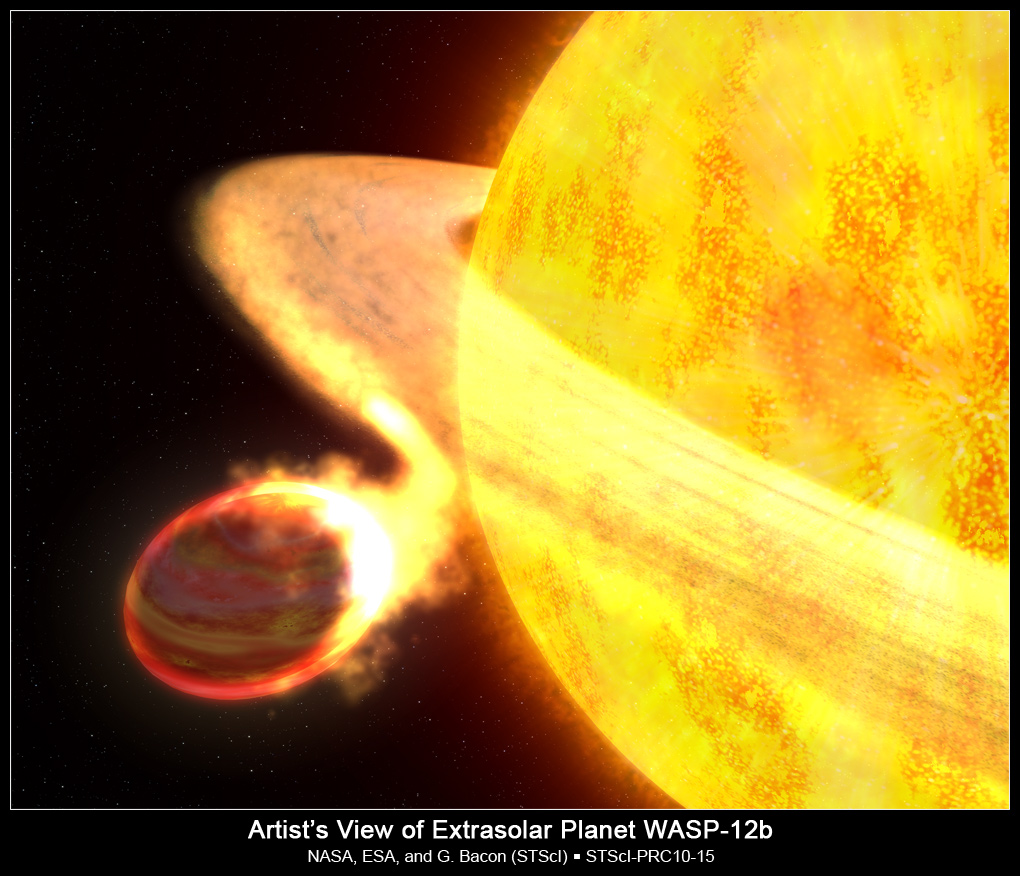
WASP-12b, a 'hot Jupiter' (Jupiter-sized, extremely hot exoplanet) about 1.4 times the mass of Jupiter and located about 1,200 light years away from Earth, has a carbon-to-oxygen ratio greater than one, according to new measurements.

That makes WASP-12b the first-ever planetary atmosphere that is substantially enriched in carbon along with being the hottest known planet in the Milky Way galaxy.

The researchers contend this carbon-rich atmosphere supports the possibility that rocky exoplanets could be composed of pure carbon rocks like diamond or graphite rather than the silica-based rock found in Earth.
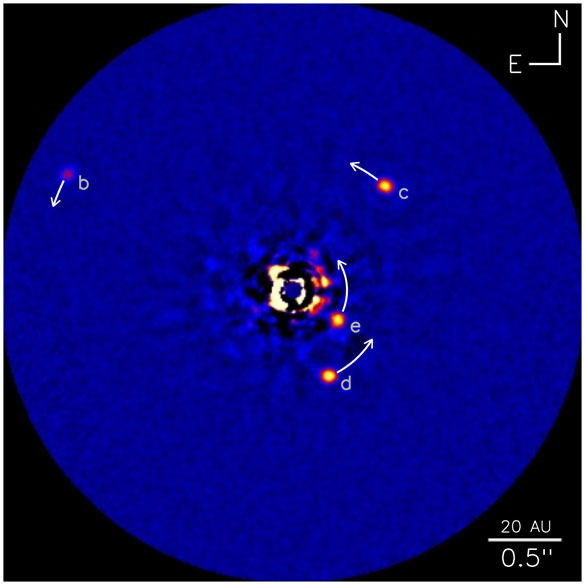
A new fourth planet (known as HR 8799e) which orbits a bright star called HR 8799 some 129 light years from Earth (faintly visible to the naked eye) has been discovered, making it the fourth giant planet found outside our solar system.

Our four giant planets are Jupiter, Saturn, Uranus and Neptune.  Like our solar system, HR 8799 also contains two 'debris belts' composed of small rocky or icy objects, along with lots of tiny dust particles, ours being the asteroid belt between the orbits of Mars and Jupiter and the Kuiper Belt, beyond Neptune's orbit.