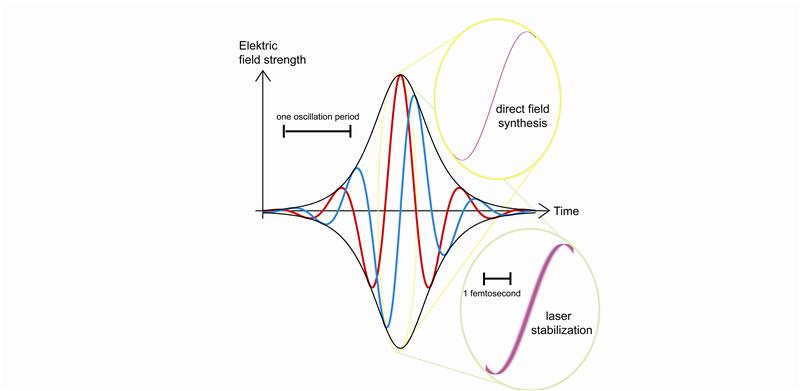
Lasers can now generate light pulses down to 100 attoseconds thereby enabling real-time measurements on ultrashort time scales that are inaccessible by any other methods. Scientists at the Max Born Institute for Nonlinear Optics and Short Time Spectroscopy (MBI) in Berlin have now demonstrated timing control with a residual uncertainty of 12 attoseconds - a new world record for the shortest controllable time scale.
A woman's touch tends to make us feel secure and increases our risk tolerance as a result, according to a new study in Psychological science. The authors believe this soothing effect originates during infancy, when children have a lot of physical contact with their mothers.
During the study, if a female experimenter patted a participant on the back, they'd risk more money on an investment or gamble than if she just talked to them, or if a man did the patting.
Scientists have identified two new genes that may be risk factors for the development of late-onset Alzheimer's disease (AD), according to a new paper in the Journal of the American Medical Association.
Using an intensive, genome-wide association analysis study (GWAS), the researchers identified two new genes at specific locations in the DNA called loci that reached the required genome-wide statistical significance threshold for the first time, thus identifying them as very likely associated with AD.
A recent survey of high school students shows that most have cheated on tests and homework and, as long the cheating requires effort, don't feel they're doing anything wrong.
The study by the University of Nebraska-Lincoln gauged both the prevalence and perceptions of cheating among high-school students. It found the practice is widespread and many students carry misconceptions about academic dishonesty, and also identified patterns among students that may help teachers stop it.
The study was published in the Mid-Western Educational Researcher.
A Texas A&M University-led team of astronomers has uncovered what may be the earliest, most distant cluster of galaxies ever detected.
The group of roughly 60 galaxies, called CLG J02182-05102, is nearly 10 billion years old — born just 4 billion years after the Big Bang. However, it's not the size nor the age of the cluster that astronomers find amazing. Rather, it's the surprisingly modern appearance of CLG J02182-05102 that has them baffled — a huge, red collection of galaxies typical of only present-day galaxies.
"It's like we dug an archaeological site in Rome and found pieces of modern Rome amongst the ruins," explains Dr. Casey Papovich, an assistant professor in the Texas A&M Department of Physics and Astronomy.
Computer analysis of sentiments expressed in a billion "tweets" during 2008-2009 yielded measures of consumer confidence and presidential job approval similar to those of well-established public opinion polls, Carnegie Mellon University researchers say.
The findings suggest that analyzing the text found in streams of tweets could become a cheap, rapid means of gauging public opinion on at least some subjects. But tools for extracting public opinion from social media text are still crude and social media remain in their infancy, so the extent to which these methods could replace or supplement traditional polling is still unknown.


 Pilot Study: Fibromyalgia Fatigue Improved By TENS Therapy
 High Meat Consumption Linked To Lower Dementia Risk
 Long Before The Inca Colonized Peru, Natives Had A Thriving Trade Network
 Mesolithic People Had Meals With More Tradition Than You Thought