Banner
Pilot Study: Fibromyalgia Fatigue Improved By TENS Therapy

Fibromyalgia is the term for a poorly-understood condition where people experience pain and fatigue...

High Meat Consumption Linked To Lower Dementia Risk

Older people who eat large amounts of meat have a lower risk of dementia and cognitive decline...

Long Before The Inca Colonized Peru, Natives Had A Thriving Trade Network

A new DNA analysis reveals that long before the Incan Empire took over Peru, animals were...

Mesolithic People Had Meals With More Tradition Than You Thought

The common imagery of prehistoric people is either rooting through dirt for grubs and picking berries...

User picture.
News StaffRSS Feed of this column.

News Releases From All Over The World, Right To You... Read More »

Blogroll
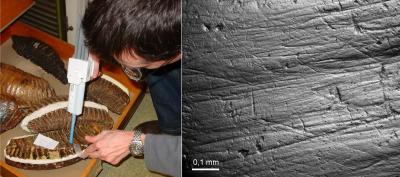
Ancient nomadic hominids moved from place to place but often how has been subject to speculation.   Now researchers think they have one answer, using the dental fossils of animals eaten by Homo heidelbergensis.

In the French cave of Arago, an international team of scientists headed by researchers from the Catalan Institute of Human Paleoecology and Social Evolution (IPHES) in Tarragona has analyzed the dental wear of herbivorous animals, the first time that an analytical method has allowed the establishment of the length of human occupations at archaeological sites. The key is the last food that these hominids consumed. 

This told them some details on the vegetation in the environment and the way of life of Homo heidelbergensis
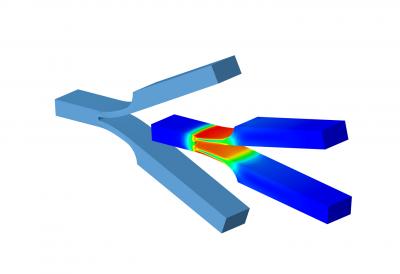
Is it a magic trick?   A man takes a paper clip and bends it so that it is just a crooked piece of wire, then he throws it into a bowl of hot water and instantly the metal wire returns to the shape of the paper clip.

This phenomenon is called the shape memory effect and it can be observed in certain metallic alloys, known as shape memory alloys. These kinds of materials are ideal for many applications. In aerospace technologies, solar sails can unfold in outer space.  In cardiology, stents are small tube-shaped, metal grid frameworks folded together and inserted into blood vessels where they expand and prevent the vessels from becoming blocked.
Does fasting lead to a longer life?   You never see any really old fat people but that has more to do with other issues than starvation.   

Some studies indicate that caloric restriction does extend life spans in fruit flies, mice and, most recently, rhesus monkeys, apparently by slowing the aging process, but in the case of most, they were also weaned that way from birth, which will get you thrown in jail if you do it to your kids.

Virtually all those studies had been performed in sterile environments, on animals raised under relatively pathogen-free conditions.   Stanford University School of Medicine researchers decided to see if reduced caloric intake also helps creatures cope with infection.
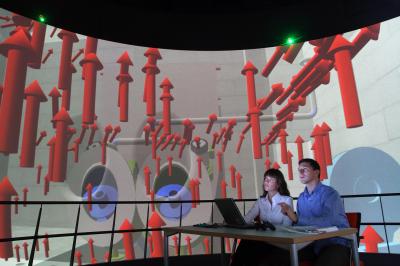
Designing a new hydroelectric power station can be a laborious task - the pressures, temperatures and fluid flows can be simulated but the actual results outside FEA showbiz graphics will still be columns of numbers or a one-dimensional representation which need analysis.

A new technique could make the process a lot more elegant. Scientists from the Fraunhofer Institute for Factory Operation and Automation IFF in Magdeburg have developed a method that visualizes the processes inside energy conversion plants, e.g. such as photovoltaic, wind, biogas and hydroelectric power stations. To do so, they have coupled 3-D plant engineering and simulation results with a virtual reality (VR) program developed at the IFF.
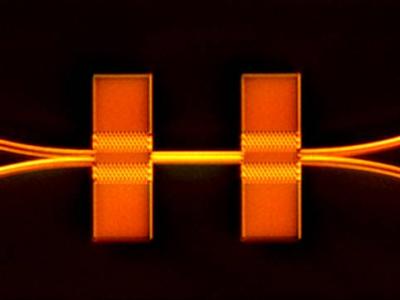
There's a bipolar force with a repulsive side that doesn't involve cosmic opera or wooden acting - it's light.  And it can be used to control components on silicon microchips, meaning future nanodevices could be controlled by light rather than electricity, according to Yale researchers. 

The team previously discovered an 'attractive' force of light and showed how it could be manipulated tiny switches in semiconducting micro- and nano-electrical systems. They say they have now uncovered its non-evil twin - a repulsive force.
University of Denver researchers say that couples who live together before they are engaged have a higher chance of getting divorced than those who wait until they are married to cohabitate.

In addition, couples who lived together before engagement and then married, reported a lower satisfaction in their marriages.   Couples who got engaged and then later moved in together had no conclusive difference one way or another.   The research published in Journal of Family Psychology was conducted by Galena Rhoades, senior researcher, Scott Stanley, research professor, and Howard Markman, professor of psychology.