Banner
Pilot Study: Fibromyalgia Fatigue Improved By TENS Therapy

Fibromyalgia is the term for a poorly-understood condition where people experience pain and fatigue...

High Meat Consumption Linked To Lower Dementia Risk

Older people who eat large amounts of meat have a lower risk of dementia and cognitive decline...

Long Before The Inca Colonized Peru, Natives Had A Thriving Trade Network

A new DNA analysis reveals that long before the Incan Empire took over Peru, animals were...

Mesolithic People Had Meals With More Tradition Than You Thought

The common imagery of prehistoric people is either rooting through dirt for grubs and picking berries...

User picture.
News StaffRSS Feed of this column.

News Releases From All Over The World, Right To You... Read More »

Blogroll
Even if we don't always notice, our brain is constantly distracted with 'noise' - unimportant messages that are filtered out.   

When we pay attention, our neurons begin firing in harmony and a study in the May 29 issue of Science lays out what researchers say is the likely brain center that serves as the conductor of our neural chorus.  MIT neuroscientists say that neurons in the prefrontal cortex, the brain's planning center, fire in unison and send signals to the visual cortex to do the same, generating high-frequency waves that oscillate between these distant brain regions like a vibrating spring. These waves, also known as gamma oscillations, have long been associated with cognitive states like attention, learning, and consciousness.
Biomedical engineers at Boston University have taught bacteria how to count.  The researchers have wired a new sequence of genes that allow the microbes to count discrete events, opening the door for a host of potential applications, which could include drug delivery and sensing environmental hazards. 

The young but burgeoning field of synthetic biology addresses biological research questions with an engineering approach. Researchers design and build networks of genes, splicing them into bacterial genomes to run specific tasks or manufacture desired molecules – a process akin to installing biological computer software. Though the field is rapidly advancing, the gene-based tools available to synthetic biologists remain limited. 

How common is scientific misconduct?   It's a tough question to answer.   Scandals like Hwang Woo-Suk's faked stem-cell lines or Jon Sudbø's made-up cancer trials have demonstrated that fraudulent research is easy to publish, even in the most prestigious print journals, but are they deviations of a few "bad apples" or evidence that a great deal more is never discovered?  The actual numbers are a matter of dispute.

In a PLoS ONE meta-analysis of surveys questioning scientists about their misbehaviors, Daniele Fanelli of the University of Edinburgh, a PhD in the behavior and genetics of Malaysian and Panamanian tropical wasps, suggests that altering or making up data is more frequent than previously estimated and might be particularly high in medical research.

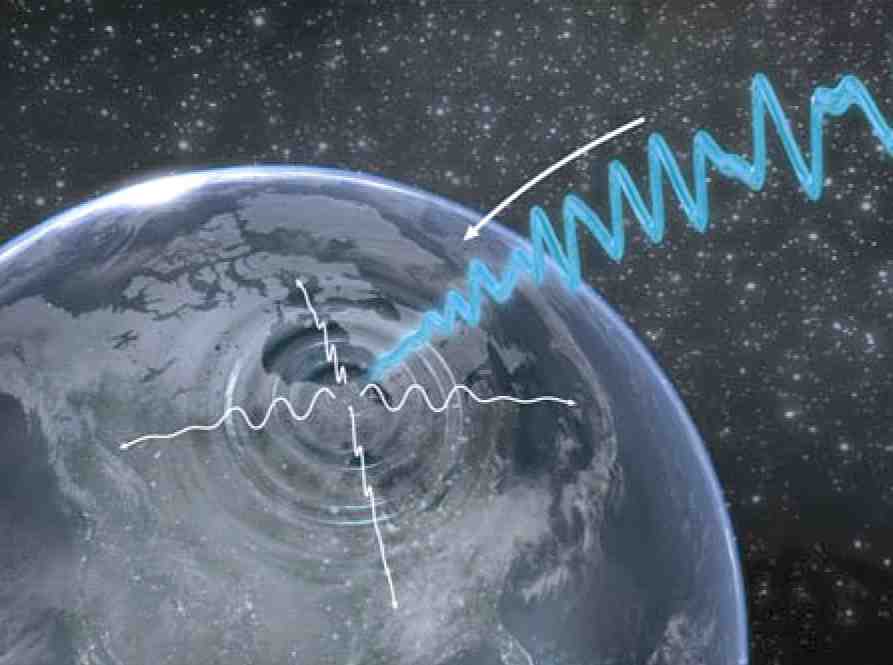
Researchers using data from NASA's THEMIS mission have pinpointed the impact epicenter of an earthbound space storm as it crashes into the atmosphere - and given an advance warning of its arrival. The team's study reveals that magnetic blast waves can be used to pinpoint and predict the location where space storms dissipate their massive amounts of energy. These storms can dump the equivalent of 50 gigawatts of power, or the output of 10 of the world's largest power stations, into Earth's atmosphere.

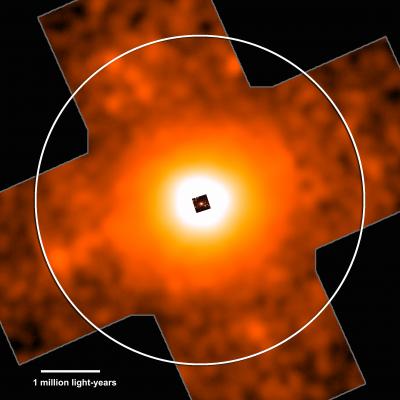
The joint Japan-U.S. Suzaku mission is providing new insight into how assemblages of thousands of galaxies pull themselves together and, for the first time, Suzaku has detected X-ray-emitting gas at a cluster's outskirts, where a billion-year plunge to the center begins.

Suzaku ("red bird of the south") was launched on July 10, 2005. The observatory was developed at the Japanese Institute of Space and Astronautical Science (ISAS), which is part of the Japan Aerospace Exploration Agency (JAXA), in collaboration with NASA and other Japanese and U.S. institutions.
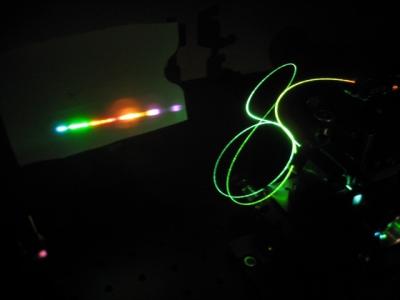
A team of physicists and engineers have demonstrated all-fibre quantum logic, where single photons are generated and used to perform the contolled-NOT quantum logic gate in optical fibers with high fidelity.

The only quantum technology in practical use today is quantum cryptography and is currently limited in the distance over which secure communication may occur.

More sophisticated quantum networks will require multiple nodes with the ability to implement small-scale quantum processing in order to increase the range of quantum communications. Such networks will rely on optical fibre links, making fibre-based photon generation and information processing of key technological importance.