Banner
Pilot Study: Fibromyalgia Fatigue Improved By TENS Therapy

Fibromyalgia is the term for a poorly-understood condition where people experience pain and fatigue...

High Meat Consumption Linked To Lower Dementia Risk

Older people who eat large amounts of meat have a lower risk of dementia and cognitive decline...

Long Before The Inca Colonized Peru, Natives Had A Thriving Trade Network

A new DNA analysis reveals that long before the Incan Empire took over Peru, animals were...

Mesolithic People Had Meals With More Tradition Than You Thought

The common imagery of prehistoric people is either rooting through dirt for grubs and picking berries...

User picture.
News StaffRSS Feed of this column.

News Releases From All Over The World, Right To You... Read More »

Blogroll

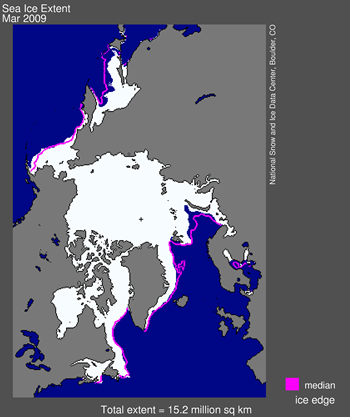
The latest data from NASA and the University of Colorado at Boulder's National Snow and Ice Data Center show the continuation of a decade-long trend of shrinking sea ice extent in the Arctic, including new evidence for thinning ice as well.

The researchers, who have been tracking Arctic sea ice cover with satellites since 1979, found that the winter of 2008-09 was the fifth lowest maximum ice extent on record. The six lowest maximum events in the satellite record have all occurred in the past six years, according to CU-Boulder researcher Walt Meier of NSIDC.

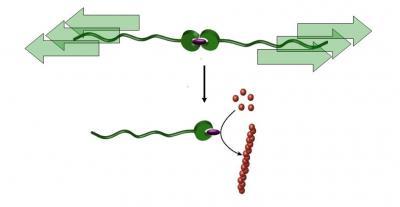
Researchers at Eindhoven University of Technology (TU/e) have developed an entirely new method for starting chemical reactions. For the first time they used mechanical forces to control catalytic activity – one of the most fundamental concepts in chemistry. This allowed them to initiate chemical reactions with mechanical force. This discovery paves the way to developing materials capable of repairing themselves under the influence of mechanical tension. The results of their research were published in Nature Chemistry.

Molecular ripcord

As science fiction plot lines go, the unintended consequences of yielding tasks too complicated or dangerous for human hands to computers and robots is a popular one. Yet real life scientists are increasingly doing just that, creating automated systems and devices that can not only help collect, organize and analyze scientific data, but that are also able to intelligently and independently draw up new hypotheses and approaches to research based on the data they receive.

Writing in Science, David Waltz of the Center for Computational Learning Systems at Columbia University and Bruce G. Buchanan of the computer science department at the University of Pittsburgh discuss this 'brave new world' of scientific research and its implications for the way science is conducted.

Researchers at the University of California, San Diego School of Medicine have compiled the first-ever review of the neurobiology of wisdom – once the sole province of religion and philosophy. The study by Dilip V. Jeste, MD, and Thomas W. Meeks, MD, of UC San Diego's Department of Psychiatry and the Stein Institute for Research on Aging, was published in the Archives of General Psychiatry.

Wisdom has been defined over centuries and civilizations to encompass numerous psychological traits. Components of wisdom are commonly agreed to include such attributes as empathy, compassion or altruism, emotional stability, self-understanding, and pro-social attitudes, including a tolerance for others' values.

With climate change looming, the hunt for places that can soak up carbon dioxide from the atmosphere is on.

Obvious "sinks" for the greenhouse gas include the oceans and the enormous trees of tropical rainforests. But temperate forests also play a role, and new research now suggests they can store more carbon than previously thought.

In a study that drew on both historical and present-day datasets, Jeanine Rhemtulla of McGill University and David Mladenoff and Murray Clayton of University of Wisconsin-Madison quantified and compared the above-ground carbon held in the forest trees of Wisconsin just prior to European settlement and widespread logging, and the total carbon they contain today.

The genetic toolkit that animals use to build fins and limbs is the same genetic toolkit that controls the development of part of the gill skeleton in sharks, according to research published in PNAS by Andrew Gillis and Neil Shubin of the University of Chicago, and Randall Dahn of Mount Desert Island Biological Laboratory.